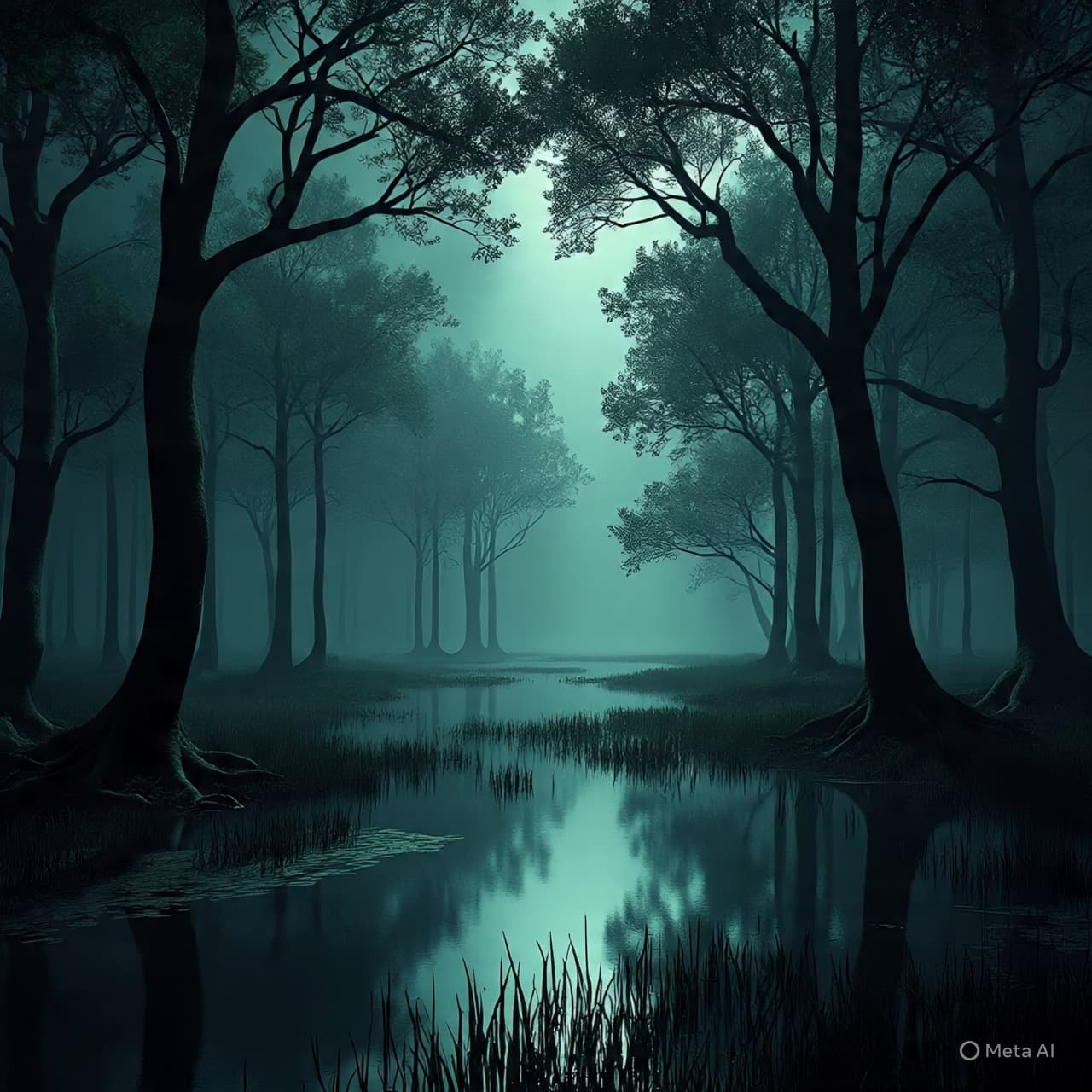
There are places where light behaves differently—where it does not arrive in clear lines or steady beams, but wavers, reflects, and dissolves into the surrounding air. In the wetlands of the American South, where water rests in long, quiet stretches and trees lean inward over dark surfaces, even the smallest shift can feel uncertain. A glimmer might be a reflection, or something else entirely. For those who spend time in such places, the boundary between what is seen and what is assumed can become difficult to fix.
It was in such a setting, within a swamp in South Carolina, that scientists encountered a phenomenon that at first seemed almost too faint to trust. A soft, intermittent glow appeared above the water’s surface—subtle enough to invite doubt, as though it might vanish if observed too directly. One researcher would later reflect that it felt like the kind of thing one might question even while witnessing it, uncertain whether it belonged to the world or to perception itself.
Yet repeated observation began to give the light a different kind of presence. It was not random, nor entirely elusive. Under certain conditions—specific combinations of moisture, temperature, and organic activity—it appeared with quiet consistency. What initially seemed like an illusion began to take on the structure of a natural process, one that had simply gone largely unnoticed.
Further investigation pointed toward a biological origin. The glow is believed to be linked to bioluminescent organisms—likely fungi or microorganisms—that emit light through chemical reactions. In environments rich with decaying plant matter, such as swamps, these organisms can thrive, feeding on organic material and, in the process, producing faint light. The effect is not dramatic, but delicate, often visible only in low-light conditions where the eye can adjust to its softness.
There is a long history of such phenomena, though they are rarely encountered directly. Known in various forms across different regions, natural bioluminescence has often been described in terms that blur observation and interpretation. In the stillness of a swamp, where reflections from water and movement in the air can alter perception, such light can easily be mistaken for something else—or dismissed altogether.
What makes this discovery notable is not that the light exists, but that it has been observed, documented, and measured in a setting where it might otherwise remain anecdotal. By approaching the phenomenon with careful instrumentation and repeated study, scientists have been able to distinguish it from reflection or external light sources, confirming its origin within the ecosystem itself.
At the same time, the conditions that allow the glow to appear are specific and transient. Changes in temperature, humidity, and biological activity can influence its presence, making it something that cannot be relied upon to appear on demand. It remains, in a sense, tied to the rhythms of the environment, emerging only when the balance is right.
There is something fitting in this. A light that is real, yet easily doubted; present, yet dependent on conditions that resist control. It reminds us that not all phenomena reveal themselves readily, and that some require both patience and a willingness to look again.
Scientists have documented a faint bioluminescent glow in a South Carolina swamp, likely produced by microorganisms or fungi. The phenomenon, once uncertain, has been confirmed through repeated observation and analysis under specific environmental conditions.
AI Image Disclaimer
Images are AI-generated for visual reference and do not represent actual photographs.
Source Check The New York Times Smithsonian Magazine BBC The Guardian National Geographic
Published by Banx Network. This article is part of the Banx decentralized media programme, powered by the BXE token on the XRP Ledger.