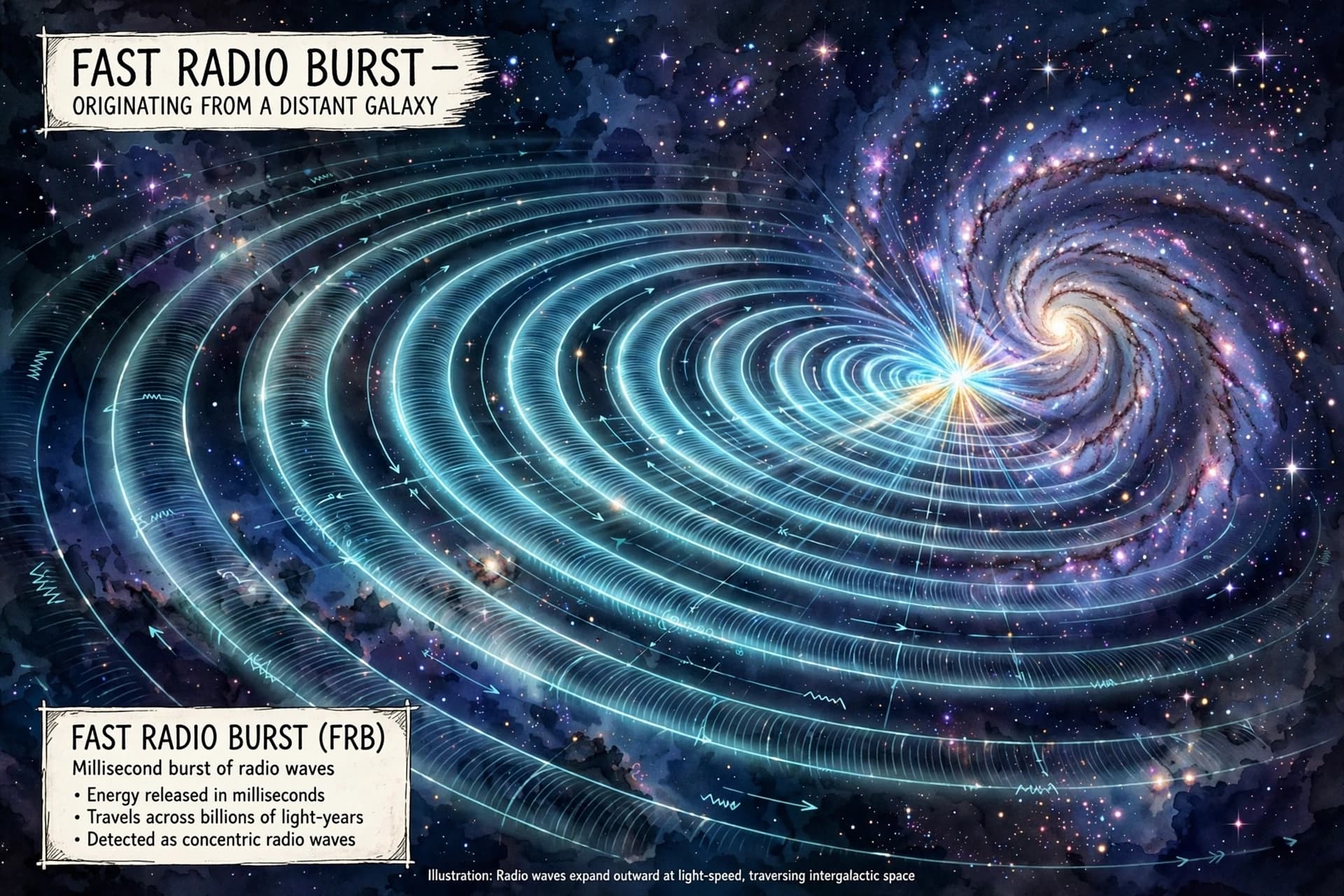
In the vast silence of space, some messages take a very long time to arrive. A flash of radio energy detected by astronomers traveled for approximately 10 billion years before reaching Earth—a journey that began when the universe was only about three billion years old, roughly 80 percent of cosmic history ago. The signal, designated FRB 20240304B, is the most distant fast radio burst ever recorded, more than doubling the previous distance record.
Fast radio bursts are among the most mysterious phenomena in astrophysics. They last only milliseconds, yet can release as much energy as the Sun produces over months or even years. Since their discovery in 2007, more than 10,000 have been catalogued, some repeating, others appearing only once and never again. Their origins remain debated, though magnetars—neutron stars with extraordinarily powerful magnetic fields—are the leading candidates.
What makes this particular detection remarkable is not only its distance but the glimpse it offers into the conditions of the early universe. "When that signal was created, there was no Earth, no Sun," said Dr. Themiya Nanayakkara of Swinburne University of Technology, one of the lead authors of the study published in Science. The signal was detected by the MeerKAT radio telescope in South Africa, and its host galaxy was subsequently identified using the James Webb Space Telescope.
That host galaxy, researchers found, is small, young, and undergoing intense star formation. It contains relatively few elements heavier than hydrogen and helium—a composition that offers clues about the environments where fast radio bursts can occur. "This is an extraordinary view into the distant universe," Nanayakkara said.
The burst's long journey also makes it a valuable tool for studying the material it passed through. As FRBs travel, they interact with gas and particles between galaxies, and the changes in the signal allow researchers to estimate the amount of matter along its path—including matter that cannot be seen directly with optical telescopes. "FRBs can be used as a sort of measure of the amount of matter the signal had to pass through before reaching Earth," said astrophysicist Sara Webb, who was not involved in the research.
Whether FRB 20240304B will ever repeat remains unknown. Some bursts flash once and fall silent forever. Others pulse again, offering astronomers a chance to study them more closely. For now, this single flash from the deep past has done what few signals can: it has carried information across most of the history of the universe, arriving at a planet that did not exist when it began its journey.
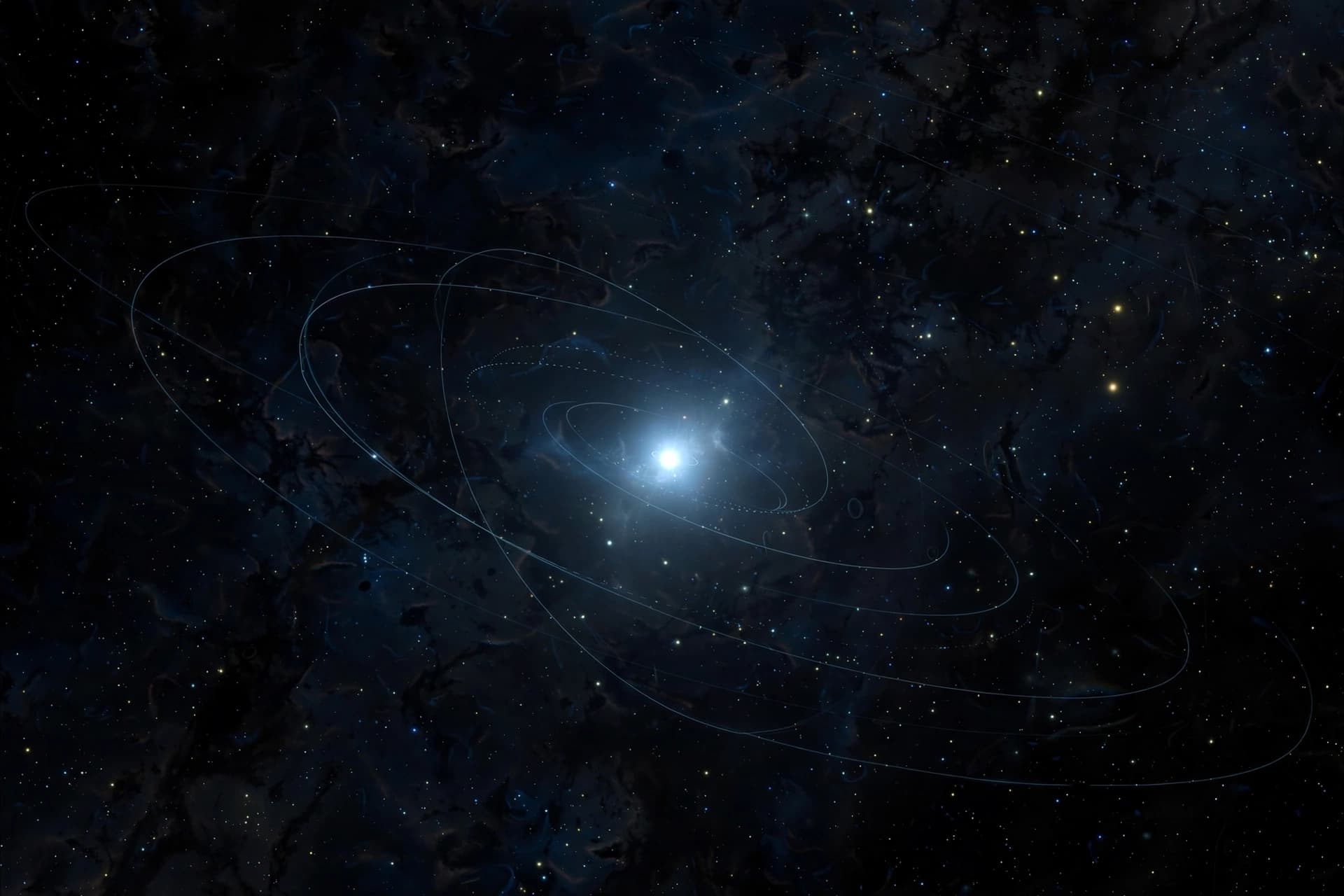
AI Image Disclaimer: Visual content accompanying this article is generated by artificial intelligence for illustrative purposes only.
Sources: Science (journal), The Guardian, Atvbl, Jornal de Alagoas, Hrvatska Danas
Published by Banx Network. This article is part of the Banx decentralized media programme, powered by the BXE token on the XRP Ledger.