
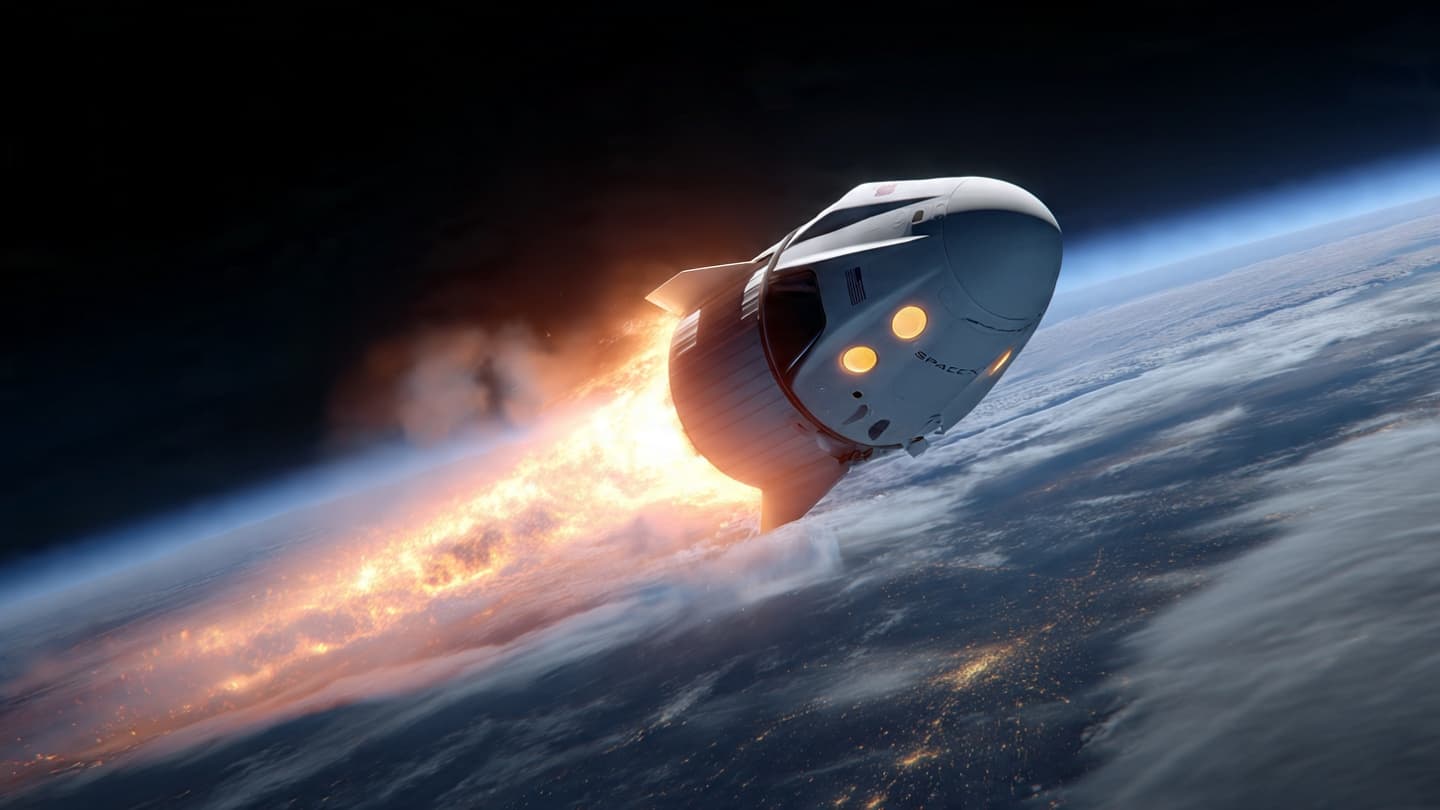
Every spacecraft returning to Earth retraces one of exploration's most delicate journeys. Between the silence of orbit and the familiarity of home lies the challenge of surviving reentry, a passage that demands precision, engineering, and resilience.
SpaceX has launched a demonstration mission known as "Starfall," designed to test technologies associated with atmospheric reentry and spacecraft recovery. The mission represents another step in the company's continuing efforts to refine reusable space systems.
Reentry remains among the most technically demanding phases of any space mission. Spacecraft traveling at orbital speeds encounter intense heat and aerodynamic forces as they descend through Earth's atmosphere.
According to mission details, the Starfall demonstration aims to gather data on vehicle performance, thermal protection systems, and recovery procedures. Such information could contribute to future spacecraft designs.
SpaceX has built much of its modern launch strategy around reusability. Successful recovery and refurbishment of spacecraft components have helped lower launch costs while increasing mission frequency.
Demonstration flights like Starfall allow engineers to evaluate hardware under real operational conditions. Data collected during these missions often informs upgrades to future vehicles and mission architectures.
Industry analysts note that advancements in reentry technologies may support a wide range of applications, including scientific research missions, commercial spaceflight, and eventual deep-space exploration.
As post-flight analyses continue, engineers will examine the mission's performance closely, using the findings to guide future development efforts within SpaceX's expanding portfolio of spacecraft systems.
AI Image Disclaimer: The illustrations featured in this report are AI-generated and serve only as visual representations.
Sources: SpaceX, SpaceNews, Ars Technica, Reuters
Published by Banx Network. This article is part of the Banx decentralized media programme, powered by the BXE token on the XRP Ledger.



