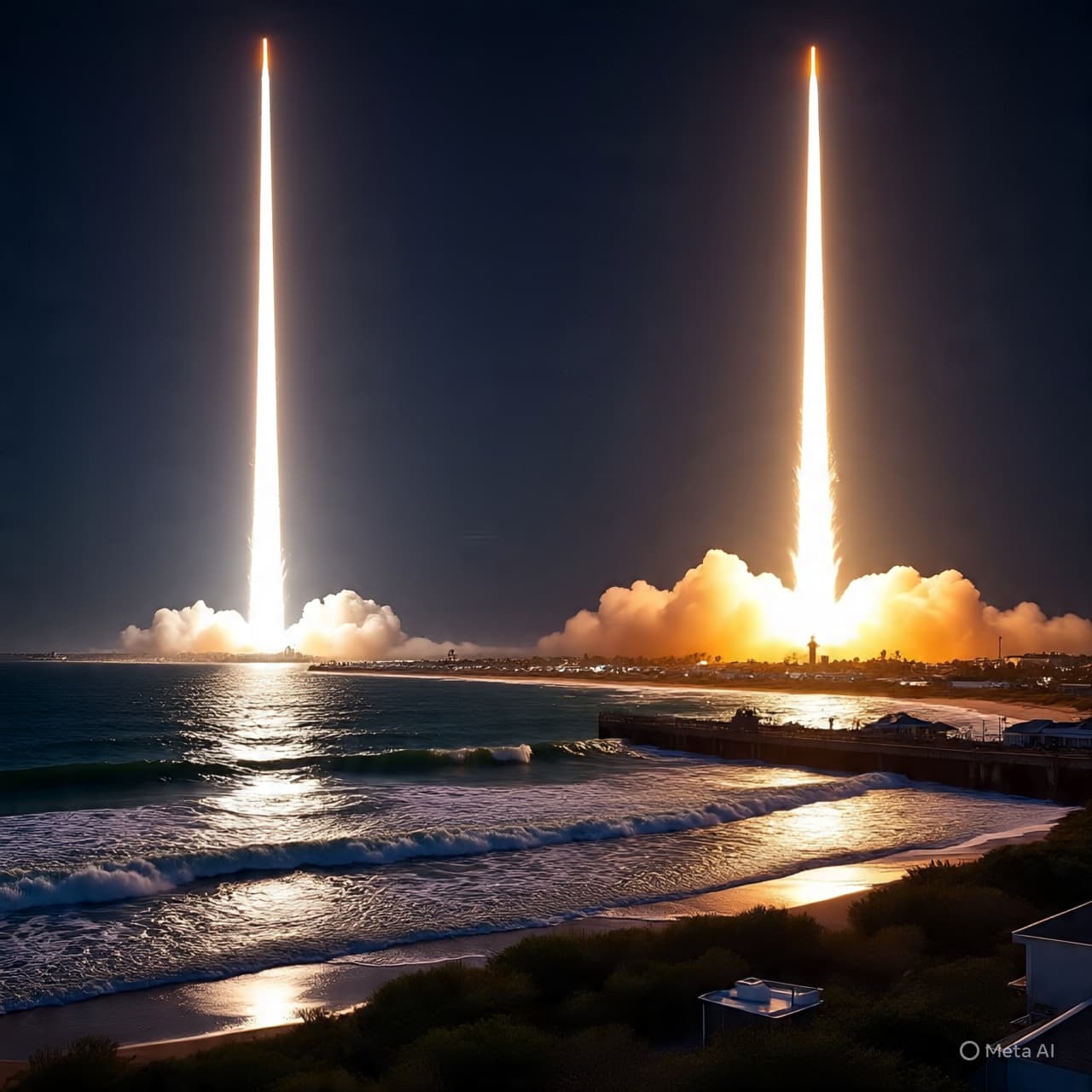
In the early hush of a winter morning, while the horizon still wore the glow of a long night, two pillars of flame reached skyward—separate in place yet united in purpose. They were like twin storytellers, whispering in fire and steel about humanity’s quiet persistence to push further, to fly again and again from the soft cradle of Earth into that vast blue unknown. On February 21, the embrace of dawn found not one but two SpaceX Falcon 9 rockets bearing satellites for the Starlink constellation, each carving a path skyward with calm precision.
The first, rising from Vandenberg Space Force Base in California, carried a cluster of Starlink broadband satellites aloft before the sun had fully risen. Hours later, in the subtropical warmth of Florida’s Cape Canaveral Space Force Station, another Falcon 9 followed its arc toward orbit, trailing history as it ascended beneath stars still faint in the night. These paired flights marked not only the rhythm of routine launch cadence but also a quiet moment of engineering poetry—the celebration of reuse.
In the space between lift-offs, the second booster—named B1067—wrote itself into the record books. With its 33rd voyage, it eclipsed all other first stages in the Falcon 9 family, making this flight the most reused rocket yet in SpaceX’s fleet. It became a testament to the company’s long-held vision: design and build not for a single journey, but for many, letting each flight leave behind fewer scars on both budgets and resources.
Piloting these voyages are no human hands but the precision of years of engineering refinement. Each ignition, each throttle down, and each graceful descent back to Earth is choreographed not merely for spectacle but for reuse—landing on drone ships named as whimsically as poems: “Of Course I Still Love You” and “A Shortfall of Gravitas.” These floating platforms receive returning boosters in the yawning embrace of the Pacific and Atlantic oceans alike, a ritual that continues to defy once-common assumptions of expendability in spaceflight.
And yet, even as boosters return and orbiting satellites link global communications, there’s a soft undercurrent of reflection that comes with such strides. This day’s launches added dozens more satellites to a constellation aimed at spreading broadband across remote reaches of Earth. Beneath the wonder of technology, one senses a greater narrative at play—of human aspiration, of cost-effective engineering, and of a sky that, increasingly, feels reachable to us all.
SpaceX’s approach to reuse has, over time, shifted from ambitious goal to accepted routine, yet milestones like this remind us of the trailblazing spirit at its heart. Each reuse record isn’t merely a technical footnote; it is a signpost in a broader journey toward sustainable access to space—a reminder that our machines might one day be as enduring as the dreams that built them.
Throughout this long February day, two rockets rose, two sets of satellites found their new orbits, and, quietly in the background, the story of rocket reuse advanced, measured not only in numbers but in the steady continuation of a quest that began decades ago and still burns strong.
AI Image Disclaimer (Rotated Wording)
“Visuals are created with AI tools and are not real photographs.”
Sources
Space.com
NewsBytes
Spaceflight Now
Space.com (Launches & Spacecraft)
Gadgets360
Published by Banx Network. This article is part of the Banx decentralized media programme, powered by the BXE token on the XRP Ledger.