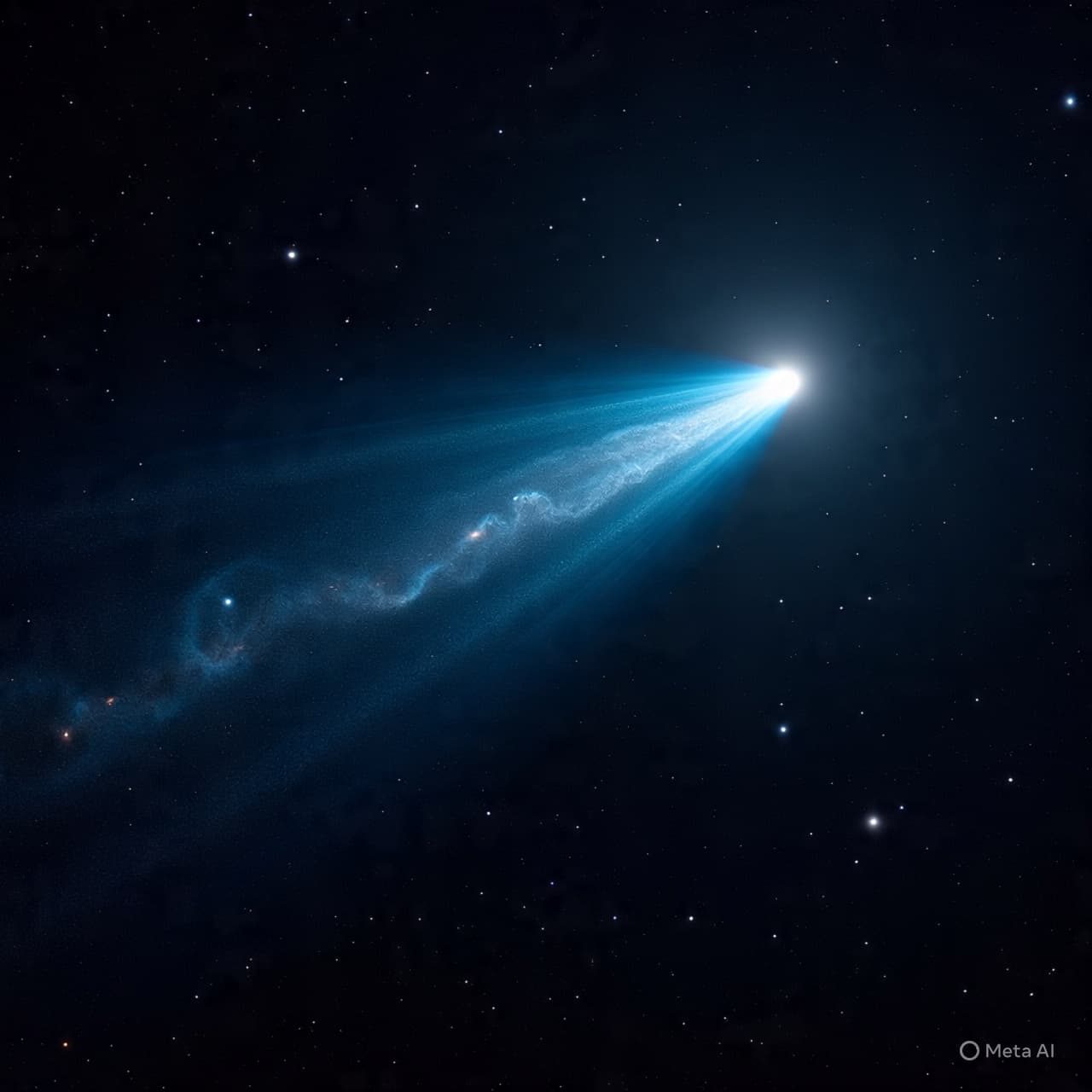
In the quiet theater of the night sky, comets often appear as fleeting performers. They arrive from distant reaches of space, blaze briefly as sunlight warms their icy surfaces, and then fade again into darkness. To observers on Earth, these luminous travelers seem mysterious yet familiar—celestial wanderers bound to our solar system’s distant edges.
But every so often, the universe sends something different.
Occasionally, a comet appears that does not belong to our cosmic neighborhood at all. Instead, it arrives from the vast spaces between stars, carrying with it fragments of matter formed in an entirely different planetary system. These rare visitors offer astronomers a remarkable opportunity: a direct glimpse into the chemistry of worlds that formed around distant suns.
One such visitor, known as 3I/ATLAS, has recently provided an unexpected scientific surprise. Observations of the comet’s glowing atmosphere have revealed the presence of alcohol molecules, including methanol—an organic compound that forms naturally in space.
While the discovery might sound unusual at first, the presence of alcohol in a comet is not entirely unprecedented. Methanol is known to exist in many icy bodies throughout the solar system. What makes this case particularly intriguing is the comet’s interstellar origin.
Unlike ordinary comets that formed alongside our Sun billions of years ago, 3I/ATLAS is believed to have formed around another star before being ejected into interstellar space. Over immense stretches of time, it drifted through the galaxy until gravity guided it toward our solar system.
As the comet approached the Sun, its frozen surface began to warm. Ice and dust escaped into space, forming the glowing cloud—known as a coma—that astronomers study with powerful telescopes. Within that expanding cloud of gas, researchers detected the spectral fingerprints of methanol molecules.
Spectroscopy, the technique used for such observations, works by examining how molecules absorb and emit light at specific wavelengths. Each chemical compound leaves a distinct pattern, much like a barcode. By analyzing these patterns, scientists can identify the materials released from the comet’s surface.
In the case of 3I/ATLAS, the chemical signals suggest that the comet contains a relatively rich concentration of methanol compared with some comets formed within our solar system.
This finding has sparked interest among astronomers because methanol plays an important role in astrochemistry. In cold interstellar clouds—the birthplaces of stars and planets—methanol forms when simple molecules freeze onto dust grains and react with hydrogen atoms. Over time, these processes create increasingly complex organic compounds.
Because comets preserve some of the earliest materials from planetary formation, they serve as natural archives of those ancient chemical environments. When scientists study the composition of a comet, they are essentially reading a chemical record of the place where it formed.
In this sense, 3I/ATLAS may be offering a rare glimpse into the chemistry of another solar system—one that existed far beyond our own Sun’s influence.
If methanol is abundant in this comet, it could suggest that the processes that create organic molecules are common across many star systems. That possibility carries interesting implications for understanding the broader chemical richness of the galaxy.
Organic molecules alone do not mean life exists elsewhere, of course. But they represent part of the chemical foundation from which more complex compounds can eventually arise.
The discovery also highlights how interstellar visitors are transforming astronomy. Only in recent years have scientists confirmed the existence of objects that originated outside our solar system and passed through it briefly.
Each of these travelers offers an opportunity to compare the building blocks of our planetary system with those formed around other stars. Even small differences in chemical composition may reveal variations in how planetary systems emerge and evolve.
For now, astronomers continue to observe 3I/ATLAS as it moves through the inner solar system. As sunlight releases more material from its icy surface, telescopes will keep analyzing the comet’s glowing coma for additional clues about its composition.
In the end, this drifting fragment of ice and dust may serve as a messenger from another corner of the galaxy—one that quietly carries the chemistry of a distant star system into view.
And within the faint glow of its passing tail, scientists are finding reminders that the ingredients of cosmic chemistry may travel far beyond the boundaries of any single solar system.
AI Image Disclaimer Graphics are AI-generated and intended for representation, not reality.
reporting outlets include:
Space.com Live Science ScienceAlert NASA New Scientist
Published by Banx Network. This article is part of the Banx decentralized media programme, powered by the BXE token on the XRP Ledger.