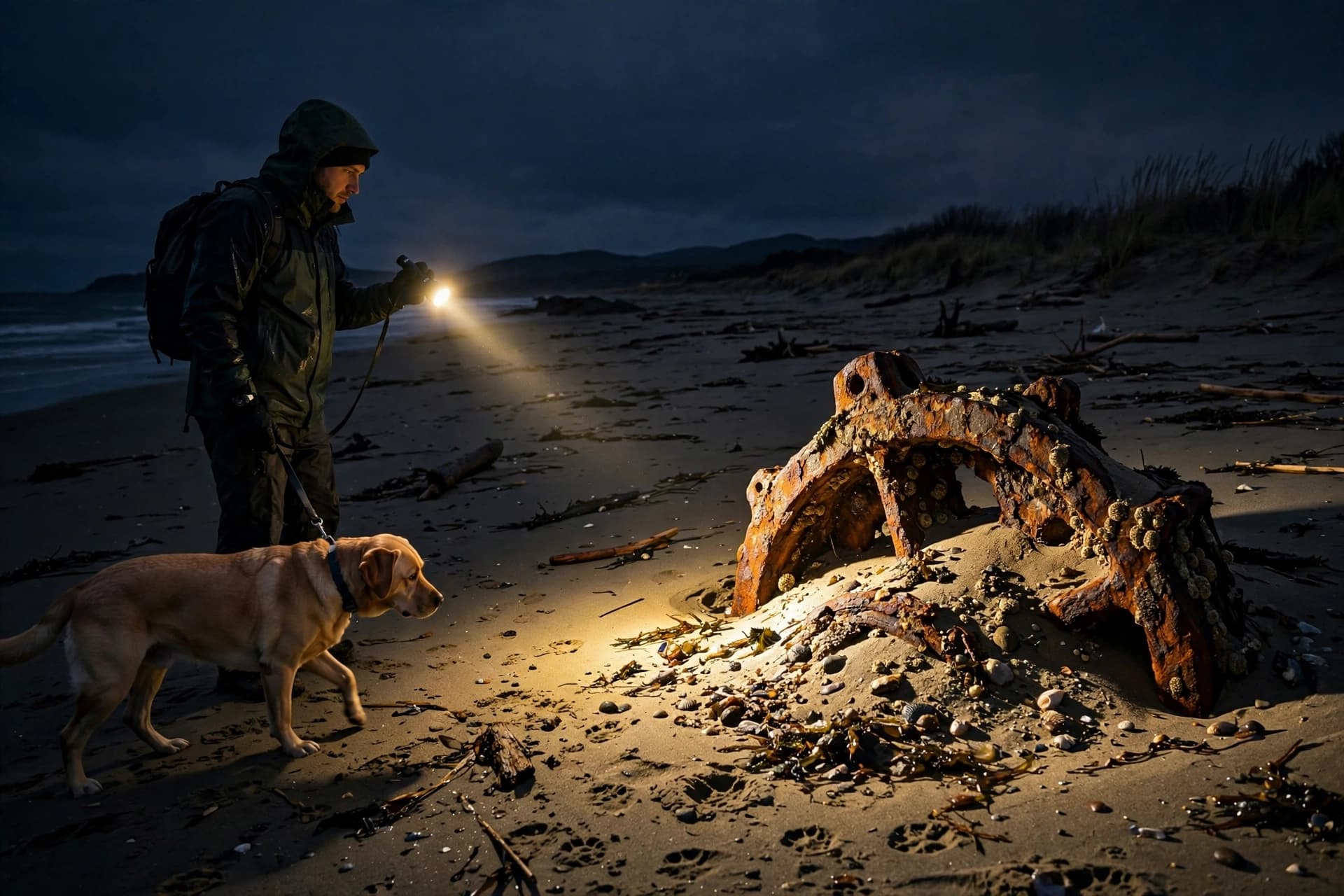
There is a particular kind of discovery that transforms an ordinary walk into something else entirely—a moment when the familiar ground beneath your feet reveals something that does not belong to the present, that carries with it the weight of history and the capacity for violence. For a dog walker in the United Kingdom, that moment arrived at midnight, on a beach where the tide had done its slow work of erosion and exposure. What the walker found was an 11-kilogram unexploded bomb from the Second World War, a device that had waited more than eighty years beneath the sand for someone to find it.
The details of this specific incident remain limited, but the context is well documented. Along the coasts of the United Kingdom, unexploded ordnance from the Second World War continues to emerge with regularity. The sea, through the action of tides, currents, and storms, moves sediment and gradually reveals what was buried . The bombs are not harmless relics. Their fuses, corroded by decades of saltwater exposure, remain sensitive. The explosives they contain have not diminished with time.
In September 2026, a discovery in Southend-on-Sea on the Thames estuary illustrated the standard response. A walker spotted a suspicious object on the mudflats shortly after 7 a.m. The coastguard cordoned off the area, and an army bomb disposal team was called. The device was identified as a 15-centimeter-diameter Second World War shell. Because moving it was considered too dangerous, the team detonated it in place at low tide, producing a column of smoke and debris visible from the shoreline. The coastguard used the incident to remind the public of the rule that applies to any suspicious object found on a beach: do not touch it, move away, and call 999 .
Other incidents have been more dangerous. In May 2026, a dog walker on Crimdon Beach in Hartlepool picked up what he thought was a "nice looking bottle" containing a bright orange liquid. It began smoking and burning in his hands. The object was later identified as a Second World War incendiary device containing white phosphorus, a substance that ignites spontaneously on contact with air. The man was uninjured, but the incident underscored the unpredictability of what the sea can return . Earlier that year, approximately 150 phosphorus-based grenades from the Second World War were found on the same stretch of coastline .
For the dog walker who found the 11-kilogram bomb at midnight, the immediate response was likely the same as in the Southend case: secure the area, alert the authorities, and wait for the experts. The bomb disposal teams who respond to these calls are trained to assess the condition of the device and determine whether it can be safely moved or must be destroyed where it lies. The decision is rarely simple, and the work is inherently dangerous.
What these discoveries reveal is something that the passage of decades can obscure: that the Second World War is not entirely past. It remains present in the objects that emerge from the earth and the sea, in the chemical compounds that have not degraded, in the fuses that have not lost their sensitivity. For the dog walker on that beach, the midnight discovery was a reminder that history, sometimes, is not buried at all. It is simply waiting.
AI Image Disclaimer: The visual elements in this article were created using AI generation tools and are intended for illustrative purposes only.
Sources: Science et Vie, Storica National Geographic, Daily Mail, HM Coastguard, BBC
Published by Banx Network. This article is part of the Banx decentralized media programme, powered by the BXE token on the XRP Ledger.