
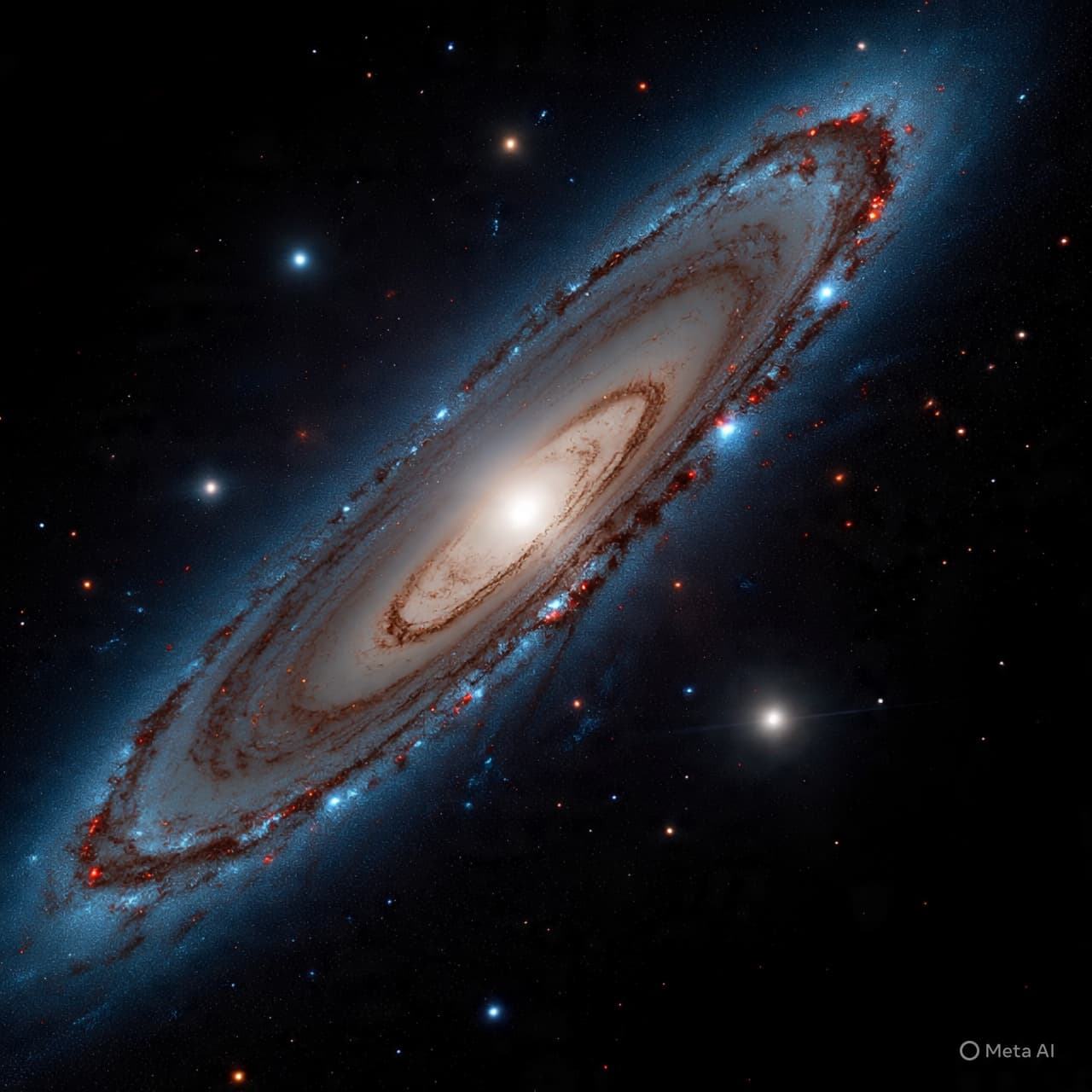
Sometimes the universe presents itself not in equations or data, but in imagery that feels almost familiar. A distant galaxy, suspended in the vastness of space, can resemble something as human as a hat—bridging the gap between cosmic scale and everyday imagination.
Astronomers have long been captivated by a galaxy known for its distinctive appearance, often likened to a sombrero due to its bright central bulge and extended dust lane. Officially cataloged as Messier 104, this galaxy lies about 31 million light-years from Earth in the constellation Virgo.
Recent imagery released as part of a “space photo of the day” highlights the striking symmetry of this celestial object. Its luminous core is surrounded by a sharply defined ring of dust, creating a layered structure that stands out against the dark backdrop of space.
The galaxy’s unique shape is the result of its orientation relative to Earth. Viewed nearly edge-on, the thin disk becomes visible as a dark band, while the central bulge appears prominently illuminated. This perspective gives rise to its iconic resemblance.
Scientific observations reveal that Messier 104 contains a supermassive black hole at its center, estimated to be billions of times the mass of the Sun. Surrounding it are billions of stars, along with globular clusters that contribute to its dense and complex structure.
Advanced telescopes, including space-based observatories, have enabled astronomers to capture high-resolution images of the galaxy. These images not only offer aesthetic appeal but also provide valuable data for understanding galactic formation and evolution.
The blending of beauty and science in such images underscores the dual role of astronomy: to expand knowledge while inspiring curiosity. For many, these visuals serve as an entry point into deeper questions about the universe.
As part of ongoing efforts to share astronomical discoveries, daily image features continue to highlight the diversity and wonder of the cosmos, connecting distant phenomena to human perception.
In the quiet stillness of space, even a galaxy can echo familiar shapes, reminding us that observation often begins with recognition.
AI Image Disclaimer: Some images referenced are AI-enhanced or AI-generated interpretations based on astronomical data.
Sources: NASA, ESA, Hubble Space Telescope, Space.com
Published by Banx Network. This article is part of the Banx decentralized media programme, powered by the BXE token on the XRP Ledger.



