There is a quiet economy in the soil that most of us never consider—a barter system older than agriculture, older than humanity itself, in which plants trade sugars for nitrogen and both parties thrive. Legumes and certain bacteria have practiced this exchange for millions of years, and understanding its terms has long been a goal of scientists seeking to reduce the world’s dependence on synthetic fertilizers. Now, a discovery in the alkaline-sodic soils of Argentina has revealed that the boundaries of this partnership are wider—and stranger—than anyone had assumed.
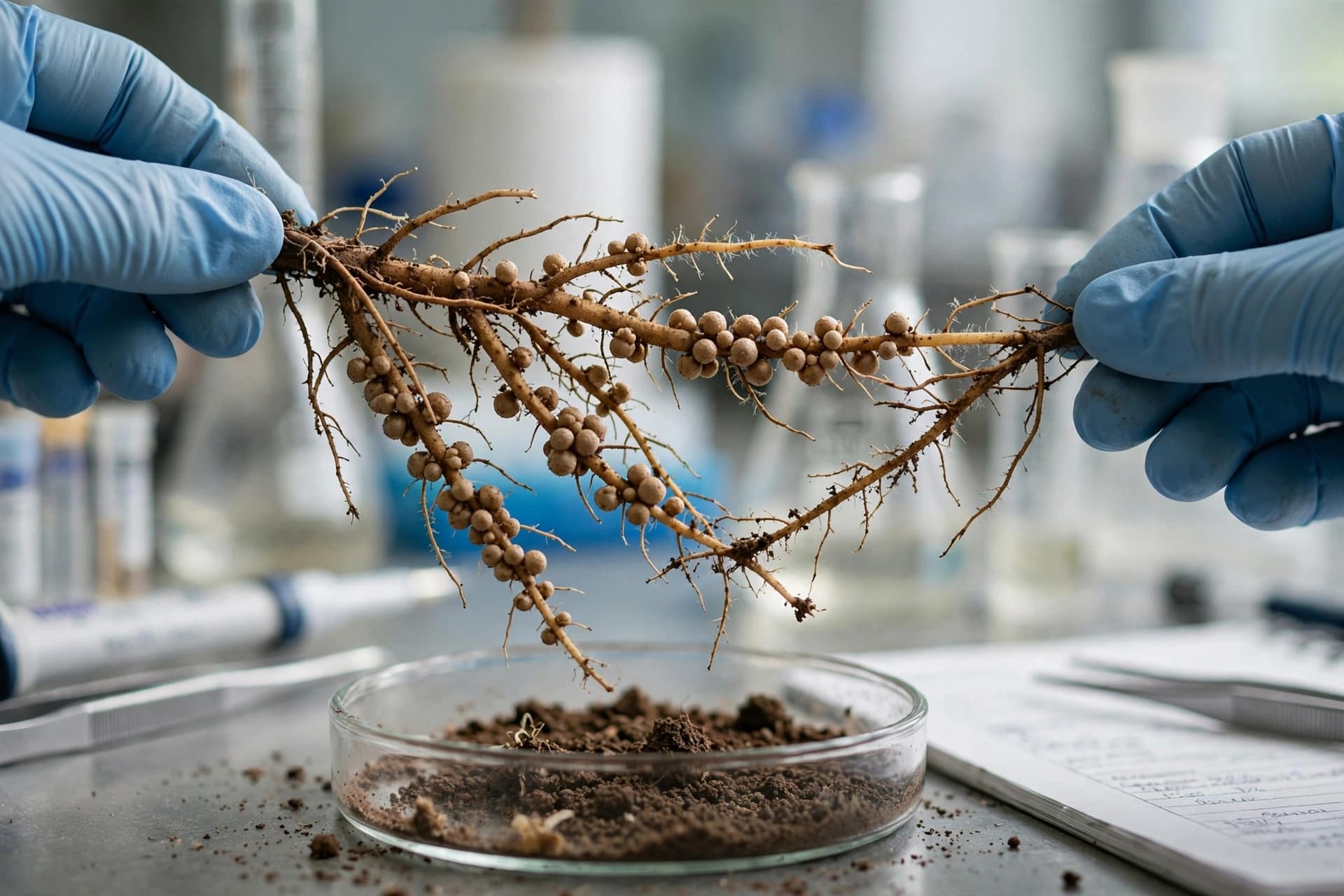
Researchers have characterized a bacterium called Aminobacter ciceronei BA135, a symbiont of the legume Lotus tenuis that was isolated from the Flooding Pampa region of Argentina . What makes BA135 unusual is that it does not belong to the classical groups of nitrogen-fixing bacteria, the rhizobia that textbooks describe as the partners of legumes. Yet it forms nodules on the roots of Lotus tenuis, fixes nitrogen, and supports plant growth under nitrogen-free conditions .
The key to this ability lies in a “symbiosis island”—a large section of DNA that BA135 acquired not from its ancestors but from a different bacterial lineage entirely. The island is integrated at a site in the chromosome orthologous to the integration site used by Mesorhizobium japonicum, and it encodes a complete set of nodulation and nitrogen fixation genes, along with the machinery needed to transfer itself to other bacteria . The nodulation genes and the conjugative transfer backbone of BA135 are nearly identical to strains co-isolated from the same soils, providing strong evidence for local horizontal gene transfer .
This is not the first time such a transfer has been documented. The genome of another Aminobacter symbiont, A. anthyllidis LMG26462, derives from a different Mesorhizobium lineage, indicating at least two independent transfers between the two genera . What the new study adds is a detailed genomic picture of how a non-canonical bacterium assembled the tools of symbiosis by borrowing them from its neighbors.
The practical implications are significant. Legume-rhizobia symbioses are critical for biological nitrogen fixation in marginal soils, where synthetic fertilizers are expensive or environmentally damaging . If the genetic toolkit for symbiosis can move between bacterial lineages—and if that movement can be understood and perhaps encouraged—then the range of crops that can benefit from nitrogen-fixing partnerships might expand beyond the traditional legume family.
The BA135 genome also encodes pathways for methylamine and glyphosate degradation, heavy metal resistance, and predicted plant growth-promoting traits . These additional capabilities suggest that the bacterium may offer benefits beyond nitrogen fixation, helping plants tolerate stressful conditions in the challenging soils where it was found.
The work does not yet translate directly into a fertilizer-free future. Moving from a single bacterium in a single soil to a broad agricultural application is a long and uncertain path. But the discovery expands the known boundaries of a partnership that has sustained life on land for eons, and it suggests that the rules governing that partnership are more flexible than we knew. In the quiet economy of the soil, it seems, genes can change hands—and with them, the possibilities for how plants might grow.
AI Image Disclaimer: The imagery accompanying this article was created using artificial intelligence for illustrative purposes only and does not depict the actual research or organisms described.
Sources: Nature Scientific Reports, Estrella et al. (2026), Nature Communications, Nature Plants
Published by Banx Network. This article is part of the Banx decentralized media programme, powered by the BXE token on the XRP Ledger.

.jpg&w=3840&q=75 "September 2026 Was the Second-Warmest on Record, With Global Temperatures Above 1.5°C for a Second Month")