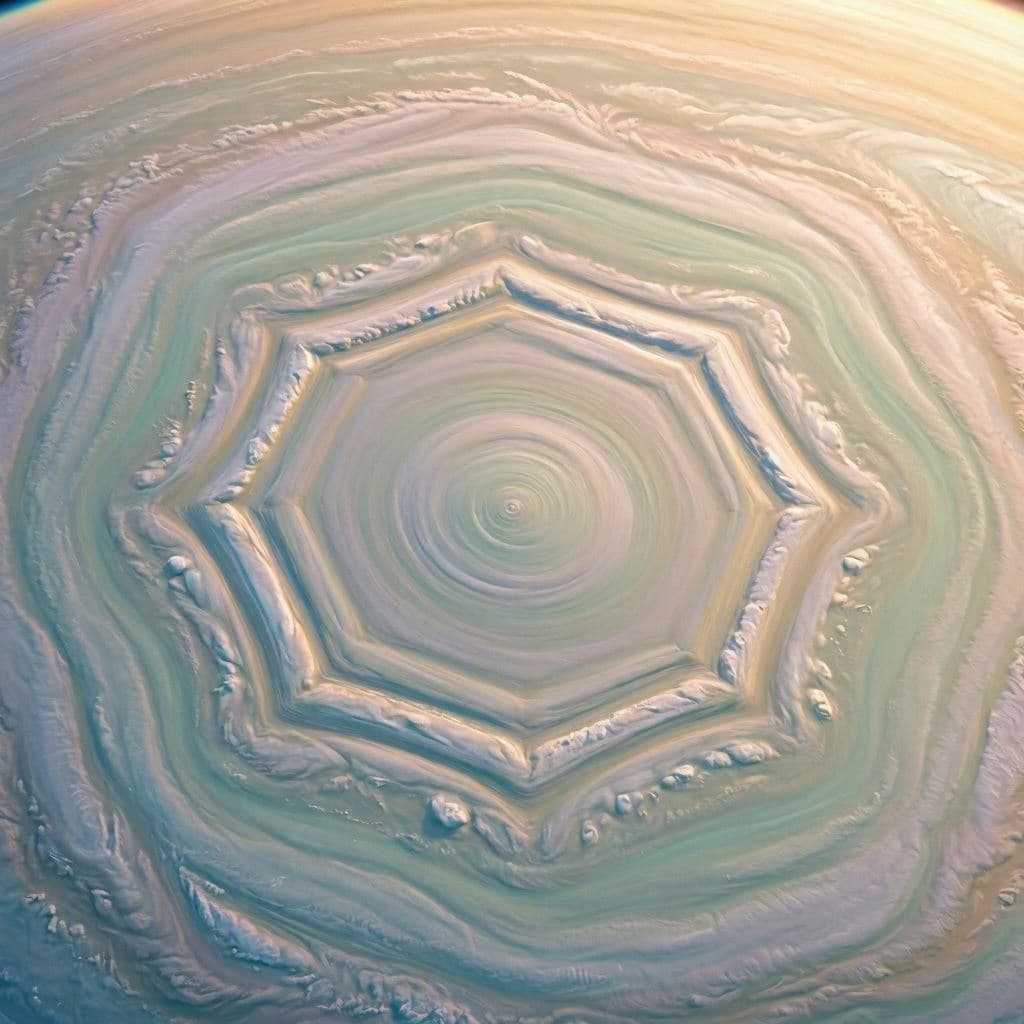
Saturn, the jewel of the solar system, has always been a planet of surprises. For thirteen years, the Cassini spacecraft orbited this gas giant, capturing intricate details of its rings and storms. Yet, one feature remained hidden, obscured by the tilt of the planet’s axis and the darkness of its winter. Now, as Saturn’s slow seasons have shifted, bringing the south pole into the light, astronomers have discovered a startling geometric pattern: a giant ten-sided figure, or decagon, swirling at the pole. This discovery reminds us that even after years of close observation, the cosmos can still withhold its secrets until the right moment arrives.
During Cassini’s mission, the north pole of Saturn was bathed in sunlight, revealing a famous hexagonal storm that has puzzled scientists for decades. The south pole, however, was shrouded in shadow, inaccessible to detailed visual study. Cassini’s instruments could sense heat and wind patterns, but they could not capture the visible structure of the clouds in that region. The planet’s axial tilt meant that the south pole was effectively turned away from both the sun and the spacecraft’s best viewing angles for the duration of the mission.
As Saturn continued its twenty-nine-year orbit around the sun, the seasons changed. Spring arrived in the southern hemisphere, lifting the veil of darkness. Recent observations from Earth-based telescopes and newer space assets have revealed the decagon. This shape, similar to the north’s hexagon but with more sides, suggests a complex interplay of atmospheric dynamics. It is a standing wave, a pattern formed by jet streams moving at different speeds, locking into a stable geometric form.
The existence of the decagon raises new questions about Saturn’s atmospheric physics. Why ten sides instead of six? Is the shape stable, or does it fluctuate over time? Scientists are eager to study this feature to understand the mechanisms that create such precise polygons in a fluid environment. Computer models are being updated to simulate the conditions at the south pole, helping to explain how these shapes form and persist against the chaos of turbulent winds.
This discovery also highlights the importance of long-term observation. Saturn’s year is long, and its seasons change slowly. A mission that lasts only a few years might miss phenomena that emerge only after decades. Cassini provided a wealth of data, but it could not see everything. The patience of astronomy, waiting for the planet to reveal itself, is rewarded with insights that immediate exploration cannot provide. It is a reminder that time is a crucial variable in scientific discovery.
The comparison between the north’s hexagon and the south’s decagon offers a unique natural laboratory. By studying both, scientists can test theories about planetary atmospheres under different conditions. Differences in temperature, sunlight, and internal heat flow may explain the variation in shape. Understanding these processes on Saturn can help improve models of weather and climate on other planets, including Earth.
For now, the decagon stands as a new icon of Saturn’s mystery. It is a symbol of the planet’s dynamic nature and the limits of our current knowledge. As telescopes continue to monitor the south pole, we may learn more about its stability and evolution. Until then, it remains a beautiful enigma, a geometric gift from the rings of Saturn, revealed only when the light finally returned.
The emergence of a ten-sided storm pattern at Saturn’s south pole, hidden during the Cassini mission due to seasonal darkness, underscores the dynamic nature of planetary atmospheres and the value of long-term astronomical observation.
AI Image Disclaimer: The images referenced in this piece are AI-created visualizations meant to evoke the setting, not direct documentation of the scientific data.
Sources: NASA Jet Propulsion Laboratory The Planetary Society Icarus Journal BBC Science
Published by Banx Network. This article is part of the Banx decentralized media programme, powered by the BXE token on the XRP Ledger.