
Key Highlights
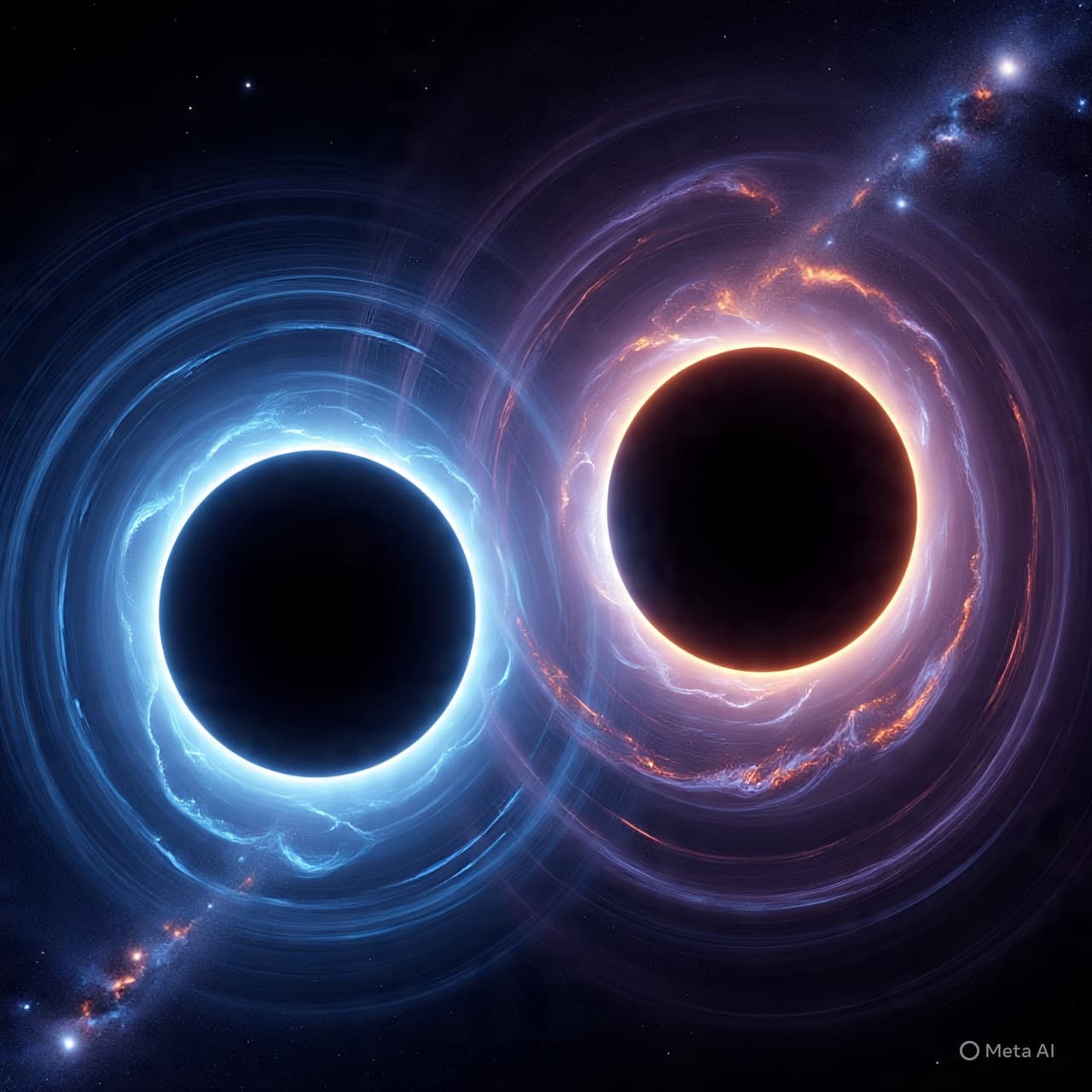
- Discovery:Astronomers have observed two supermassive black holes spiraling toward each other.
- Significance:This observation provides insights into gravitational waves and cosmic evolution.
- Timeline:The final merger of these black holes could take millions of years.
Astronomers have made a groundbreaking discovery in the realm of astrophysics: two supermassive black holes are spiraling toward one another in a rare cosmic event. These black holes, each possessing a mass millions—if not billions—of times that of our Sun, are located at the center of a distant galaxy. Their gravitational embrace marks a significant moment in our understanding of the universe, as it offers a direct observation of a phenomenon that has largely remained theoretical until now.
The significance of this observation lies not only in the existence of these colossal entities but also in their proximity to one another. Typically, supermassive black holes are found in pairs following galactic mergers, where two galaxies collide and eventually settle into a new formation. However, capturing them in such a close orbit—deep within their inward spiral—has proven to be extraordinarily challenging for astronomers. At this stage, their motion accelerates, and their separation decreases, leading to increasingly violent interactions that are invisible to the naked eye but have profound implications for our understanding of cosmic dynamics.
Scientists have long theorized that as these giants draw closer together, they form a binary system, orbiting each other at increasing speeds while emitting gravitational waves—ripples in spacetime that were first directly detected in 2015. The newly observed pair of black holes provides a unique opportunity to witness this late-stage process, allowing researchers to refine their models and test existing assumptions about the evolution of galaxies and the supermassive black holes at their centers.
While the so-called “death spiral” of these black holes is not an immediate event, it is a process that unfolds over millions of years. The clarity of this observation is significant, as it enables scientists to study one of the universe's most extreme and elusive processes with unprecedented detail. The black holes likely originated in separate galaxies, each with its own unique history and structure. Over billions of years, these galaxies drifted, collided, and merged, leading to the current scenario where the two gravitational anchors are drawn together in an irreversible motion.
Despite the fact that no light can escape these black holes, their presence has a profound impact on the surrounding environment. They shape the dynamics of their host galaxies, influencing the orbits of stars and the distribution of matter. The gravitational effects of these black holes leave subtle signals and distortions that travel across vast distances, allowing scientists on Earth to reconstruct the unseen phenomena through advanced observational techniques.
As astronomers continue to monitor this rare binary system, they will gather more data that could enhance our understanding of the universe's most extreme phenomena. While the final merger of these supermassive black holes remains far in the future, this discovery represents a crucial opportunity to study the intricate dance of cosmic giants and the gravitational waves they produce, ultimately shedding light on the evolution of galaxies over cosmic time.
Published by Banx Network. This article is part of the Banx decentralized media programme, powered by the BXE token on the XRP Ledger.



