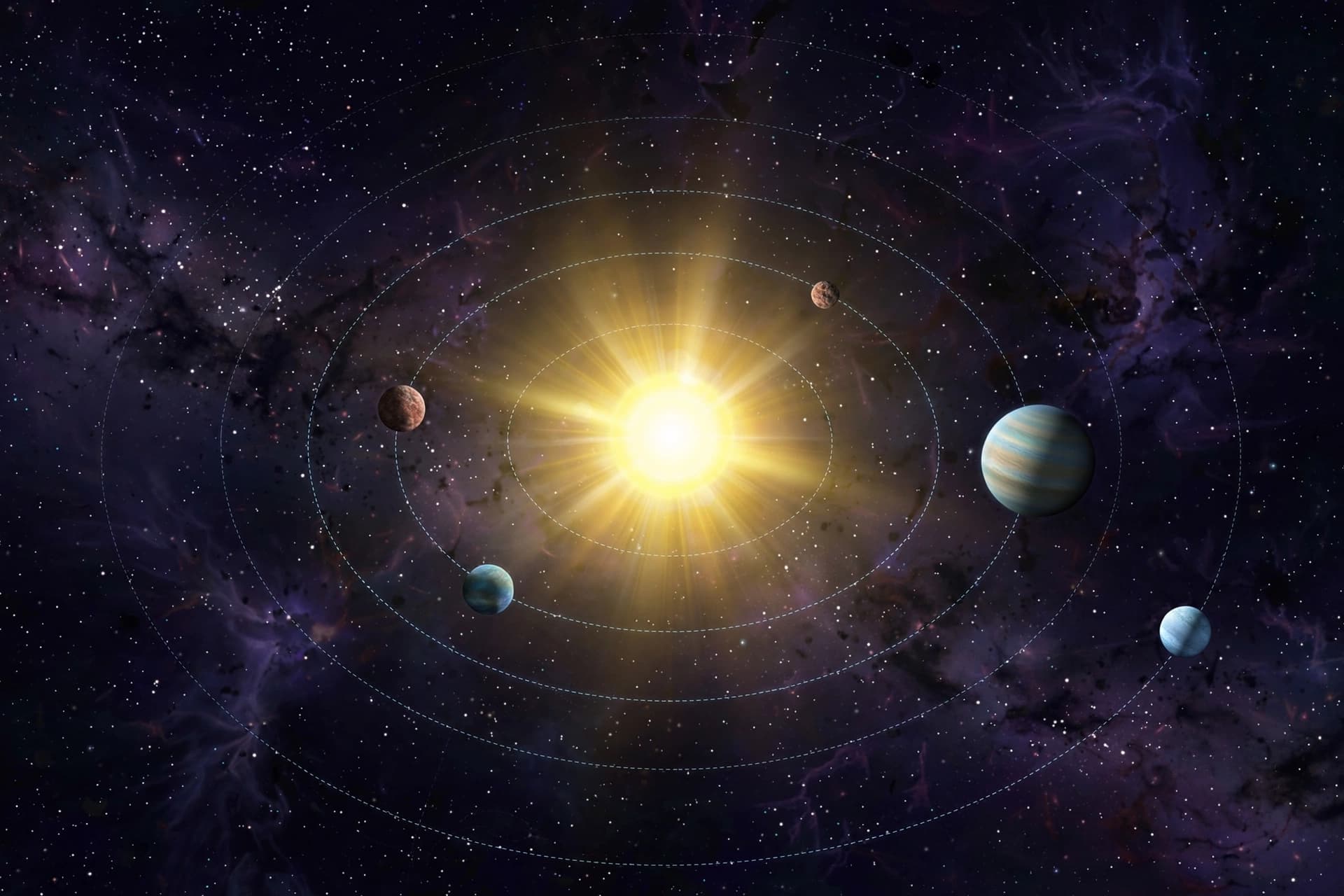
On certain nights, the universe offers a quiet spectacle, one that invites both wonder and reflection. This week, skywatchers in the northern hemisphere are being treated to just such a moment: a rare celestial alignment in which six planets — Mercury, Venus, Mars, Jupiter, Saturn, and Uranus — appear to line up across the evening sky.
While the planets are not truly in a straight line, their apparent positioning from Earth creates the illusion of a procession, an orderly parade of worlds silently orbiting the Sun. Astronomers describe this as a “planetary conjunction,” a phenomenon that occurs only occasionally and is often best observed in clear, dark skies away from urban light pollution.
Experts advise that this week offers a prime viewing opportunity. The planets are visible in the western horizon after sunset, gradually setting as night deepens. Binoculars or small telescopes can enhance the experience, revealing subtle differences in color, brightness, and apparent size. Venus shines as the brightest, a pearly beacon, while Mercury and Uranus are more modest, requiring a careful eye.
Historically, such alignments have captured human imagination. Ancient civilizations often interpreted planetary groupings as omens or messages, linking celestial patterns to events on Earth. Today, while science guides our understanding of gravitational mechanics and orbital dynamics, the aesthetic appeal remains — a reminder that the cosmos continues its slow, predictable dance far beyond human concern.
Astronomy enthusiasts highlight the educational value of these events. Observing planets in conjunction provides an accessible way to understand the relative motions of celestial bodies and the structure of our solar system. Families, schools, and local astronomy clubs are encouraged to participate, often hosting evening gatherings with telescopes and star charts.
Weather, however, remains a limiting factor. Cloud cover or haze can obscure the planets, and light pollution from urban areas can make fainter worlds like Mercury or Uranus nearly invisible. Planning ahead, experts recommend checking forecasts and choosing elevated or rural observation points.
The current alignment is not only visually striking but also serves as a reminder of our place in the solar system. In the vastness of space, the planets follow paths determined by gravity, unaffected by human schedules or seasons. Their apparent meeting is a gentle, astronomical coincidence that evokes reflection and awe.
For professional and amateur astronomers alike, capturing the event with photography has become popular. Long-exposure shots can trace the planets’ glow, highlighting color differences and illustrating the seeming parade across the sky. Social media often fills with images from around the world, connecting observers through shared wonder.
While these alignments are temporary, they inspire enduring interest in space. Observers may note the alignment lasts only for a few nights, but it can rekindle curiosity about planetary motion, solar dynamics, and the scale of the cosmos.
As twilight deepens into night, the planets slowly descend toward the horizon. Yet for those who pause to look upward, the parade leaves a lasting impression: a reminder of the rhythm and order of the heavens, and of the small but meaningful role we play as watchers beneath the stars.
AI Image Disclaimer Illustrations were produced with AI and serve as conceptual depictions.
Sources : BBC News The Guardian Sky News NASA News The Independent
Published by Banx Network. This article is part of the Banx decentralized media programme, powered by the BXE token on the XRP Ledger.