
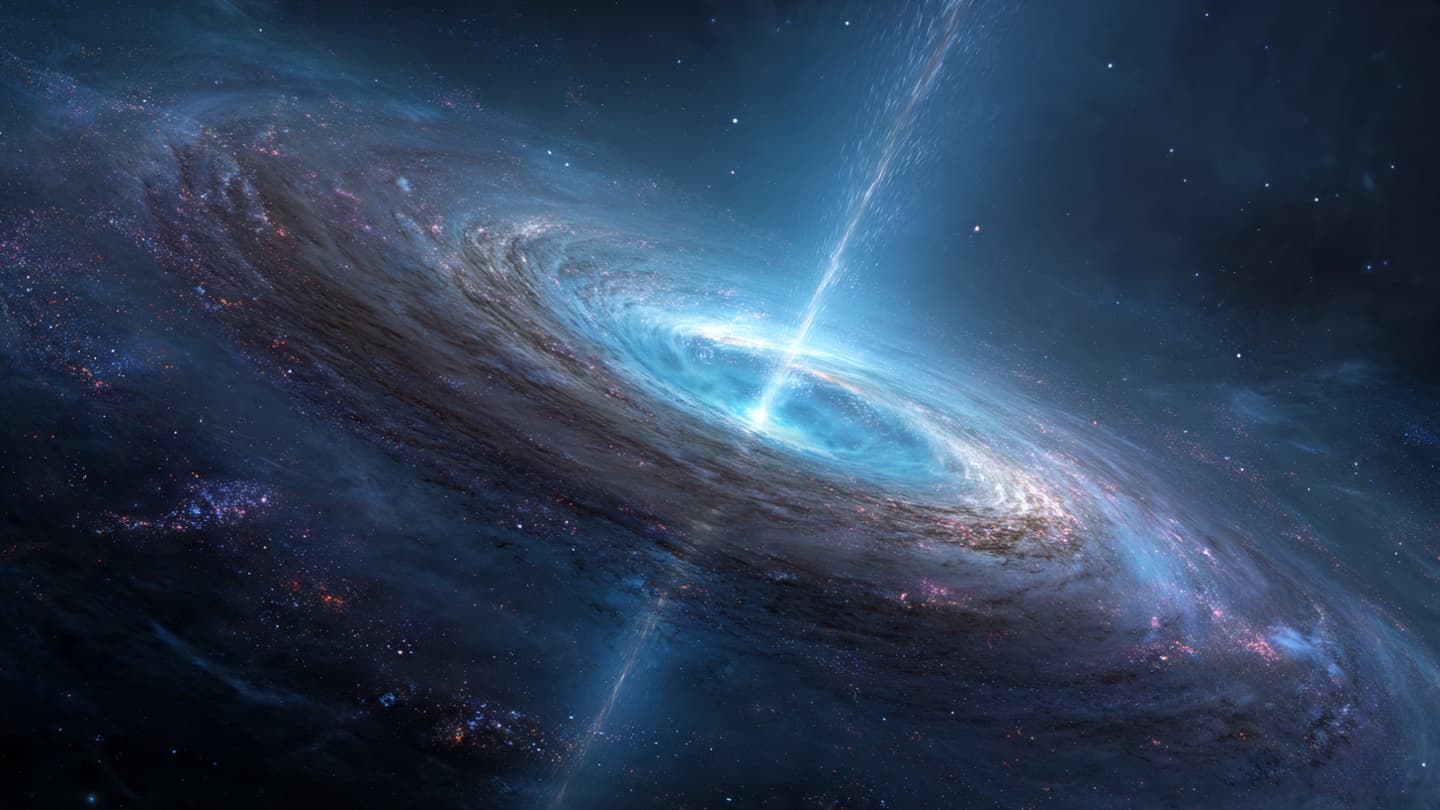
The universe often operates on scales that challenge ordinary imagination. Winds on Earth shape weather patterns and storms, yet far beyond our planet, astronomers have observed cosmic outflows so powerful that familiar comparisons become almost symbolic. Recent observations of black hole winds have offered a striking illustration of nature's extremes.
Researchers studying a supermassive black hole found evidence of extraordinarily fast winds being expelled from the region surrounding the object. These outflows travel at a significant fraction of the speed of light and carry immense amounts of energy into surrounding space.
To help convey the scale of the phenomenon, scientists noted that if such winds could somehow be translated into Earth's atmospheric conditions, they would exceed anything experienced in terrestrial weather. Estimates suggest their equivalent force would surpass even the strongest hurricane categories by an enormous margin.
The black hole responsible for these observations resides at the center of a distant galaxy. Material falling toward the black hole forms a rapidly rotating accretion disk, where friction, gravity, and magnetic forces create conditions capable of launching energetic winds outward.
Astronomers rely on advanced telescopes and spectroscopic measurements to detect these outflows. By analyzing shifts in light signatures, researchers can estimate the speed and composition of material moving away from the black hole.
Such winds play an important role in galaxy evolution. Scientists believe they can regulate star formation by heating or dispersing gas that would otherwise contribute to the birth of new stars. In this way, black holes influence regions far beyond their immediate surroundings.
The findings contribute to a growing understanding of how galaxies and their central black holes evolve together over cosmic time. Rather than acting as isolated objects, black holes appear deeply connected to the larger structures around them.
Although comparisons with hurricanes provide useful perspective, researchers emphasize that black hole winds and atmospheric storms are fundamentally different phenomena governed by very different physical processes.
The study adds another chapter to humanity's effort to comprehend the universe's most energetic environments, where familiar concepts often serve only as stepping stones toward understanding something far larger.
AI Image Disclaimer: The accompanying visuals are AI-generated artistic interpretations intended to represent the scientific concepts discussed in this article.
Sources Verified: NASA, European Space Agency, Nature Astronomy, Space.com, Live Science
Published by Banx Network. This article is part of the Banx decentralized media programme, powered by the BXE token on the XRP Ledger.



