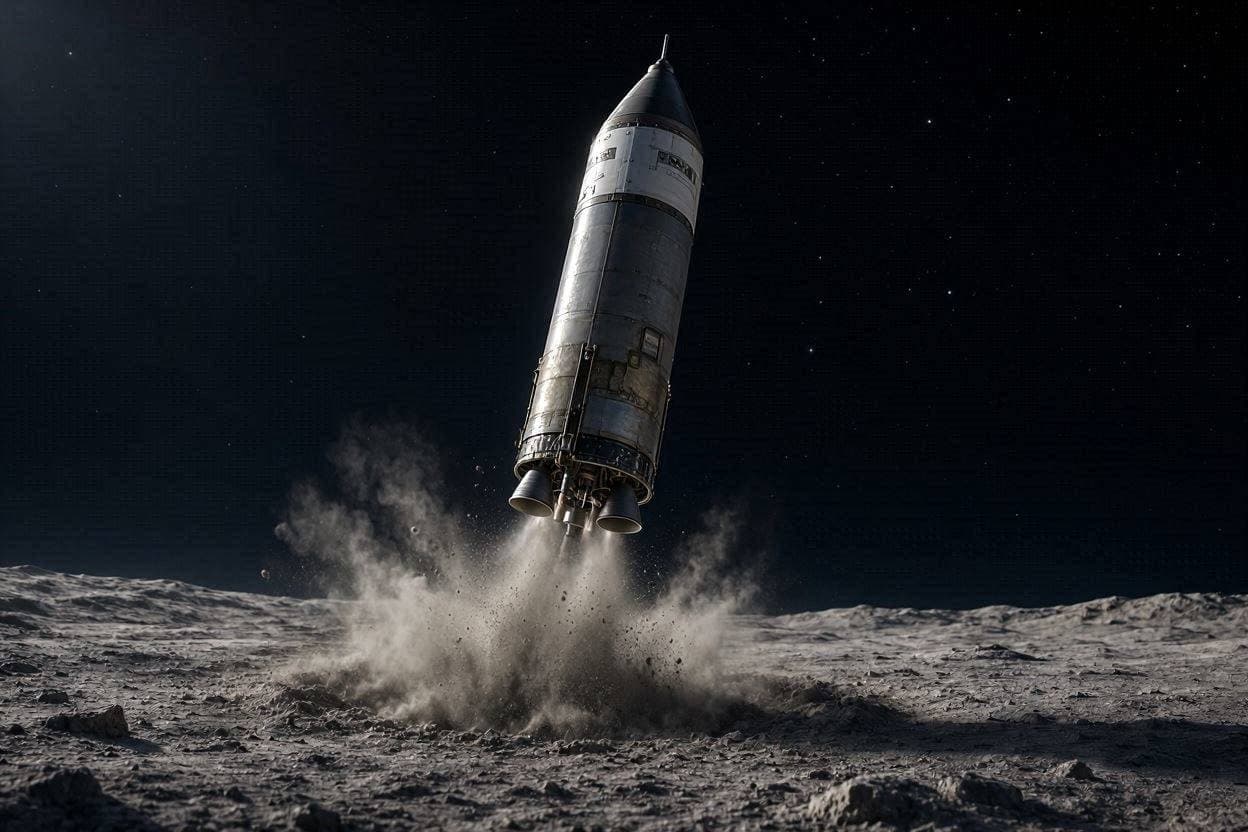
In the silent theater of space, where human ambition meets the vastness of the cosmos, a piece of our technological past is on a collision course with the lunar surface. An abandoned upper stage of a SpaceX Falcon 9 rocket, left in high-Earth orbit after a mission in early 2025, is predicted to strike the Moon on August 5, 2026. Traveling at approximately 5,400 miles per hour, the 4,000-kilogram structure will impact with an energy equivalent to 11.8 gigajoules. This event, while posing no danger to Earth or lunar operations, serves as a stark reminder of the growing issue of space debris and the long-lasting footprint of our exploration. It invites reflection on the responsibilities that come with reaching for the stars.
The impending impact highlights the complex dynamics of orbital mechanics and the unintended consequences of spaceflight. It underscores the need for sustainable practices in an era of increasing celestial traffic.
Body: The rocket stage, part of a mission launched in January 2025, was not designed for controlled re-entry or disposal in a graveyard orbit. Instead, it drifted into a chaotic trajectory influenced by the gravitational pulls of the Earth and Moon. Astronomers, including Bill Gray of Project Pluto, have tracked its path, predicting an impact near the Einstein Crater on the Moon’s near side. The location is visible from Earth, making it a point of interest for amateur and professional observers alike.
Unlike previous accidental impacts, such as those by Chinese rocket stages, this event involves hardware from a private commercial entity. SpaceX has revolutionized access to space, but this incident raises questions about the end-of-life management for reusable and expendable components. While the Falcon 9 first stage is recovered, the upper stage often remains in orbit, eventually succumbing to gravitational perturbations.
The energy of the impact, 11.8 gigajoules, is significant but small compared to natural meteorite strikes. Scientists hope to observe the resulting plume of dust and debris using telescopes. Such observations can provide valuable data on the lunar regolith’s composition and the physics of hypervelocity impacts. However, without a dedicated mission to monitor the site, the scientific yield may be limited.
Space debris is a growing concern for the sustainability of orbital environments. Thousands of defunct satellites, rocket bodies, and fragments circle the Earth, posing risks to active missions. International guidelines recommend de-orbiting or moving hardware to safe orbits, but enforcement remains challenging. This lunar crash serves as a visible example of why better disposal methods are necessary.
Public reaction has been mixed, with some expressing concern about "polluting" the Moon, while others view it as an inevitable part of exploration. The Moon has been struck by human-made objects before, including Apollo mission components and other rocket stages. Each impact adds a layer to the lunar archaeological record, marking the history of human presence in space.
Regulatory bodies are beginning to address these issues. The Federal Communications Commission (FCC) and other international agencies are developing stricter rules for mission termination plans. Companies are also exploring technologies for active debris removal and more durable upper stages that can perform controlled maneuvers after payload deployment.
For now, the focus is on observation. Amateur astronomers are encouraged to look toward the Einstein Crater around the predicted impact time. While the flash may be faint, the opportunity to witness a piece of modern history meeting an ancient celestial body is rare. It connects us to the ongoing narrative of space exploration.
As we continue to expand our presence in the solar system, lessons from these accidental impacts will shape future policies. The goal is to ensure that our quest for knowledge does not leave behind a trail of hazardous waste.
Closing: The predicted impact of a Falcon 9 rocket stage on the Moon highlights the challenges of space debris management. It invites continued dialogue on sustainable space practices and the preservation of celestial environments.
AI Image Disclaimer: The visuals accompanying this article are AI-generated illustrations designed to reflect the themes of space debris and lunar impact.
Sources: Project Pluto Sky at Night Magazine SpaceNews Phys.org
Published by Banx Network. This article is part of the Banx decentralized media programme, powered by the BXE token on the XRP Ledger.