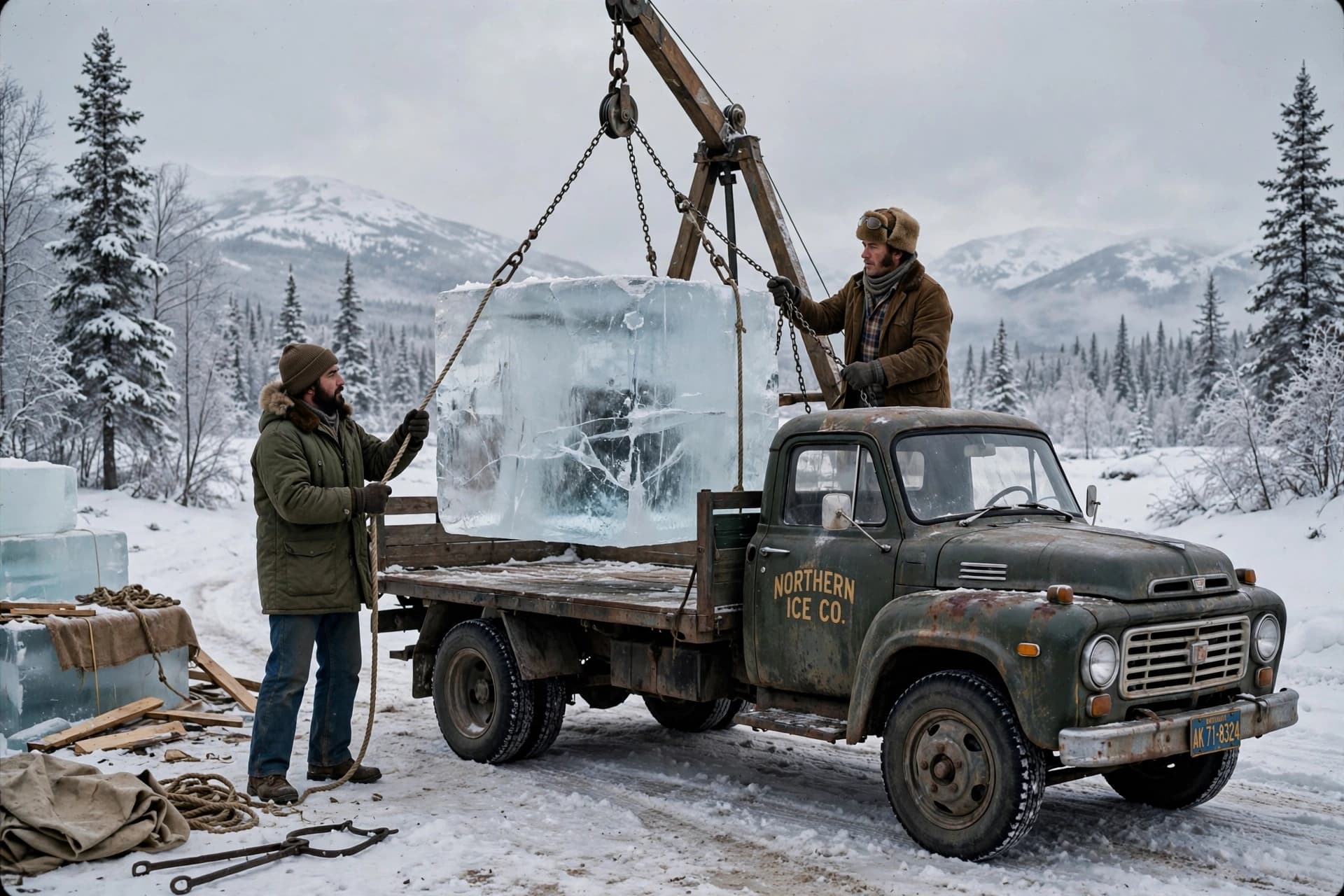
In the annals of unconventional scientific experiments, few stories are as striking as the journey of a two-ton block of ice from Alaska to Iowa. In 1977, this massive chunk of glacier was transported thousands of miles to demonstrate the feasibility of towing icebergs to arid regions for fresh water. The experiment was a logistical triumph, proving that ice could survive the trip. However, the broader idea it sought to validate ultimately melted away under the weight of economic and environmental realities. It remains a curious chapter in the history of human ingenuity and ambition.
The project was initiated by a Saudi prince who envisioned harvesting icebergs from polar regions to address water scarcity in the Middle East. To test the concept, a 2,500-pound block was cut from the Portage Glacier near Anchorage. It was then transported via helicopter, plane, and refrigerated truck to Iowa State University, where it was displayed at a conference. The ice arrived largely intact, a testament to the careful planning and insulation techniques employed by the team.
The choice of Iowa as the destination was symbolic, placing a piece of the Arctic in the heart of the American Midwest. At the conference, attendees were served drinks made from the ancient ice, offering a tangible connection to the experiment’s goal. While the spectacle drew attention, it also highlighted the immense challenges involved in scaling such an operation. The cost of transporting a single block was significant, raising questions about the viability of moving millions of tons of ice across oceans.
Environmental concerns also played a role in the idea’s decline. Critics argued that towing icebergs could disrupt marine ecosystems and alter local ocean temperatures. Additionally, the energy required for such operations would contribute to the very climate change causing water scarcity in the first place. These contradictions made the proposal difficult to justify, despite its initial appeal as a creative solution to a pressing problem.
Technological limitations further hindered the plan. While the small block survived, larger icebergs are prone to breaking apart and melting rapidly in warmer waters. Engineering solutions to prevent this fragmentation were complex and expensive. Without reliable methods to preserve the ice during transit, the risk of loss was too high for investors and governments to commit to large-scale projects.
Despite its failure to launch, the experiment left a lasting impression. It sparked discussions about alternative water sources and the lengths to which humanity might go to secure resources. It also served as a reminder that not all innovative ideas are practical, no matter how compelling they may seem. The story of the Alaskan ice block is a lesson in the balance between ambition and feasibility.
Today, as water scarcity becomes an increasingly urgent global issue, the idea of harvesting icebergs occasionally resurfaces. However, modern approaches focus more on desalination and conservation rather than transportation. The 1977 experiment stands as a historical footnote, a bold attempt that, while unsuccessful, contributed to the broader conversation about resource management and sustainability.
The journey of the Alaskan glacier block to Iowa was a remarkable feat of logistics, even if the underlying idea did not take root. It reminds us that innovation often involves trial and error, and that even failed experiments can offer valuable insights. As we face new environmental challenges, the spirit of curiosity that drove this project remains essential.
AI Image Disclaimer: The images accompanying this article are AI-generated artistic interpretations of the 1977 ice transport experiment, not actual historical photographs.
Sources: The New York Times Archives ScienceBlog Environment & Society Portal
Published by Banx Network. This article is part of the Banx decentralized media programme, powered by the BXE token on the XRP Ledger.