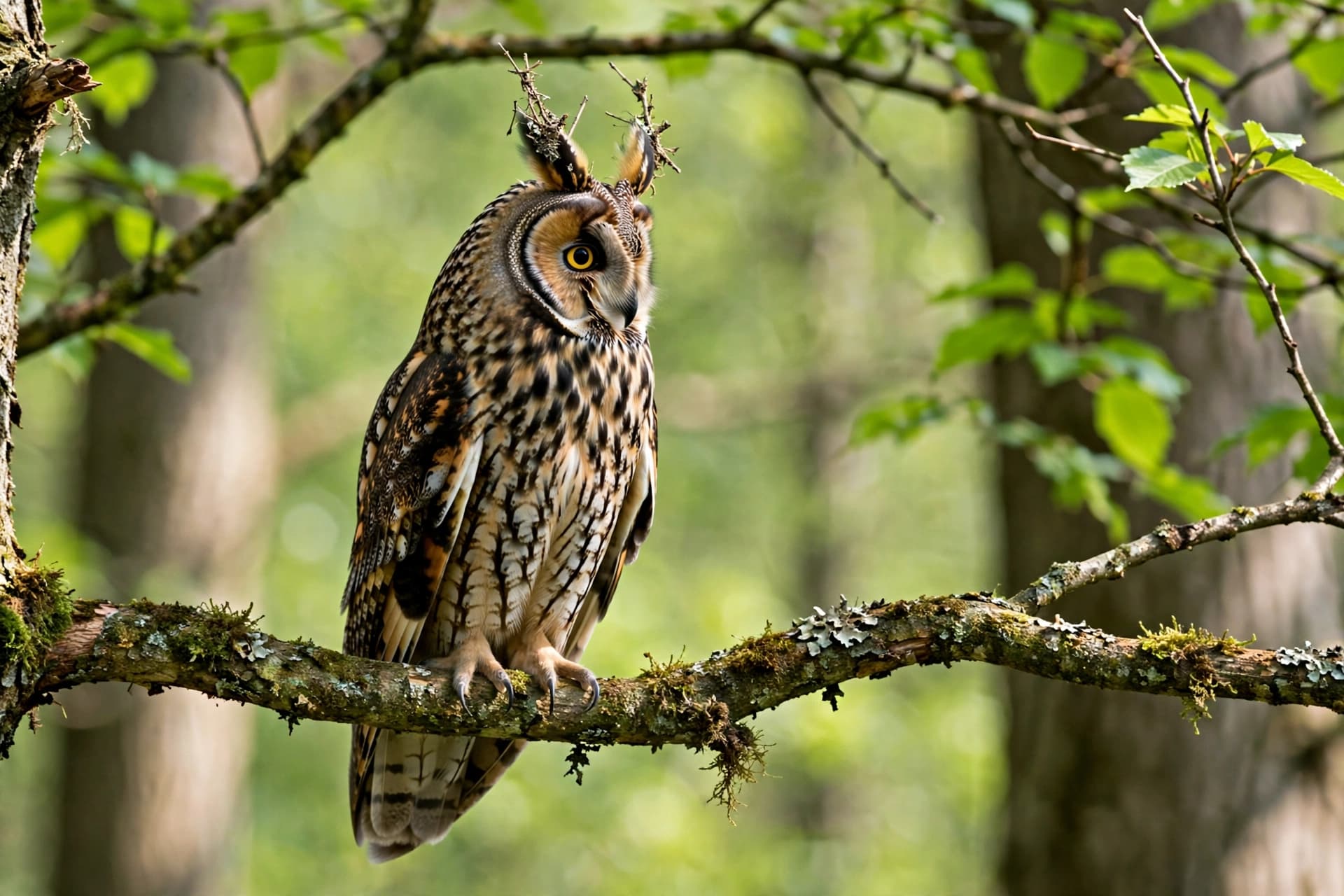
There is a particular mystery in the way owls present themselves to the world—the tufts of feathers that rise from their heads like small horns, that give some species an almost mythical appearance, and that have puzzled naturalists for generations. The long-eared owl has them, prominent and upright. The short-eared owl has them too, but so small they are often invisible. The great horned owl wears them like a crown. And then there are owls without them entirely—the snowy owl, the barn owl, the great grey owl—whose heads are smooth and rounded, their silhouettes unadorned. The question of why some owls have ear tufts and others do not has been answered, in part, by evolutionary biology, and the answer is more interesting than the name suggests.
Those tufts are not ears at all. The actual ears of owls are located on the sides of their heads, hidden beneath feathers, and they are asymmetrical—one ear placed slightly higher than the other—which allows the birds to pinpoint the location of a sound with remarkable precision . The tufts, called plumicorns, are simply feathers. They do not enhance hearing in any way . So what are they for? A 2025 study published in Frontiers in Zoology examined the evolutionary history of ear tufts across the Strigidae family and found that their presence correlates strongly with a specific lifestyle: strictly nocturnal activity. Ear tufts, the researchers concluded, likely evolved as a form of camouflage, allowing a sleeping owl to blend in with its surroundings during daylight hours .
The logic is elegant. A nocturnal owl roosting in a tree during the day faces a risk from diurnal predators and from mobbing birds that would harass it. An owl with ear tufts, seen from a distance, resembles a broken branch—the tufts mimicking the forked ends of a dead limb. The camouflage is not perfect, but it does not need to be; it only needs to make the owl slightly less obvious, slightly less worth investigating. The study found that ear tufts are most prominent in species that roost in trees or shrubs and are strictly nocturnal. Diurnal owls tend to lack them, as do species that roost on the ground or in open areas .
But camouflage is not the only function. The tufts also serve as a form of communication. In the Eurasian eagle-owl, the tufts are erect when the bird is alarmed or excited and lie flat when it is relaxed . They are, in a sense, a mood indicator—a visible signal to other owls and to potential threats. A study on the anti-predatory function of ear tufts suggested that they may serve a dual purpose: camouflage during rest, and startle display when the owl is threatened . The tufts become part of the owl's visual vocabulary, a way of saying "I am here" or "I am not" depending on the circumstances.
For the owls that lack tufts, the reasons vary. The snowy owl, which hunts during the day in the open tundra, has no need for branch-like camouflage. The barn owl, with its distinctive heart-shaped face, roosts in cavities and buildings, not in the open branches where a broken-branch silhouette would be useful . The great grey owl, a diurnal hunter of the northern forests, has a rounded head that blends with the soft contours of its preferred habitat. In each case, the absence of tufts reflects a different strategy—a different set of pressures, a different way of surviving.
The tufts, then, are not a matter of fashion or accident. They are an adaptation, shaped by millions of years of natural selection, and they tell us something about how owls live: where they sleep, when they hunt, and what they fear. The next time you see an owl with tufts, consider that you are looking at a creature that has learned to hide in plain sight, to become a branch among branches, to vanish into the daylight it avoids.
AI Image Disclaimer: The images accompanying this article were generated by artificial intelligence and are for illustrative purposes only.
Sources: Frontiers in Zoology, Semantic Scholar, IUCN UK Peatland Programme, Forest Preserve District of Will County, Los Angeles Zoo
Published by Banx Network. This article is part of the Banx decentralized media programme, powered by the BXE token on the XRP Ledger.