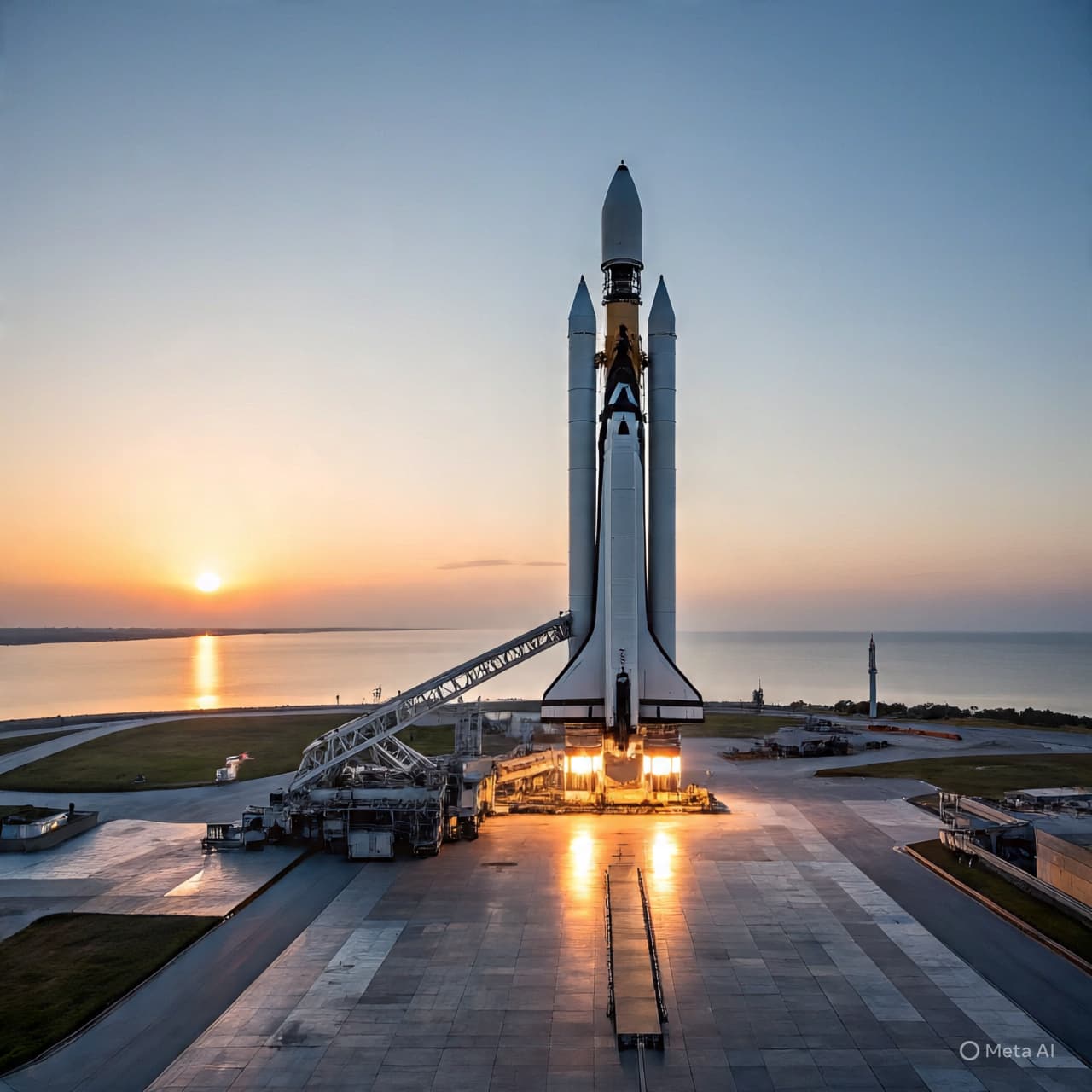
At Kennedy Space Center, the morning air often feels heavy with anticipation. The Atlantic stretches outward in patient blue, and the launch tower rises in deliberate geometry above the flat Florida landscape. Against that horizon stands the Space Launch System rocket, prepared for Artemis II — a mission meant to carry astronauts around the Moon and back, tracing a path first opened more than half a century ago.
Yet even in this choreography of readiness, the smallest detail can shift the rhythm.
Engineers reviewing data from the rocket’s systems recently detected an irregular helium flow within part of the vehicle’s pressurization network. Helium, light and inert, is used to maintain pressure inside propellant tanks, ensuring fuel moves correctly when engines ignite. Though it rarely commands public attention, its steady movement is essential to the complex balance that sustains a rocket from liftoff through ascent.
The discovery has prompted NASA to evaluate whether the Artemis II launch schedule should be adjusted. Officials have indicated that teams are analyzing the anomaly to determine its cause and whether additional testing or corrective work is required. In the language of spaceflight, such deliberation is neither dramatic nor unusual. It is procedure — the quiet discipline that underpins missions where margins are measured with precision.
Artemis II carries particular significance. Unlike Artemis I, which flew without crew, this mission is designed to send astronauts on a journey around the Moon before returning to Earth. It marks the first crewed lunar voyage of the Artemis era and represents a critical step toward sustained exploration beyond low Earth orbit. The responsibility embedded in that objective lends added weight to even minor technical findings.
Within the structure of the rocket, helium systems thread alongside vast cryogenic tanks filled with liquid hydrogen and liquid oxygen. When engines ignite, the interplay of pressure and fuel must unfold in exact sequence. A deviation in flow — however subtle — invites scrutiny. Engineers must determine whether it reflects a sensor fluctuation, a hardware issue, or an environmental factor encountered during testing.
NASA’s culture has long been shaped by lessons learned through experience. Countdown clocks have paused before. Components have been replaced, recalibrated, reinforced. Each delay, when it occurs, is framed not as retreat but as refinement. The distance to the Moon does not diminish because a schedule shifts; what changes is the confidence with which the journey begins.
Beyond the technical details, Artemis II stands within a broader ambition. The Artemis program seeks to establish a sustained human presence around the Moon, working with international partners and laying groundwork for eventual missions deeper into space. Each mission therefore becomes more than a singular event. It is a foundation stone placed carefully, meant to bear future weight.
On the ground in Florida, crews continue their work amid scaffolding and cables, reviewing telemetry and conducting inspections with methodical focus. The rocket remains upright and composed, its engines dormant, its trajectory awaiting confirmation. The helium discovery has not altered the destination — only the deliberation surrounding departure.
Should NASA ultimately decide to roll back the launch timeline, it would reflect the principle that exploration advances through patience as much as propulsion. In rocketry, the smallest element can influence the largest arc. A gas lighter than air becomes a guardian of safety when human lives are involved.
As sunlight moves across the launch complex and shadows shorten on the concrete, Artemis II stands poised between readiness and reconsideration. The Moon remains in its steady orbit above, indifferent to calendars and countdowns.
The path toward it continues — shaped not only by ambition, but by the careful listening that ensures each mission begins with certainty rather than haste.
Published by Banx Network. This article is part of the Banx decentralized media programme, powered by the BXE token on the XRP Ledger.