In the world of scientific images, there is an unwritten contract between beauty and truth. A micrograph can take your breath away, but its power comes precisely from the honesty it carries—what the lens actually saw, not what imagination or algorithm filled in. This year's winning video in Nikon's Small World in Motion competition touched the most sensitive nerve in that contract.
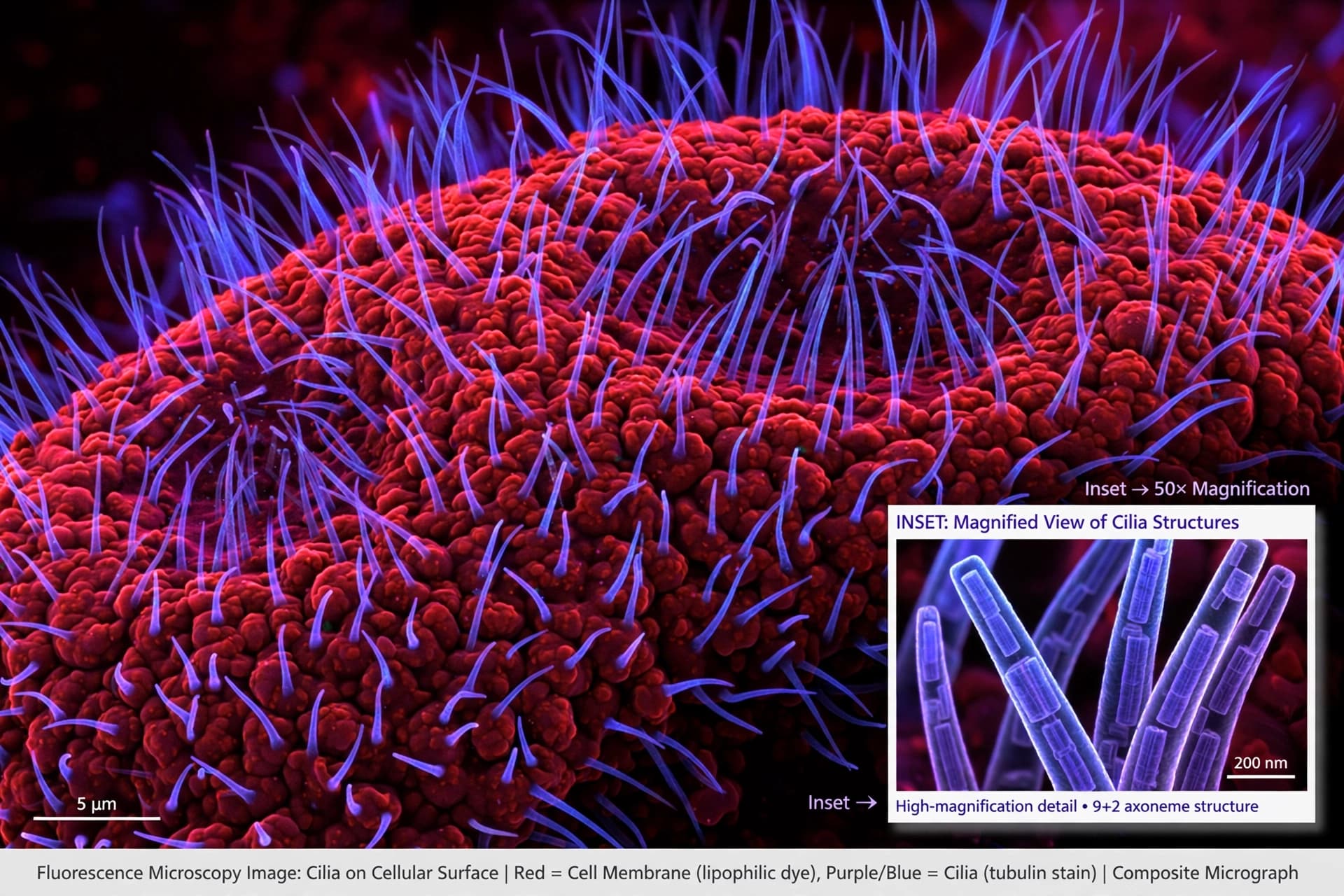
The winner was Dr. Xu Ning, a researcher at Tsinghua University in China, whose short video purported to show abnormal ciliary motion in the airways of a child with primary ciliary dyskinesia. The video was vivid and colorful, with cilia waving above structures in red, purple, and blue. The visual effect was striking. But soon after the award was announced, scientists began questioning the biological plausibility of the structures shown.
Edward Phelps, a bioengineering researcher at the University of Florida, noted on LinkedIn that the purple structures "resemble mitochondria, but subepithelial structures composed of extracellular mitochondria the size of nuclei do not exist in biology." He also observed that some structures "flicker in and out," and that cilia "appear out of nowhere." Ian Donovan, a doctoral student at UT Southwestern Medical Center, claimed that watermarks characteristic of AI-generated images were present in the source material.
At the heart of the dispute is how AI was used. Xu acknowledged using AI but insisted it was only for "post-processing"—to distinguish and visualize features in grayscale images, not to generate the experimental footage, the cilia, or their motion. "AI was not used to generate the experimental movie, the cilia, or their movement," he wrote on LinkedIn. "It is important to distinguish between using AI to create something that never existed in the experiment and using AI to process or visualize real experimental data."
Nikon's position supports that interpretation. The company said Xu "respectfully cooperated" with its review and provided additional technical documentation, and that it currently sees no rule violation. Nikon also updated the winning page to note the use of an "unsupervised" AI model to assist post-processing. A Nikon spokesperson told Nature that using AI as a tool to enhance microscopically generated source data, rather than generating images from scratch, aligns with the contest rules.
But former judges and microscopy experts were not entirely convinced. Christophe Leterrier, a neuroscientist who has judged the Nikon Small World competition and won it multiple times, said the processing "changes the original image too much." He noted that the layers beneath the cilia show structures that experts identify as nuclei, mitochondria, and plasma membranes. "You're seeing something very beautiful, very appealing, but it absolutely does not represent biological reality."
For scientists studying primary ciliary dyskinesia, the problem is especially serious. Robert Hirst of the University of Leicester pointed out that the video misleads viewers into thinking each cell has a single cilium, when in fact there are about two hundred. "It creates an underlying structure beneath the cilia that is wrong in scale, wrong in biology, and looks entirely fabricated." Hirst's greatest concern is that patients will see the video and believe their own cilia and cells look like that.
The episode touches a broader question: as AI becomes increasingly involved in scientific image processing, what counts as "enhancement" and what counts as "fabrication"? Nikon's contest rules allow artificial coloring with dyes, typically done manually on the sample. But when an algorithm replaces the dye, and when the boundary of "visualization" becomes blurred, the trust that underpins scientific images is put to the test. As Melanie White of the University of Queensland put it: "Scientific images are not just illustrations. They are data, and we need to be able to trust that what we see is based on underlying measurements."
AI Image Disclaimer: The visual materials in this article were produced by artificial intelligence and are used solely for illustrative purposes.
Sources: BBC, Nature, The Scientist, AITopics
Published by Banx Network. This article is part of the Banx decentralized media programme, powered by the BXE token on the XRP Ledger.