Key Highlights
- XRP's total supply is fixed at 100 billion tokens, with 55 billion locked in escrow.
- The claim of $65,000 per XRP is a misinterpretation of escrow data.
- XRP's market cap is currently in the hundreds of billions, far from quadrillions.
[Understanding XRP's Token Economics]
XRP, the native cryptocurrency of the Ripple network, operates on a unique economic model characterized by a fixed supply of 100 billion tokens. All XRP were created in 2012 through a process known as pre-mining, which differs significantly from the mining processes used by many other cryptocurrencies. This pre-mined structure allows Ripple Labs to manage the distribution of XRP effectively, with approximately 80% allocated to the company and the remaining 20% to its founders. This controlled distribution is crucial for maintaining market stability and preventing oversaturation.
In 2017, Ripple implemented a strategic measure to manage the supply of XRP by locking 55 billion tokens—55% of the total supply—into on-ledger escrows. These escrows are designed to release 1 billion XRP per month over a period of 55 months, ensuring a gradual and predictable release of tokens into circulation. Any unused tokens from a given month are rolled over into the next cycle, further controlling the supply and mitigating market volatility.
[Debunking the $65,000 Claim]
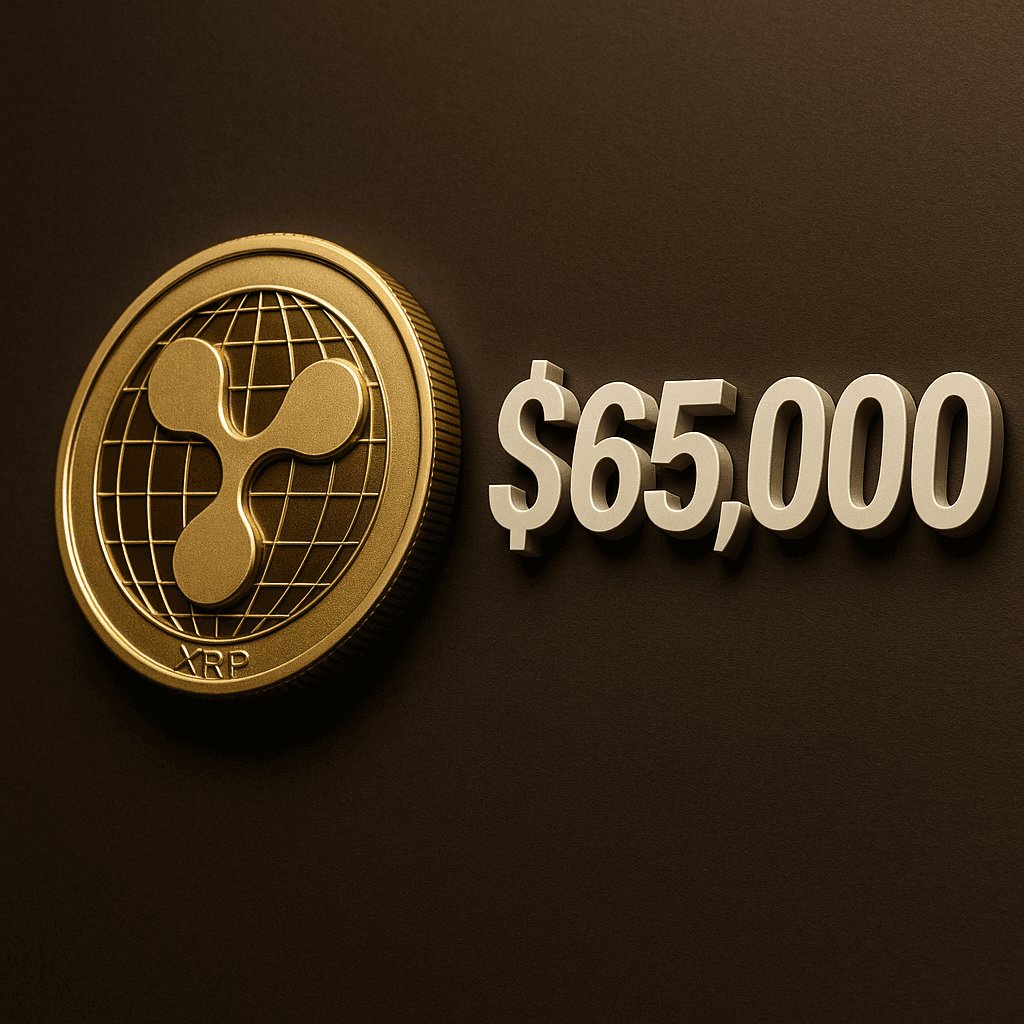
Recently, the headline claiming that "$65,000 XRP is locked in" has circulated, but this assertion misinterprets the nature of escrow. The escrow mechanism does not dictate or guarantee a specific price per token; rather, it serves to control the supply of XRP in the market. The notion that XRP could reach a valuation of $65,000 is based on a theoretical calculation that divides a hypothetical $6.5 quadrillion financial system by the total supply of 100 billion XRP. While mathematically sound, this scenario fails to consider the practical realities of market adoption, liquidity, and regulatory challenges.
[Market Cap and Valuation Realities]
As of early 2025, XRP's market capitalization remains in the hundreds of billions of dollars, a far cry from the trillions or quadrillions needed to support such a valuation. For XRP to underpin a financial system valued at $6.5 quadrillion, it would need to surpass the combined value of gold, global real estate, and all financial markets, an implausible leap without significant changes in the global financial landscape. This highlights the importance of grounding discussions about cryptocurrency valuations in market realities rather than speculative mathematics.
[The Role of XRP in Financial Systems]
XRP is designed primarily as a liquidity bridge for cross-border payments, facilitated through RippleNet's On-Demand Liquidity (ODL) service. This service allows for near-instant settlement of transactions with minimal fees, positioning XRP as a competitive option in the evolving landscape of payment technologies. However, it is essential to recognize that XRP is one of many emerging solutions, including central bank digital currencies (CBDCs) and stablecoins, which are also vying for institutional adoption and market share.
[Conclusion]
While the idea of XRP reaching a price of $65,000 or serving as the backbone of a quadrillion-dollar financial ecosystem is captivating, it lacks support from both the escrow data and current market conditions. Ripple's escrow system indeed provides a mechanism for supply control, but it does not imply a locked-in price. The future of XRP will depend on its adoption, utility, regulatory environment, and competitive positioning in the broader financial landscape.
Published by Banx Network. This article is part of the Banx decentralized media programme, powered by the BXE token on the XRP Ledger.