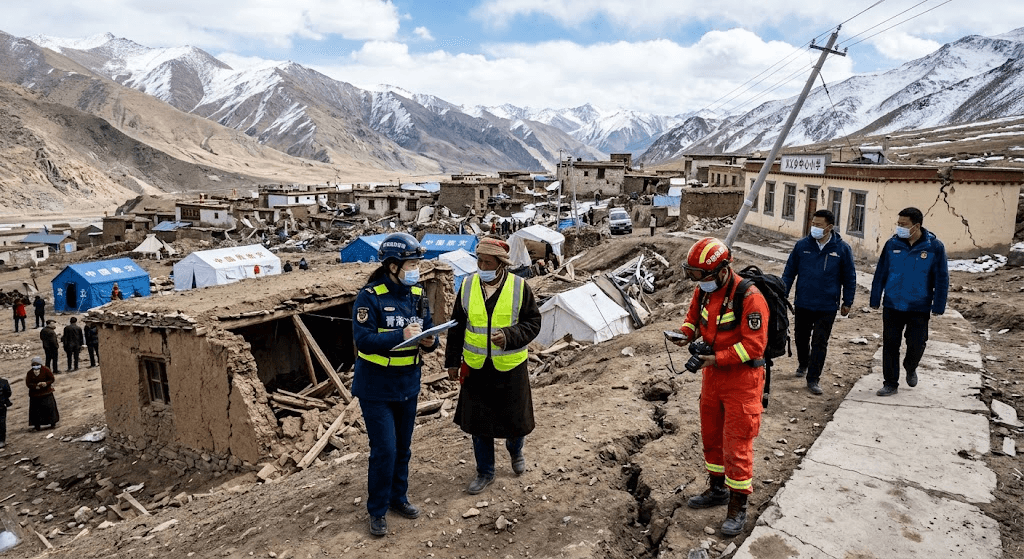
XINING, China — A 5.3-magnitude earthquake struck Zadoi County in northwest China's Qinghai Province on Saturday afternoon, October 24, 2026, sending tremors across the sparsely populated mountainous region.
According to the China Earthquake Networks Center (CENC), the temblor struck at 4:39 p.m. Beijing time at a shallow focal depth of 10 kilometers. The epicenter was monitored at 32.54 degrees north latitude and 93.97 degrees east longitude in Yushu Tibetan Autonomous Prefecture.
Local authorities reported that residents in nearby townships felt moderate shaking. However, owing to the high altitude and low population density near the epicenter, there were no immediate reports of casualties or severe structural damage following the initial strike. Emergency management departments in Qinghai quickly initiated preliminary response protocols to inspect local infrastructure and residential areas.
The earthquake comes at a time of heightened regional alertness, occurring just two days after a powerful 7.0-magnitude earthquake jolted neighboring Tibet. That earlier disaster prompted extensive disaster relief operations, the deployment of thousands of rescue personnel, and widespread evacuations across adjacent mountain zones.
Seismologists note that the high-altitude Tibetan Plateau experiences frequent seismic activity due to ongoing tectonic friction caused by the collision between the Indian and Eurasian plates. Field teams and local civil defense units in Yushu Prefecture are actively monitoring for aftershocks, assessing remote pastoral communities, and ensuring emergency supplies are accessible if needed.
Local transport and communication lines across Zadoi County remained fully operational, with no initial disruptions reported along major highways or telecommunication networks. Provincial authorities deployed mobile inspection units to verify the structural integrity of schools, clinics, and bridges throughout the affected sectors.
Given its historical vulnerability to seismic activity, Qinghai Province has consistently prioritized earthquake-resistant construction standards and community preparedness training. Disaster response teams remain on high alert as geological monitoring agencies continue to analyze aftershock patterns across the plateau.
Published by Banx Network. This article is part of the Banx decentralized media programme, powered by the BXE token on the XRP Ledger.