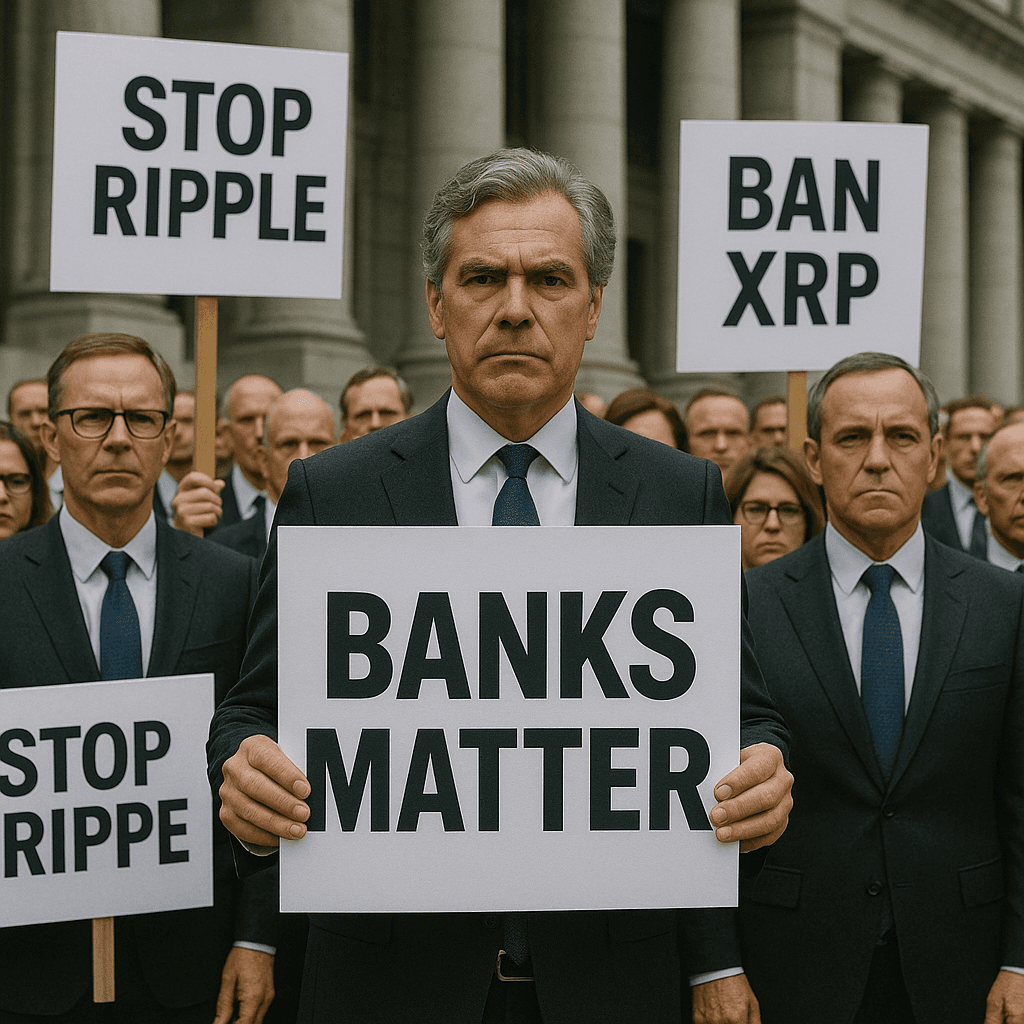
Ripple’s pursuit of a U.S. federal trust bank license is facing strong opposition from legacy financial institutions — and analysts say it’s because traditional banks are beginning to realize they may be running out of time to stop what could be a historic shift in global finance.
🔥 U.S. BANKING GROUPS PUSH BACK HARD On July 19, five major U.S. banking associations, including the American Bankers Association (ABA) and the Bank Policy Institute (BPI), formally urged federal regulators to deny or delay Ripple and Circle’s national trust bank applications. Their joint comment letter to the Office of the Comptroller of the Currency (OCC) argued that the crypto firms do not meet the legal definition of a fiduciary bank and called the public comment process “procedurally deficient.”
“There is no public version of the business plan or even a redacted version… This leaves the public without sufficient information to evaluate the application,” the letter stated.
The associations claim Ripple’s application lacks clarity on how it would comply with fiduciary responsibilities under U.S. banking law.
📉 LEGACY BANKS FEAR SYSTEMIC DISPLACEMENT Although the letter focuses on technical and procedural arguments, many industry analysts see a deeper motive.
According to fintech analyst Eleanor Terrett, the opposition is about preserving control:
“These groups aren’t just raising regulatory concerns — they’re worried about a future where Ripple doesn’t need them anymore,” she said during a July 22 appearance on Fox Business.
Ripple’s On-Demand Liquidity (ODL) system and XRP Ledger (XRPL) already allow institutions to settle cross-border payments instantly, with no correspondent banks required. If Ripple secures a federal charter, it could gain direct access to the Fed, disintermediating a core function of traditional banks.
📊 WHAT’S AT STAKE $155 trillion+: Annual cross-border payment volume targeted by Ripple
70–90%: Average transaction cost savings vs. SWIFT, according to Ripple’s 2023 ODL report
80+ countries: RippleNet’s current institutional reach
100+ tokens launched: On XRPL via BanxChange.com, powered by the BXE token
🏛️ THE FINAL PUSH — BEFORE IT’S TOO LATE? The OCC is expected to make a decision on Ripple’s license within weeks. Should it be approved, Ripple would become one of the first blockchain-native firms with a federal banking license — enabling it to integrate directly with the U.S. financial system.
According to John Deaton, pro-XRP legal advocate and founder of CryptoLaw:
“The banks are pulling every lever they have to slow this down. They see what’s coming, and they’re scared of it.”
Deaton also noted that most traditional banks can’t compete on settlement speed, transparency, or fees, making Ripple’s entry into banking a “major inflection point.”
📌 CONCLUSION Legacy banks may have just weeks left before Ripple joins their ranks — not as a partner, but as a competitor with technological superiority.
And with XRP positioned as the fuel behind Ripple’s system, this may mark a pivotal moment in the shift away from legacy infrastructure toward blockchain-native financial rails.
“They’re not just trying to stop Ripple,” Deaton said. “They’re trying to stop the inevitable.”
Published by Banx Network. This article is part of the Banx decentralized media programme, powered by the BXE token on the XRP Ledger.