1. The End of the Waiting List?
Modern transplantation depends on scarcity.
A patient with irreversible kidney failure may require a donor kidney. Someone with severe liver disease may need a transplant. A failing heart can mean that transplantation becomes the difference between life and death.
The problem is simple: there are not enough donor organs.
That creates an unusual situation in medicine. Doctors may know exactly what a patient needs, yet still be unable to provide it because the biological replacement does not exist.
3D bioprinting offers a radically different model.
Instead of waiting for an organ to become available, hospitals could one day manufacture biological replacements using a patient's own cells.
The organ would not be manufactured like a plastic component.
It would be grown and assembled as living tissue.
Researchers increasingly describe bioprinting as part of a broader regenerative-medicine ecosystem involving stem cells, organoids, biomaterials, tissue engineering and computational design.
That distinction is crucial.
A future bioprinter would not simply produce an object.
It could potentially produce something alive.
2. What Is 3D Bioprinting?
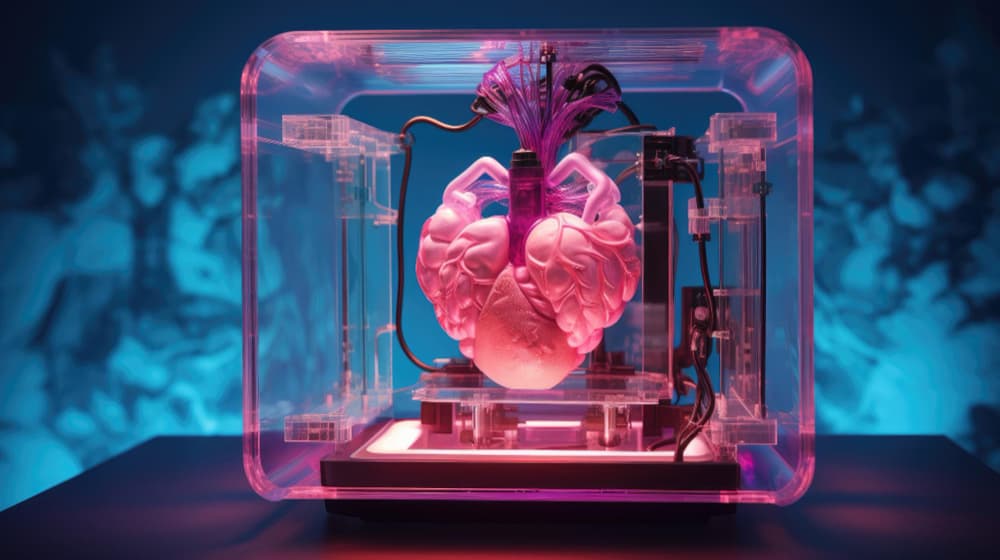
Traditional 3D printing builds physical objects by depositing or solidifying material according to a digital design.
Bioprinting takes the same basic manufacturing philosophy and applies it to biology.
Instead of plastic, metal or resin, researchers can use biological materials known as bioinks.
These may contain combinations of:
living cells hydrogels extracellular-matrix components growth factors biomaterials organ-specific biological materials
The printer then deposits these materials in carefully controlled patterns.
The objective is not merely to reproduce the external shape of an organ.
The internal architecture matters.
Cells need to be positioned correctly. Different cell types need to communicate. Mechanical properties need to be appropriate. Nutrients and oxygen need to reach living tissue.
The result therefore has to be designed as a biological system rather than simply a three-dimensional object.
Modern research includes extrusion-based, droplet-based, laser-assisted and projection-based approaches, each offering different compromises between speed, resolution and cell survival.
3. The Printer Is Only Half the Story
It is tempting to imagine a futuristic machine resembling a conventional desktop 3D printer.
Insert cells.
Upload an organ scan.
Press print.
Receive a replacement heart.
Reality is vastly more complicated.
The printer is only one component of the process.
Scientists also need to determine:
Which cells should be used? Where should each cell type be placed? What biological materials should surround them? How should the cells mature? How should blood vessels be created? How should nerves connect? How should the tissue respond to mechanical forces? How can the final organ survive transplantation? How can its quality be verified? How can the entire process be reproduced safely?
This is why organ bioprinting is fundamentally a multidisciplinary problem.
It combines biology, medicine, materials science, mechanical engineering, fluid dynamics, computer science and manufacturing.
4. The Living Ink
One of the most important technologies in bioprinting is the bioink.
Traditional printer ink only needs to produce an image.
Bioink has to support life.
It must allow cells to survive the printing process while providing an environment in which they can attach, communicate, grow and eventually organize themselves into functional tissue.
Researchers are investigating hydrogels and extracellular-matrix-derived materials because they can provide biological environments resembling aspects of natural tissue. Hybrid materials are also being developed to balance biological compatibility with the mechanical properties needed for printing.
This creates a fundamental engineering challenge.
The material needs to be printable.
But it also needs to be biologically useful.
Those requirements do not always align.
A material that prints beautifully may not provide the right environment for cells.
A biologically excellent material may be too difficult to manufacture with sufficient precision.
The future of bioprinting therefore depends partly on discovering materials that satisfy both worlds.
5. Where Do the Cells Come From?
The most exciting possibility involves patient-specific cells.
Imagine a patient requiring a replacement organ.
Doctors could potentially obtain cells from that individual and reprogram or expand them into the types of cells required for tissue engineering.
One important route involves induced pluripotent stem cells, which can be generated by reprogramming mature cells into a stem-cell-like state.
In principle, this creates a biological starting material that belongs to the patient.
The eventual objective would be to construct tissue containing cells genetically compatible with the recipient.
That could dramatically change transplantation.
Today, transplantation involves finding a sufficiently compatible donor.
Tomorrow, the long-term vision could be to manufacture a biological replacement specifically for the patient.
That does not mean immune rejection would automatically disappear. Engineered tissues contain many interacting biological components, and immune responses remain an important challenge. Researchers are therefore investigating patient-derived cells, biomaterials and other strategies to improve compatibility.
6. Organoids: The Miniature Organ Revolution
Before scientists can print complete organs, they are learning how to reproduce pieces of them.
One important tool is the organoid.
Organoids are three-dimensional cell structures that can reproduce some characteristics of human organs.
They are not miniature fully functional human organs.
But they can provide researchers with valuable models of development, disease and tissue organization.
Bioprinting can potentially control the spatial arrangement of organoids and organ-forming cells, creating increasingly sophisticated biological structures.
This creates an intriguing possibility.
Instead of attempting to print an entire organ from individual cells, future systems might assemble biological building blocks that already possess some degree of self-organization.
The printer provides the architecture.
The cells provide the biology.
The combination could be far more powerful than either technology alone.
7. The Biggest Problem: Blood
There is one problem that may determine whether full-size bioprinted organs ever become reality.
Blood vessels.
A small piece of tissue can survive relatively easily because oxygen and nutrients can diffuse over short distances.
A human organ is different.
It contains billions of cells arranged throughout a three-dimensional structure.
Those cells require continuous access to oxygen and nutrients while waste products must be removed.
Without an adequate vascular network, the centre of a large engineered tissue can become starved of oxygen.
Vascularisation is therefore one of the central obstacles to creating large, functional tissues.
And the required network is extraordinarily complicated.
A human body contains vessels ranging from major arteries down to microscopic capillaries.
A future printed organ will need a vascular architecture capable of connecting to the patient's circulation and delivering blood throughout the tissue.
This is not simply a printing problem.
It is a fluid-dynamics problem, a biological problem and a surgical problem simultaneously.
8. Printing Blood Vessels
Researchers are attacking the vascularisation problem from multiple directions.
One approach is to print vascular channels directly into engineered tissue.
Another is to encourage cells to create their own vascular networks.
Others are developing sacrificial materials that can be printed into a structure and later removed, leaving behind channels.
In 2025, researchers reported a computational approach capable of rapidly generating synthetic vascular models for organ-scale biomanufacturing and demonstrated that these models could support perfusion of engineered living-tissue constructs.
This matters because vascular architecture may ultimately become one of the defining pieces of the organ-printing puzzle.
The future organ printer may therefore need to design not just the organ itself but the entire circulatory infrastructure inside it.
9. Printing a Heart
The heart is one of the ultimate tests.
A heart is not simply a pump-shaped structure.
It contains highly organized muscle cells, valves, blood vessels, electrical conduction pathways and connective tissues.
Its cells must contract in a coordinated sequence.
Its chambers must withstand constant mechanical stress.
Its electrical system must maintain rhythm.
A future bioprinted heart would therefore need to reproduce multiple biological systems simultaneously.
Researchers are already investigating bioprinting strategies for cardiac tissue, but a completely functional, transplant-ready human heart remains far beyond current clinical capabilities. Reviews of the field continue to identify vascularisation, cellular integration, maturation and scale as major barriers.
The significance is enormous.
If scientists eventually solve the heart, they would demonstrate that complex mechanical and biological functionality can be manufactured together.
10. The Liver May Be Different
The liver presents another fascinating possibility.
Unlike the heart, it does not need to beat.
Its complexity comes from its extraordinary biochemical activity.
The liver performs hundreds of functions involving metabolism, detoxification, protein production and regulation of the body's internal chemistry.
That makes liver tissue particularly interesting for bioprinting research.
Researchers could potentially develop increasingly sophisticated liver tissues for:
disease modelling drug testing toxicity testing regenerative medicine eventual transplantation
The path toward a transplantable organ may therefore begin not with printing an entire liver overnight, but with progressively improving smaller functional components.
11. What About Kidneys?
The kidney may be one of the hardest organs to reproduce.
A kidney contains intricate filtration structures and an enormous network of microscopic blood vessels and tubules.
Its architecture is directly tied to its function.
Simply producing a kidney-shaped object would accomplish almost nothing.
The tissue must actually filter blood, regulate fluid balance and perform its other physiological functions.
This illustrates a central principle of bioprinting:
Shape is not function.
A successful artificial organ must behave like the biological organ it replaces.
That distinction separates medical bioprinting from conventional additive manufacturing.
12. AI Could Become the Organ Designer
Artificial intelligence could become one of the most important technologies in future bioprinting.
A human organ contains enormous amounts of biological complexity.
Designing its internal architecture manually would be extraordinarily difficult.
AI systems could eventually analyze:
medical scans anatomical structures vascular networks cellular distributions mechanical properties patient-specific measurements previous printing outcomes
An AI system could then generate an optimized manufacturing blueprint.
Imagine a future workflow:
Medical scan → AI organ model → patient-specific cell preparation → automated bioprinting → maturation → quality control → transplantation
AI could also help optimize bioinks, printing paths, vascular structures and manufacturing processes. Recent reviews specifically identify AI-assisted design, process control and quality assurance as important directions for organ-scale biomanufacturing.
The printer would become less like a machine operated by a technician and more like a biological manufacturing platform.
13. The Organ Factory
If bioprinting becomes clinically viable, hospitals may eventually need something resembling a biological manufacturing facility.
Instead of storing only donor organs, specialist centres could maintain:
cell-processing laboratories bioprinters automated tissue-culture systems imaging equipment AI design systems robotic quality-control systems sterile manufacturing environments cryogenic cell-storage facilities
The organ would move through a production pipeline.
Patient data
↓
Biological cell source
↓
AI-assisted design
↓
Bioink preparation
↓
Bioprinting
↓
Tissue maturation
↓
Functional testing
↓
Quality control
↓
Transplantation
This would effectively create a new branch of manufacturing:
biological manufacturing.
14. The 4D Organ
The next step may be more sophisticated than 3D printing.
It could be 4D bioprinting.
The fourth dimension is time.
Instead of producing a static structure, researchers are exploring materials and biological systems that change after fabrication.
A printed structure could potentially:
change shape respond to temperature respond to chemical signals contract degrade encourage cellular organization
This matters because living organisms are dynamic.
A natural organ is not a static object.
It develops, remodels and responds to its environment.
Future bioprinting may therefore involve creating structures that continue developing after they leave the printer.
15. Printing Instead of Transplanting
The most radical future would be a shift in the meaning of transplantation.
Today:
Donor → Organ → Patient
The future could become:
Patient → Cells → Bioprinter → Organ → Patient
That would eliminate the donor as the central source of replacement tissue.
It could also reduce dependence on donor matching.
Instead of asking:
"Who has an organ compatible with this patient?"
medicine could eventually ask:
"How do we manufacture the organ this patient needs?"
That would represent one of the biggest transformations in transplantation history.
16. Could Organ Donation Become Obsolete?
Eventually, perhaps.
But not soon.
Current research is nowhere near routinely printing fully functional human hearts, kidneys or livers for transplantation.
The field is still dealing with fundamental problems involving:
vascularisation tissue maturation scale mechanical strength cellular organization immune compatibility long-term function manufacturing consistency safety regulation
Recent comprehensive reviews emphasize that translation from experimental bioprinting to transplant-ready organs remains constrained by these biological and manufacturing challenges.
The more realistic near-term future is therefore incremental.
First tissues.
Then increasingly complex tissue structures.
Then partial organ replacements.
Then perhaps smaller functional organs.
Eventually, if the science succeeds, complete organs.
17. The First Generation of Bioprinted Medicine
The first major revolution may not involve complete organs at all.
It could involve replacement tissue.
Imagine a patient suffering severe damage to a section of tissue.
Rather than implanting an artificial material, doctors could potentially use engineered living tissue designed specifically for that patient.
Possible applications include:
skin cartilage bone blood vessels corneal tissue patches for damaged organs reconstructive surgery
This would allow medicine to move progressively from replacing structures with synthetic materials toward regenerating them with living biological material.
18. What Happens to Organ Donation?
If fully functional bioprinted organs become reliable, the traditional transplant system would eventually change.
The organ waiting list could shrink.
The importance of donor matching could decline.
Organ transport networks could become less central.
Emergency medicine could gain new options.
Hospitals might maintain biological manufacturing capabilities instead of relying exclusively on donor networks.
But organ donation would probably not disappear immediately.
There could be a long transitional period where donor organs, xenotransplantation, mechanical devices, regenerative medicine and bioprinted tissues all coexist.
Indeed, transplantation itself is already being reshaped by multiple technologies, including AI, xenotransplantation, organoids and regenerative medicine.
The future may not have one solution.
It may have an entire ecosystem of replacement technologies.
19. The Economics of Manufactured Organs
The economic implications could be enormous.
Organ failure places major financial burdens on healthcare systems.
Kidney failure, for example, can require years of intensive treatment.
A future in which replacement organs could be manufactured would potentially change healthcare economics from long-term disease management toward one-time biological replacement.
But there is an important question:
Who gets access?
Early bioprinting technology would probably be expensive.
The first generation could require sophisticated laboratories, highly trained specialists and complex cell-processing systems.
That raises the possibility of a new form of medical inequality.
We could enter a world where wealthy patients can obtain biological replacement parts while poorer populations remain dependent on conventional transplantation.
Technology does not automatically create equality.
It creates possibilities.
Society still has to decide how those possibilities are distributed.
20. The Ethical Question: Are We Manufacturing Human Life?
Bioprinting also raises questions that conventional manufacturing never had to confront.
If a laboratory creates a complex piece of human tissue, what exactly has been produced?
A medical device?
A biological product?
A living organism?
An extension of the patient?
As tissues become increasingly sophisticated, regulators and ethicists will have to determine where existing categories stop being adequate.
There are also questions surrounding ownership.
If a patient's cells are used to create a biological product, who owns the resulting tissue?
Could companies patent components of biological manufacturing systems?
Could patient-derived cells become commercially valuable?
Could engineered organs be enhanced beyond their natural biological characteristics?
The technology could eventually force society to reconsider the boundary between medicine and biological engineering.
21. Could We Upgrade Human Organs?
This is where the future becomes particularly strange.
The original purpose of bioprinting is replacement.
But once humans can manufacture biological structures, the question of enhancement inevitably appears.
Suppose a printed heart could be designed to resist a particular disease.
Suppose engineered cartilage could be more durable than natural cartilage.
Suppose biological tissues could be modified to recover faster after injury.
At what point does replacement become enhancement?
Medicine has historically attempted to restore people to normal biological function.
Future biotechnology may allow something more ambitious:
designing biological function.
That could transform the ethical debate.
22. The 2035 Scenario
By the mid-2030s, a realistic scenario would not involve hospitals printing perfect human hearts on demand.
Instead, bioprinting could become increasingly established in areas such as tissue engineering, disease modelling, drug development, surgical planning and regenerative medicine.
Patient-specific biological models could become much more sophisticated.
AI could increasingly assist with tissue design and manufacturing.
More advanced vascularisation strategies could improve the scale of engineered tissues.
The boundary between biological research and manufacturing could become increasingly blurred.
The technology would still be experimental for many organ-scale applications.
But the infrastructure for the future could already exist.
23. The 2050 Scenario
By 2050, the picture could be dramatically different.
If researchers overcome vascularisation, maturation and manufacturing challenges, hospitals could potentially offer increasingly sophisticated engineered tissues and selected organ replacements.
A patient might arrive with severe organ damage.
Instead of immediately entering a donor waiting system, clinicians could evaluate whether a biological replacement could be manufactured.
The patient's medical data could be converted into a personalized organ design.
Their cells could provide the biological starting material.
Automated systems could fabricate and mature the tissue.
The result could be tested before transplantation.
It would still be an extraordinary medical procedure.
But it would no longer be science fiction.
24. The 2100 Possibility
Go further into the future and the implications become difficult to predict.
If biological manufacturing becomes sufficiently reliable, organ scarcity could largely disappear.
Humans could potentially replace damaged organs rather than simply treating their decline.
A damaged liver might be replaced.
A failing heart might be regenerated.
A severely damaged limb could potentially be reconstructed.
The distinction between repairing the human body and manufacturing replacement components could become increasingly meaningless.
Medicine could become less about accepting biological deterioration and more about maintaining biological systems.
That would fundamentally change how humanity thinks about ageing, disease and mortality.
25. Three Possible Futures Scenario One: The Slow Revolution
Bioprinting becomes valuable for tissues, drug testing and medical research but never achieves routine whole-organ transplantation.
Donor organs remain essential.
Bioprinting becomes another tool in regenerative medicine rather than a replacement for transplantation.
Scenario Two: The Transplant Revolution
Researchers successfully solve vascularisation, maturation and immune compatibility.
Bioprinted kidneys, livers and other organs become clinically viable.
Waiting lists shrink dramatically.
Organ donation remains available but becomes less essential.
Scenario Three: The Biological Manufacturing Revolution
Bioprinting merges with AI, stem-cell engineering, synthetic biology and regenerative medicine.
Organs become manufacturable biological products.
Hospitals operate biological manufacturing facilities.
Patients receive personalized tissues based on their own cells.
The organ shortage becomes a historical problem.
And medicine moves from transplantation toward biological manufacturing.
26. The Real Revolution
The most important aspect of 3D-printed organs may not actually be the printer.
It is the philosophy behind it.
For most of medical history, humans have treated the body as something that must be repaired using whatever biological parts are available.
Bioprinting proposes something different.
What if damaged biology could be manufactured?
That is an enormous conceptual shift.
A heart would no longer necessarily have to come from another human.
A kidney would not necessarily have to come from a donor.
A damaged tissue might not need to remain permanently damaged.
Instead, biological engineering could potentially produce replacement structures tailored to the individual.
The body could become partially repairable through manufacturing.
Conclusion: From Donor Organs to Biological Manufacturing
3D-printed human organs remain one of the most ambitious goals in regenerative medicine.
The technology has already progressed far beyond the earliest demonstrations of simple printed tissues. Researchers are now working with organoids, sophisticated bioinks, vascular architectures, computational design and increasingly complex tissue models.
But the gap between printing biological structures and manufacturing a transplant-ready human organ remains enormous.
A real organ must survive.
It must integrate.
It must receive blood.
It must communicate with surrounding tissues.
It must perform its biological function.
And it must continue doing so for years.
That is why the future of bioprinting will not be determined by how quickly a printer can deposit cells.
It will be determined by whether scientists can reproduce the extraordinary complexity of biology itself.
If they succeed, one of medicine's oldest problems could eventually disappear.
The future patient may not wait for someone else to die so they can live.
They may simply receive a replacement organ manufactured specifically for them.
The ultimate medical 3D printer may not print objects.
It may print life.
References
[1] Huang, M. S. et al. Organoid bioprinting: from cells to functional tissues. Nature Reviews Bioengineering, 2025.
[2] Engineering the future of organ transplantation: A comprehensive review of 3D bioprinting advances for organ bioengineering. Bioprinting, 2026.
[3] Saleh, T. et al. Ex vivo organ engineering using decellularized tissue scaffolds. Nature Reviews Bioengineering, 2025.
[4] Loupy, A. et al. Reshaping transplantation with AI, emerging technologies and xenotransplantation. Nature Medicine, 2025.
[5] Sexton, Z. A. et al. Rapid model-guided design of organ-scale synthetic vasculature for biomanufacturing. Science, 2025.
[6] A roadmap for the implementation of 3D-printed organs in healthcare. Device, 2025.
[7] Gupta, D. et al. Droplet-based bioprinting. Nature Reviews Methods Primers, 2025.
[8] Velu, A. et al. Advances and Challenges in 3D Bioprinting for Organ Transplantation: Bridging the Gap Between Research and Clinical Applications. Cureus, 2025.
[9] Getting Blood out of a Stone: Vascularization via Spheroids and Organoids in 3D Bioprinting. 2025.
[10] Progress in Organ Bioprinting for Regenerative Medicine. Engineering, 2024.
Published by Banx Network. This article is part of the Banx decentralized media programme, powered by the BXE token on the XRP Ledger.