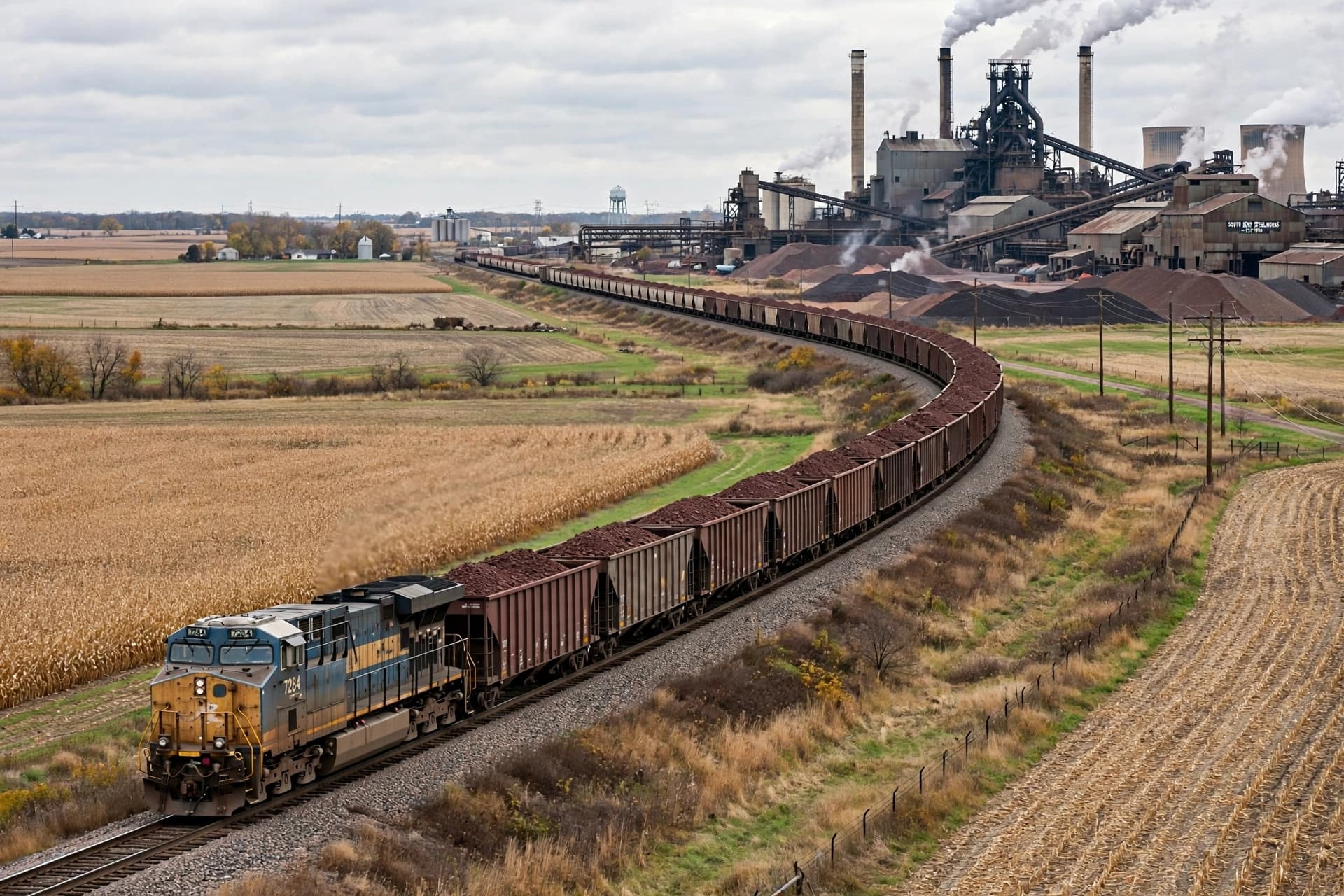
Across the American Midwest, industrial landscapes have long been shaped by the movement of raw materials. Iron ore leaves the mine, rail lines carry it toward processing facilities, and steel eventually emerges as a material for buildings, vehicles, machinery and infrastructure.
A new project announced in Iowa seeks to connect several parts of that chain in one large industrial system. Mesabi Metallics plans to build a steel mill in Iowa with an investment of about $15 billion, according to Reuters. The company recently opened a new iron ore mine in Minnesota, creating a supply route that would connect the two states.
The first phase of the Iowa project is expected to produce about 7.5 million tons of steel annually, with eventual capacity projected to reach 10 million tons. The White House has described the planned facility as the largest steel plant in U.S. history. Production is expected to begin in 2030.
Mesabi Metallics is owned by India-based Essar Group. The company's Minnesota operation is located in the Mesabi Iron Range, an area with a long history of iron-ore production. The new mine was described as the first new U.S. iron ore mine in roughly five decades.
The planned supply chain is notable because the raw material and steelmaking operations would be connected across state lines. Iron ore from Minnesota would be transported to Iowa, where the company plans to process it into steel. The arrangement would give the project a vertically integrated structure from mine to steel production.
The scale of the investment also brings a significant employment component. The first phase is expected to create at least 1,750 permanent jobs in Iowa and support as many as 6,000 construction jobs, according to figures cited by Reuters from the White House.
The project is being developed against a complicated background for the global steel industry. Steel producers have been dealing with excess capacity in some markets, particularly China, while demand has remained uneven. In the United States, domestic steel prices have also been influenced by trade measures affecting imported steel.
For Iowa, the proposed facility would add another major industrial presence to a state whose landscape includes agriculture, manufacturing, logistics and energy infrastructure. The plant would require extensive transportation, electricity and supporting services as construction moves forward.
The project is also tied to a wider effort to expand domestic industrial capacity. Its planned production would supply steel for sectors that rely heavily on large volumes of metal, including infrastructure, automobiles, energy and other manufacturing activities.
The path from an iron-ore mine in Minnesota to a steel mill in Iowa will take several years to complete. Construction, financing, transportation systems, equipment installation and regulatory processes will all shape the timetable. For now, the proposal remains a large industrial plan on paper, but its scale illustrates how the movement of raw materials can still reshape the economic geography of the American Midwest.
IMAGE DISCLAIMER
These visuals are AI-generated conceptual illustrations and are not photographs of the actual reported project.
SOURCES
Reuters The White House Mesabi Metallics Essar Group
Published by Banx Network. This article is part of the Banx decentralized media programme, powered by the BXE token on the XRP Ledger.