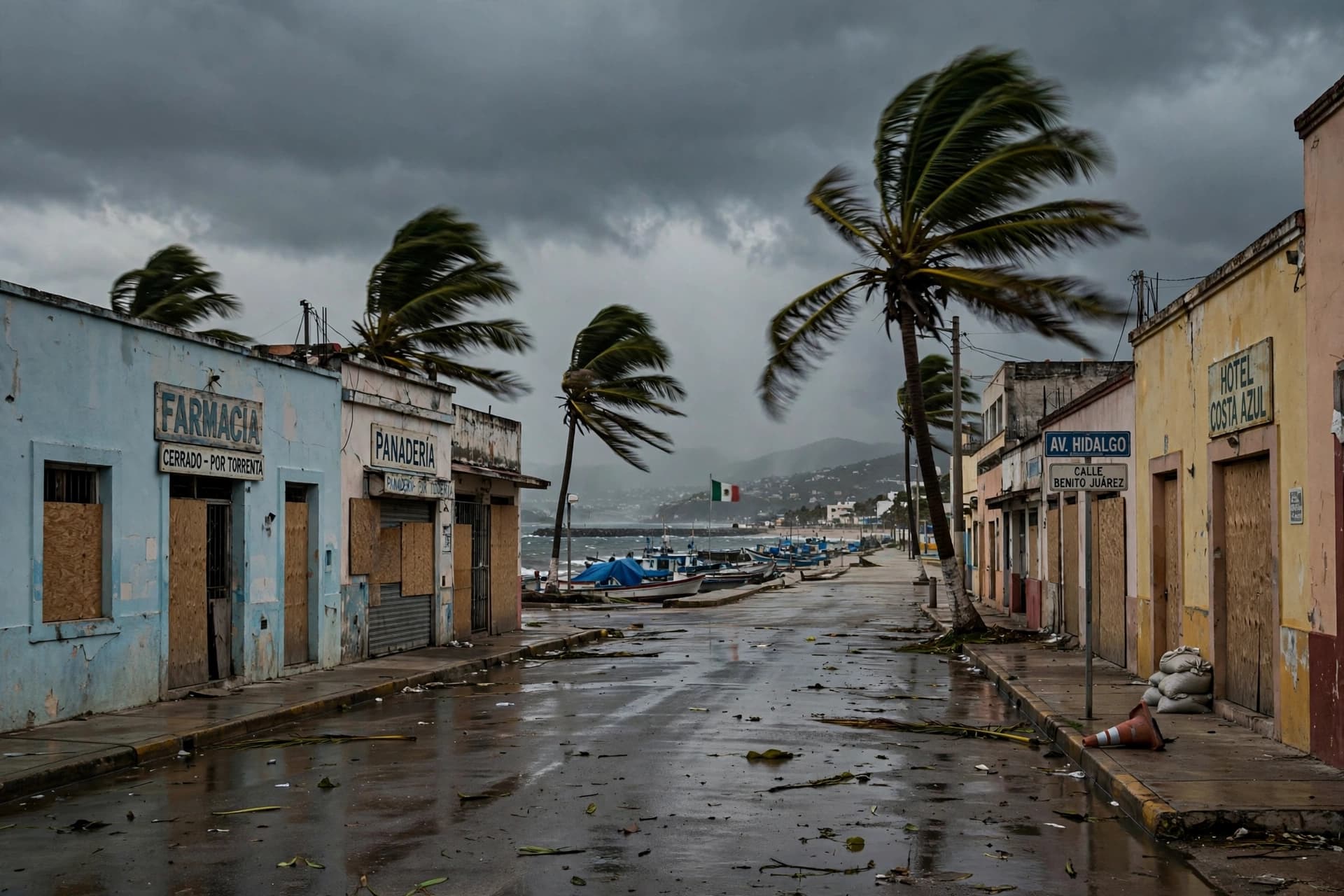
There is a particular stillness that settles over a coastal city when the sky begins to darken and the sea grows restless. In Puerto Vallarta this weekend, that stillness was everywhere—in the boarded windows of convenience stores, in the empty streets beneath overcast skies, in the quiet patience of people waiting for a storm they could not control but could prepare for. Hurricane Simon, a ferocious Category 4 system, was moving slowly toward Mexico's Pacific coast, and the question on every mind was not whether it would come, but where it would land.
Simon had strengthened to 155 mph by early Sunday, just below the threshold of a Category 5 storm. Its eye was positioned about 60 miles west-southwest of Manzanilla, moving north-northwest at a crawl of 6 mph . Forecasters at the National Hurricane Center warned that the storm's slow forward speed would allow it to dump enormous quantities of rain—10 to 20 inches across parts of southwestern Mexico, with isolated areas in Michoacan, Colima, and Jalisco potentially receiving up to 30 inches . That rainfall, the center noted, would produce "life-threatening flooding and mudslides, especially in areas of steep terrain" .
Jalisco state acted with quiet urgency. Classes were suspended on Friday and Monday across 22 coastal municipalities. Dozens of residents were evacuated from at-risk areas. The tourism sector in Puerto Vallarta—a destination popular with American visitors—was asked to ensure that workers and tourists alike had access to shelters or safe zones . By Saturday, hotels and businesses had boarded their windows, and the streets, usually thick with foot traffic, were largely empty.
For those who remained, the waiting carried its own texture. Jesús Gómez stood outside a shop, handing out free samples of candied peanuts to passersby, as if the ordinary rituals of life might hold the storm at bay. "Let's hope it doesn't hit us, right? That it doesn't affect us," he said. "We'll be working as usual throughout the day, but when Civil Protection officials come and tell us we need to close, then we'll close and take shelter until the storm passes" . Canadian tourist Ed Currie, with five days left of his vacation, took a simpler view: "Just stay in the hotel and look out the window hopefully. I just don't know what to expect" .
The hurricane center expected a dangerous storm surge along the coast near and to the east of where the center makes landfall, with large and destructive waves accompanying the surge . The storm's exact track remained uncertain—some models showed it moving inland over Jalisco within 24 to 36 hours, while others kept it just offshore, brushing along the coastline before weakening. Philippe Pappin, a senior hurricane specialist, said the eye was "basically moving very close or parallel to the coast," and that Cabo Corrientes, Mexico's westernmost tip, was most likely to receive a direct hit .
The uncertainty extended inland, where many Mexicans live in communities nestled between the Sierra Madre mountains and the ocean—housing that might not withstand a Category 4 hurricane. The heavy terrain could also weaken Simon as it approached, but forecasters cautioned that if the storm remained offshore, it could sustain its strength longer than predicted .
By Sunday morning, Simon's outer rainbands were already spreading across southwestern Mexico, and the storm's slow, deliberate approach meant that the worst was still to come. Jalisco officials had done what they could. Residents had done what they could. Now, there was only the waiting—and the hope that when the storm finally passed, the damage would be measured in property rather than lives.
AI Image Disclaimer: The visual elements in this article were created using artificial intelligence and are intended for illustrative purposes only, not as documentary records of the events described.
Sources: Associated Press, Georgia Public Broadcasting, The Canadian Press, National Hurricane Center, NOAA
Published by Banx Network. This article is part of the Banx decentralized media programme, powered by the BXE token on the XRP Ledger.