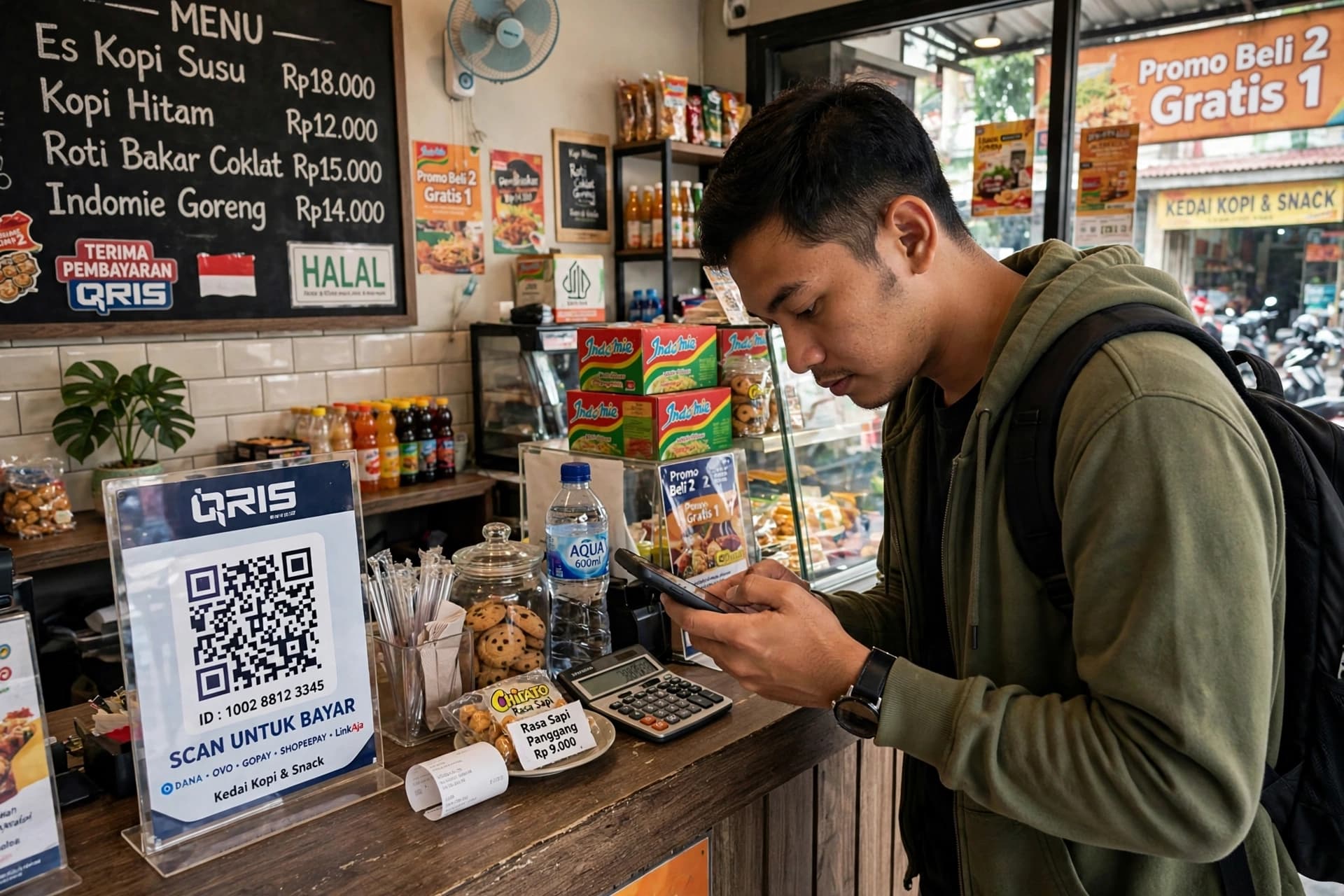
A small square of black-and-white patterns can now represent something much larger than a simple payment. On a phone screen or at a merchant counter, a QR code can connect consumers, banks and businesses without requiring the physical exchange of cash.
Indonesia’s Quick Response Code Indonesian Standard, or QRIS, has been moving gradually beyond the country’s borders. Bank Indonesia has signed agreements with Timor-Leste and Hong Kong as it works to expand cross-border payment connectivity. (bi.go.id)
The agreement with Banco Central de Timor-Leste was signed on September 25, while Bank Indonesia and the Hong Kong Monetary Authority signed a separate memorandum of understanding on September 24. Both arrangements provide a framework for cooperation in payment systems and digital financial innovation.
For Timor-Leste, the cooperation includes exploring the implementation of cross-border QRIS. Bank Indonesia has said that sandboxing is planned during 2026, with the cross-border service targeted for launch the following year. (thejakartapost.com)
The Hong Kong agreement similarly focuses on developing a framework for cross-border QR-code payments. Bank Indonesia and the Hong Kong Monetary Authority said the cooperation is intended to make cross-border payments faster, more affordable, transparent and inclusive. (bi.go.id)
The expansion comes after QRIS had already been connected with several other markets, including Malaysia, Singapore, Thailand, Japan, South Korea and China. With the new arrangements, Indonesia is extending the system into additional regional payment corridors.
The scale of existing activity gives some indication of how widely the system has been used. From its initial implementation in 2022 through July 2026, users from partner countries made about 21 million inbound QRIS transactions in Indonesia worth Rp5.9 trillion, according to Bank Indonesia data reported by The Jakarta Post. (thejakartapost.com)
For travelers, the significance is practical. A visitor who can use a familiar payment system abroad does not necessarily need to rely on cash or navigate an unfamiliar local payment process for every small transaction.
For merchants, particularly smaller businesses, greater payment connectivity can potentially make transactions with international visitors easier. The benefit depends on the technical and commercial arrangements established between financial institutions in each participating market.
Behind the simplicity of scanning a code are more complicated systems involving settlement, regulation, data exchange and financial institutions. Those systems must work reliably before a payment can appear almost instantly at a merchant counter.
The expansion of QRIS therefore represents more than another digital-payment feature. It reflects the gradual construction of financial connections between economies that increasingly interact through tourism, trade and digital commerce. A QR code may occupy only a few centimeters of a screen, but the network behind it continues to grow across national borders.
IMAGE DISCLAIMER
These visuals are AI-generated conceptual illustrations and are not photographs of the actual payment transactions.
SOURCES
Bank Indonesia The Jakarta Post Hong Kong Monetary Authority Banco Central de Timor-Leste
Published by Banx Network. This article is part of the Banx decentralized media programme, powered by the BXE token on the XRP Ledger.