
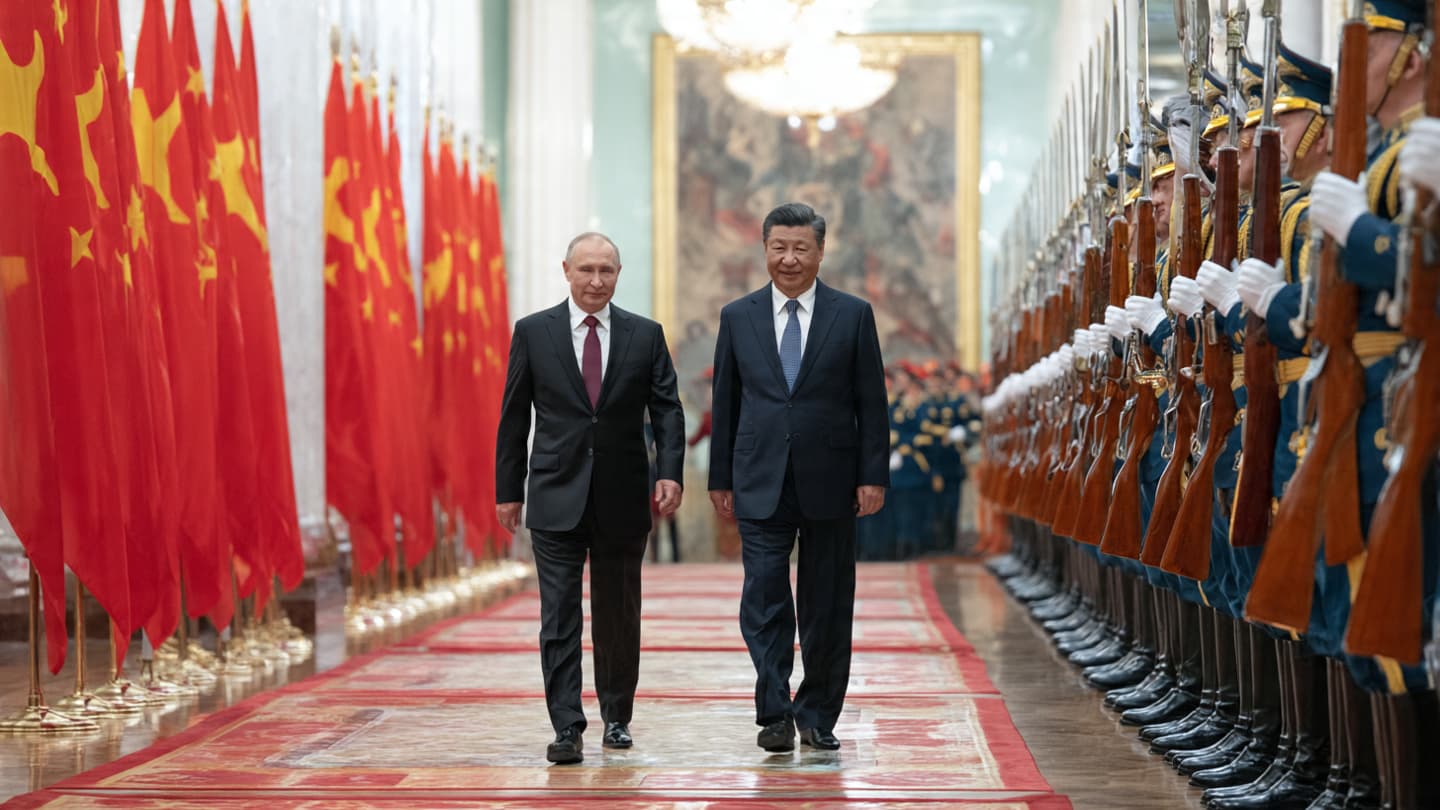
In Beijing, ceremony often arrives wrapped in stillness. Motorcades glide past wide boulevards lined with red flags, while the city’s ancient geometry — its walls, gates, and measured avenues — seems designed to absorb history without revealing too much of it. Beneath gray spring skies, visiting leaders move through carefully arranged halls where every gesture is deliberate, every photograph composed with quiet precision. Yet even within these displays of solidarity, there are silences that linger longer than the speeches themselves.
This week, Russian President Vladimir Putin arrived in China for another closely watched meeting with Chinese leader Xi Jinping, presenting an image of partnership at a moment when both nations continue defining themselves against American influence. Publicly, the visit carried familiar themes: strategic cooperation, economic coordination, opposition to what both governments describe as Western dominance, and promises of a “multipolar world.” State media in both countries emphasized friendship, stability, and shared resistance to external pressure. But beneath the choreography of unity, analysts say a quieter undercurrent persists — one shaped by caution, imbalance, and historical mistrust that neither side fully abandons.
The relationship between Moscow and Beijing has deepened considerably since Russia’s invasion of Ukraine in 2022. As Western sanctions isolated the Russian economy from Europe and North America, China became one of Moscow’s most critical economic lifelines. Trade between the two countries surged to record levels, driven largely by Russian energy exports and Chinese industrial goods. Pipelines stretching across Siberia now carry increasing volumes of oil and natural gas eastward, while Chinese companies have filled gaps left by departing Western manufacturers.
Yet partnerships forged through necessity often carry their own tensions. Russia increasingly depends on Chinese markets, financing, and technology in ways that subtly reshape the balance between the two powers. Analysts note that Moscow, once accustomed to projecting itself as an equal geopolitical counterweight to Beijing, now enters negotiations from a position weakened by war, sanctions, and economic strain. China, meanwhile, benefits from discounted energy supplies and expanded influence across Eurasia while remaining careful not to become entangled directly in Russia’s military confrontation with the West.
That caution has become one of the defining features of the modern China–Russia relationship. Beijing has avoided openly condemning Moscow’s war in Ukraine, frequently criticizing NATO and American policy instead. At the same time, Chinese leaders have also avoided providing the kind of overt military support that could trigger severe secondary sanctions or deeper confrontation with Europe and the United States. The result is a partnership that often appears strong in symbolism but measured in execution.
History also lingers quietly behind the diplomatic language. Though China and Russia speak often of friendship, the two countries spent decades during the Cold War locked in ideological rivalry and border tensions. The Sino-Soviet split of the 1960s transformed former communist allies into suspicious competitors, culminating in armed clashes along their shared frontier. Those memories remain embedded within strategic thinking on both sides, even if rarely acknowledged publicly.
Today, the imbalance between the two nations has become increasingly visible. China’s economy is now roughly ten times larger than Russia’s, giving Beijing enormous leverage within the relationship. In Central Asia — historically viewed by Moscow as part of its sphere of influence — Chinese infrastructure projects and investment initiatives continue expanding steadily through rail lines, trade corridors, and energy development. Some Russian nationalists and security figures quietly express concern that Moscow risks becoming the junior partner in a relationship it once imagined as equal.
Still, for both Xi and Putin, the strategic logic of cooperation remains powerful. Both governments view the United States as the dominant force shaping global pressure against them, whether through sanctions, military alliances, trade restrictions, or technological competition. Shared opposition to Washington has created a political gravity strong enough to overcome many underlying suspicions, at least for now.
During the visit, officials highlighted cooperation in artificial intelligence, energy, military exercises, and cross-border infrastructure. Diplomatic statements described the partnership as entering a “new era,” language that has become increasingly common in joint communiqués between the two capitals. Yet even as those declarations filled television screens and state newspapers, analysts observed how carefully each side continues protecting its own strategic flexibility.
In Beijing’s grand meeting halls, alliances are often presented as timeless, steady, and inevitable. But international relationships rarely move with such certainty. They shift gradually beneath the surface, shaped not only by shared interests but by memory, ambition, and unequal power. As Putin’s visit unfolded beneath the red banners and ceremonial handshakes, the partnership between Russia and China appeared both durable and fragile at once — strengthened by common rivals, yet shadowed by the quiet awareness that trust between great powers is rarely complete.
For now, Moscow and Beijing continue walking in parallel, joined by circumstance and strategy as much as by conviction. But beyond the official photographs and carefully measured speeches, the space between cooperation and caution remains very much alive.
AI Image Disclaimer: These visuals were produced with AI assistance and are intended as illustrative interpretations of real-world events.
Sources:
Reuters Associated Press Financial Times The New York Times Council on Foreign Relations
Note: This article was published on BanxChange.com and is powered by the BXE Token on the XRP Ledger. For the latest articles and news, please visit BanxChange.com