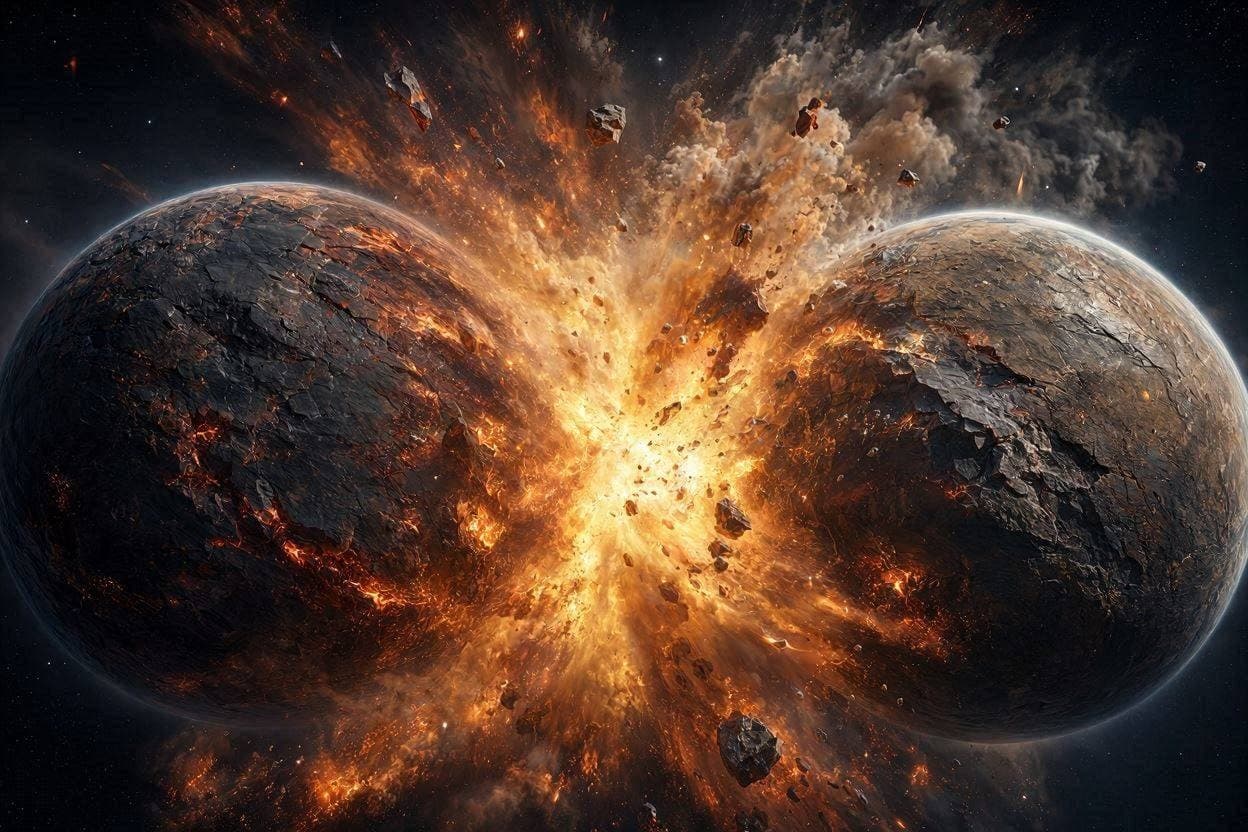
In the vast, silent theater of the cosmos, where stars burn with steady patience, sudden cataclysms occasionally punctuate the darkness. Astronomers have recently captured evidence of a rare and violent event: the collision of two planets in a distant star system. This cosmic crash, observed through subtle shifts in light and heat, offers a glimpse into the chaotic processes that shape planetary systems, echoing the turbulent origins of our own solar neighborhood.
Body: The discovery centers on a star named Gaia20ehk, located approximately 11,000 light-years away in the constellation Puppis. Initially appearing as an ordinary, unremarkable sun-like star, it began to exhibit erratic behavior in 2020, flickering wildly and dimming in unpredictable patterns. It was this unusual activity that caught the attention of researchers, including Anastasios Tzanidakis from the University of Washington, who were combing through archival telescope data for anomalies.
Further analysis revealed that the star’s brightness drops were accompanied by a significant increase in infrared radiation. This combination suggested the presence of a massive cloud of hot dust and debris, likely formed by the impact of two large rocky bodies. The energy released in such a collision would be immense, vaporizing rock and creating a glowing shroud that temporarily obscures the star’s light while radiating heat into space.
This event is reminiscent of the theoretical collision between Earth and a Mars-sized body named Theia, which is believed to have formed our Moon billions of years ago. By observing a similar process in real-time, albeit from a great distance, scientists can refine their models of planetary formation and evolution. It provides a rare opportunity to study the dynamics of giant impacts, which are thought to be common in the early stages of star systems but rarely witnessed in mature ones.
The role of advanced telescopes and data processing algorithms cannot be overstated in this discovery. Instruments capable of detecting minute changes in brightness and spectral composition allow astronomers to piece together events that occur too far away to be seen directly. The collaboration between ground-based observatories and space missions ensures a comprehensive view of these transient phenomena.
For the field of astrobiology and the search for extraterrestrial intelligence, such findings are crucial. Understanding the frequency and nature of planetary collisions helps assess the stability of habitable zones. While this specific event was destructive, it highlights the dynamic environment in which planets exist, influencing their potential to support life over geological timescales.
The scientific community continues to monitor Gaia20ehk, expecting the dust cloud to gradually dissipate over time. As the debris settles, the star may return to its previous state, or the aftermath may reveal new structures, such as a ring system or a merged planet. Each observation adds a piece to the puzzle of how planetary systems evolve from chaos to order.
Closing: As the dust settles on this distant cosmic event, the data collected will inform our understanding of planetary science for years to come. The observation serves as a powerful reminder of the violence and beauty inherent in the universe’s ongoing creation.
AI Image Disclaimer: The visual content accompanying this article is AI-generated for illustrative purposes and does not depict actual footage of the exoplanet collision.
Sources: SETI Institute ScienceDaily Space.com University of Washington
Published by Banx Network. This article is part of the Banx decentralized media programme, powered by the BXE token on the XRP Ledger.