
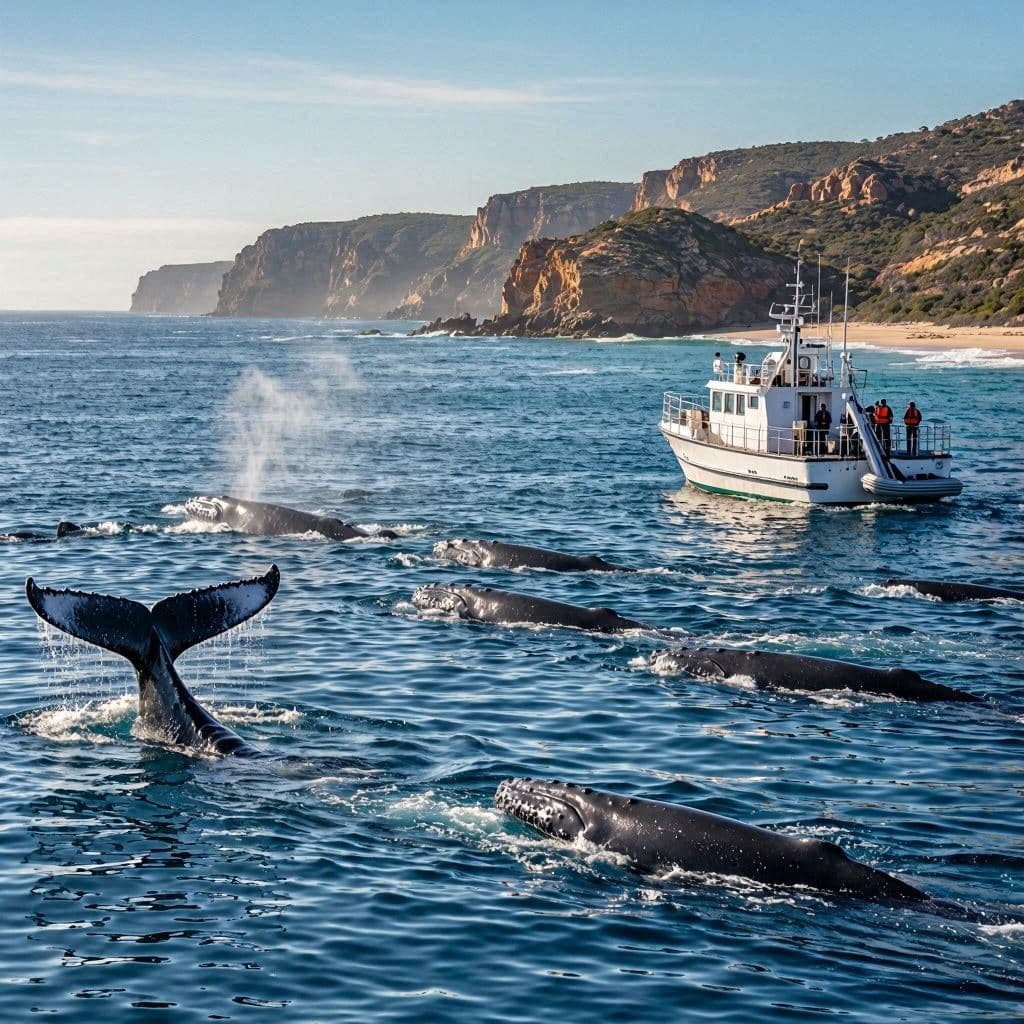
Nature often speaks in quiet changes rather than dramatic moments. Sometimes the most meaningful signal is not what suddenly appears, but what gradually becomes absent. Along Australia's southwest coastline, marine scientists are carefully studying one such silence after a recent whale census recorded a significant decline in sightings during the annual migration season.
The survey, conducted by researchers and experienced volunteers, found that migrating whales were observed far less frequently than in previous years. While annual fluctuations are not unusual, scientists noted that the latest decline was substantially greater than expected, prompting closer investigation into possible environmental influences.
Researchers emphasize that the findings should not immediately be interpreted as evidence of a shrinking whale population. Migration patterns can be affected by numerous factors, including ocean temperatures, food availability, changing currents, and weather conditions that influence the routes whales choose during their long journeys.
Marine biologists are now comparing this year's observations with historical records collected over several decades. Long-term monitoring allows researchers to distinguish between natural variations and emerging trends that may require conservation attention. Such data has become increasingly valuable as ocean ecosystems continue to evolve under changing environmental conditions.
The southwest coast of Western Australia has long served as one of the country's most important observation points for migrating whales. Every season, both researchers and visitors gather along the coastline to witness the remarkable migration that stretches across thousands of kilometers. A noticeable reduction in sightings therefore attracts scientific as well as public interest.
Scientists are also examining whether prey distribution may have shifted farther offshore, encouraging whales to travel beyond traditional observation areas. Advances in satellite monitoring, acoustic sensors, and aerial surveys may help determine whether the animals have simply altered their migration routes rather than disappearing altogether.
Conservation organizations stress that continued monitoring remains essential before drawing broader conclusions. Population health is best understood through multiple years of consistent scientific observation rather than a single season. Researchers intend to continue gathering evidence throughout future migration cycles.
Australia has invested heavily in whale conservation over recent decades, with many whale populations showing encouraging recovery after the end of commercial whaling. The current decline in sightings therefore represents an important scientific question rather than confirmation of population loss.
For now, researchers remain focused on understanding the reasons behind the unexpected census results. Their work reflects the careful patience that defines modern science—recognizing that protecting wildlife begins with understanding the stories the natural world quietly tells.
AI-generated image disclaimer: This illustration was generated using AI to visualize migrating whales and is intended for editorial purposes only.
Published by Banx Network. This article is part of the Banx decentralized media programme, powered by the BXE token on the XRP Ledger.


