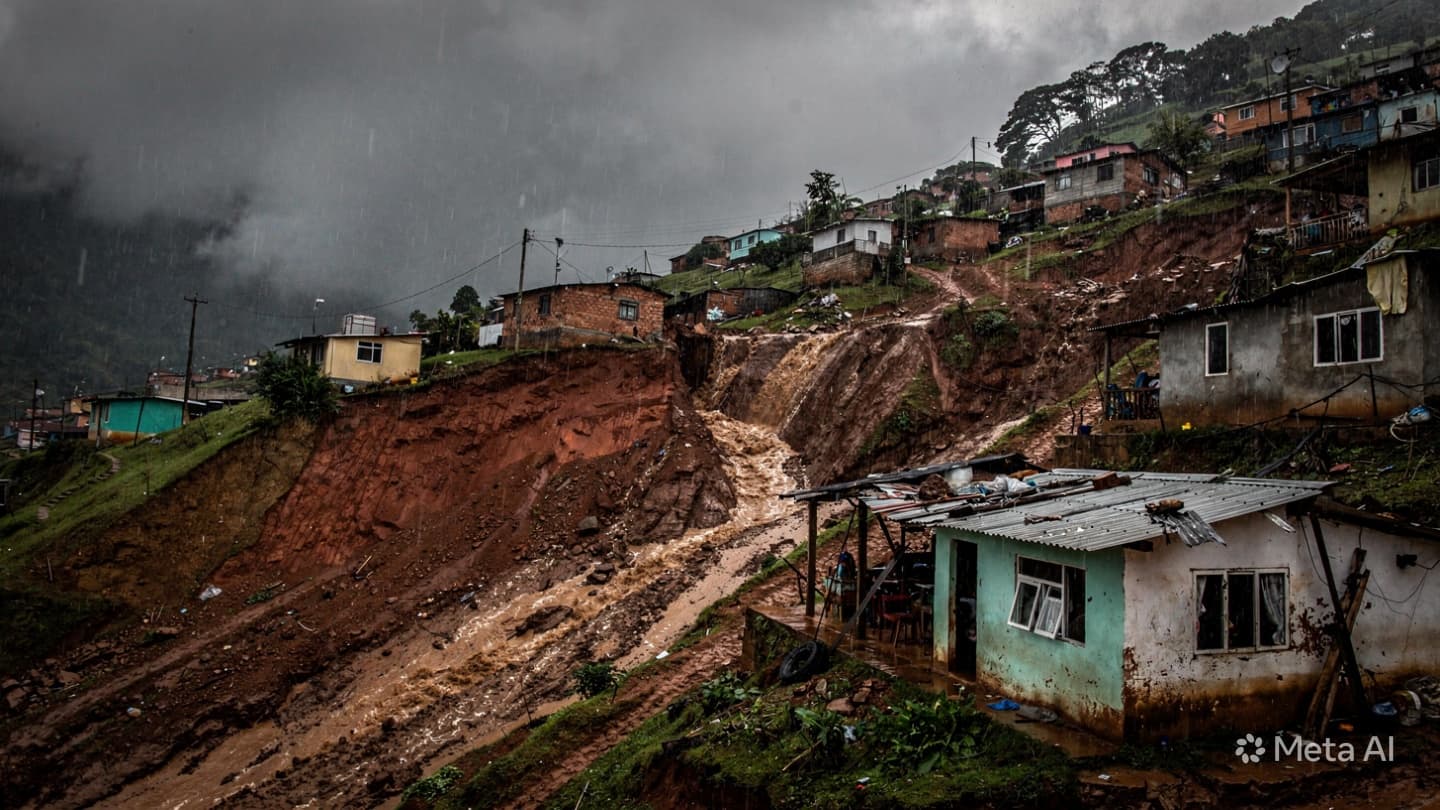
The coastal city of Pemba is defined by its dramatic contours, where steep hillsides of red earth slope downward toward the brilliant blue of the bay. But when the sky turns a heavy, unbroken gray for days on end, those picturesque slopes lose their stability, transforming from solid ground into a heavy, fluid threat. The torrential downpours that characterize the height of the season do not merely wash over the city; they soak deep into the soil, weighting it down until the earth itself can no longer hold its own posture.
To live on the hillsides of Pemba’s informal neighborhoods is to exist in a permanent state of negotiation with gravity and the weather. Houses built of mud brick, scrap timber, and corrugated iron cling to the steep inclines, separated by narrow pathways that double as drainage channels during the rains. When the water falls continuously, without intermission, the quiet saturation of the soil proceeds invisibly beneath the floorboards, softening the foundations until the structure becomes a trap.
The collapse of a house under the weight of water is a sudden, muffled tragedy, occurring often in the deep hours of the night when families are asleep. The earth gives way with a heavy, sliding roar, burying rooms beneath a weight of mud and debris before anyone can reach the threshold. In the aftermath, the neighborhood awakens not to the sound of alarms, but to the frantic, rhythmic scraping of plastic shovels and bare hands digging into the wet clay.
The loss of life in these steep sectors brings a specific, heavy silence to the community, a collective mourning that takes place amidst the ongoing downpour. Neighbors gather beneath umbrellas and pieces of plastic sheeting, watching the recovery efforts with wet faces that show no distinction between tears and rain. Each house lost represents more than a structural failure; it is the destruction of a life's savings and the fracturing of a family unit.
The city's infrastructure, designed for a smaller population and more predictable weather patterns, finds itself completely overwhelmed by the volume of runoff. Main avenues are transformed into rushing rivers that carry the debris of the hillside neighborhoods down toward the sea, leaving behind thick deposits of silt and garbage. The lower districts of the city sit in a state of stagnant inundation, their drainage channels choked with the refuse of the upper slopes.
Emergency responders struggle to reach the hardest-hit neighborhoods, their vehicles slipping on the steep, unpaved inclines that have been turned into rivers of red mud. Much of the rescue work must be done by the community itself, with young men forming human chains to move heavy debris and clear the paths so that medical teams can eventually walk in on foot. This collective effort is heroic, but it is born of a desperate lack of alternatives.
For those whose homes still stand on the edge of the landslide zones, the remaining days of the storm are spent in a state of watchful terror. Every creak of a timber or shift in the floor causes families to look toward the door, ready to run into the downpour at the first sign of a landslide. The comfort of shelter is completely erased, replaced by the realization that the walls meant to protect them are themselves vulnerable to the changing earth.
As the rain finally thins to a steady drizzle, the hillsides of Pemba appear scarred and broken, patches of raw red earth exposed where homes and families once stood.
In meteorological and administrative reports, it was confirmed that recent unseasonably high rainfall totals triggered multiple structural failures and fatal landslides in Pemba's high-density neighborhoods. Municipal authorities have urged residents on vulnerable slopes to seek temporary shelter in public buildings until geological stability can be verified. Humanitarian groups are currently distributing emergency shelter kits and basic provisions to the affected families.
Published by Banx Network. This article is part of the Banx decentralized media programme, powered by the BXE token on the XRP Ledger.