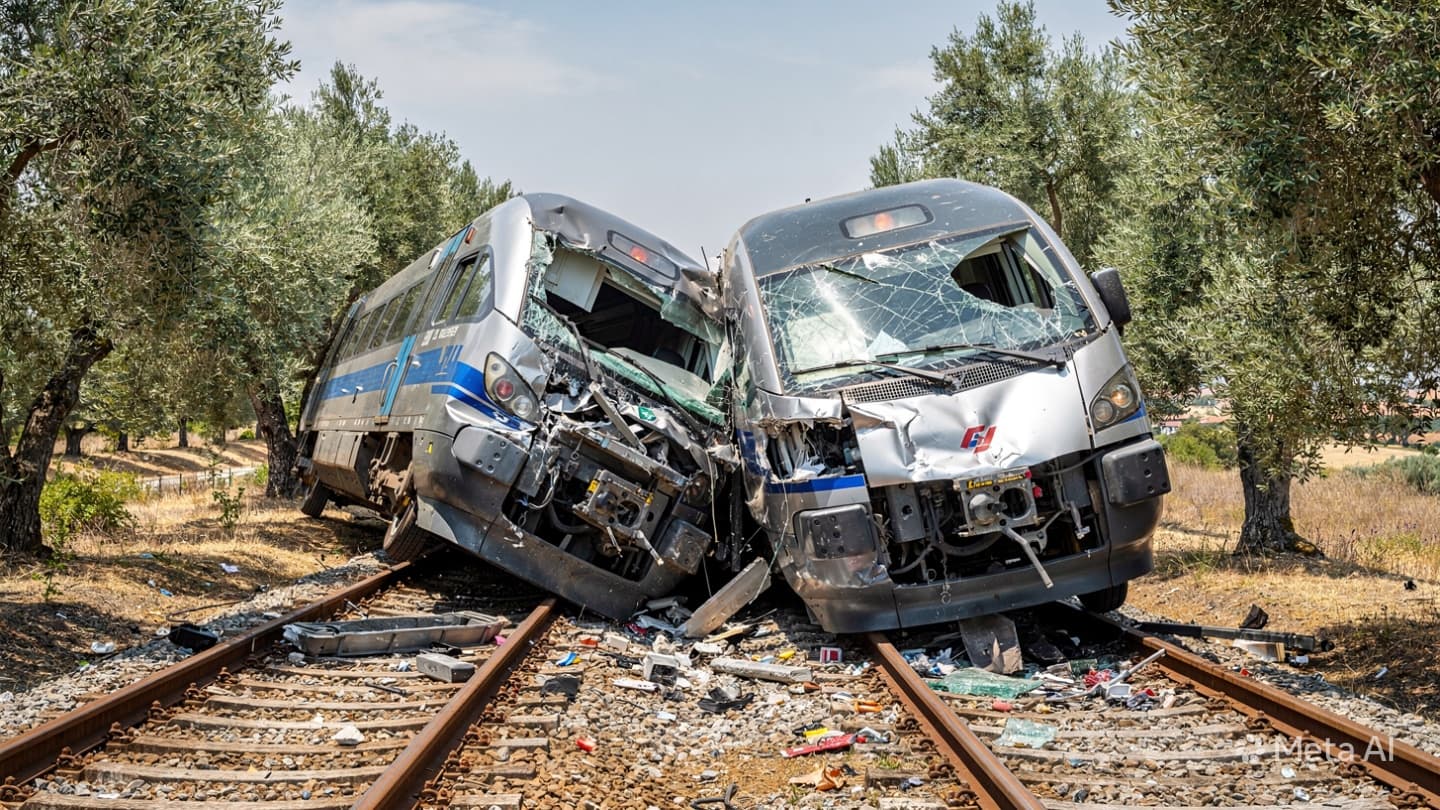
Bari, Italy—A catastrophic head-on collision between two passenger trains traveling along a single tracking line left five railway operators dead early Thursday morning. The accident occurred at approximately 6:12 a.m. on a rural stretch of rail connecting small agricultural municipalities north of Bari. The sheer velocity of the impact completely compressed the leading aluminum carriages of both trains, scattering heavy metal fragments across adjacent olive groves and pinning crew members inside the wreckage.
National emergency squads and volunteer regional fire brigades rushed to the rural coordinates, setting up an inflatable field triage station in an adjacent field. Technicians utilized heavy hydraulic cutters, metal saws, and high-pressure jacks to breach the mangled driver cabins. Medical personnel confirmed that four operators died instantly from the massive physical forces, while a fifth worker succumbed to internal injuries before transport teams could stabilize him.
The chief prosecutor for the district arrived at the collision site by mid-morning to open a formal judicial inquiry. He confirmed that no passengers were killed, though twenty-eight commuters are undergoing treatment for moderate injuries and shock. The deceased were all veteran transit employees, including both train conductors and three on-duty technical operators who were positioned in the forward engineering bays.
Local infrastructure analysts noted that the specific regional corridor still relies on an outdated telephone-based traffic authorization mechanism rather than modern automated tracking software. Preliminary data indicates one of the commuter trains departed a nearby terminal minutes ahead of its scheduled window, entering the single-track zone directly into the path of the incoming express service.
A specialized mechanical engineer reviewing the damaged undercarriages noted that neither train showed significant brake-pad friction wear on the main rotors. This absence of damage suggests that thick morning fog rolling across the low plains reduced visibility to the point where the bridge crews did not see the opposing headlight beams until moments before the impact occurred.
Grieving family members and local transport union representatives gathered outside the regional transit authority's administrative office in Bari, demanding immediate upgrades to the southern rail network. Union leaders stated that they have staged three separate walkouts over the past two years to protest the government's continued delay in installing digital safety override transponders along single-track rural routes.
The Ministry of Infrastructure and Transport ordered an immediate temporary closure of the entire regional transit line to allow investigators to download the internal data logs from the heavily damaged black boxes. The closure suspended daily commuter transport for thousands of suburban workers, forcing regional planners to deploy an emergency fleet of transit buses to handle the traffic.
Legal experts representing the victims' families announced they are preparing a class-action filing against the private regional track management firm for failing to enforce basic tracking protocols. They argue that the company's reliance on manual human dispatch signals on an active multi-train line represents an unacceptable operational risk.
Salvage crews are currently deploying heavy rail-mounted cranes to lift the locked chassis units off the cracked steel ties. The extraction work remains highly tedious, as technicians must continually anchor the unstable, vertical metal hulls with steel cables to prevent them from sliding into the deep drainage ditches running parallel to the line.
Published by Banx Network. This article is part of the Banx decentralized media programme, powered by the BXE token on the XRP Ledger.