
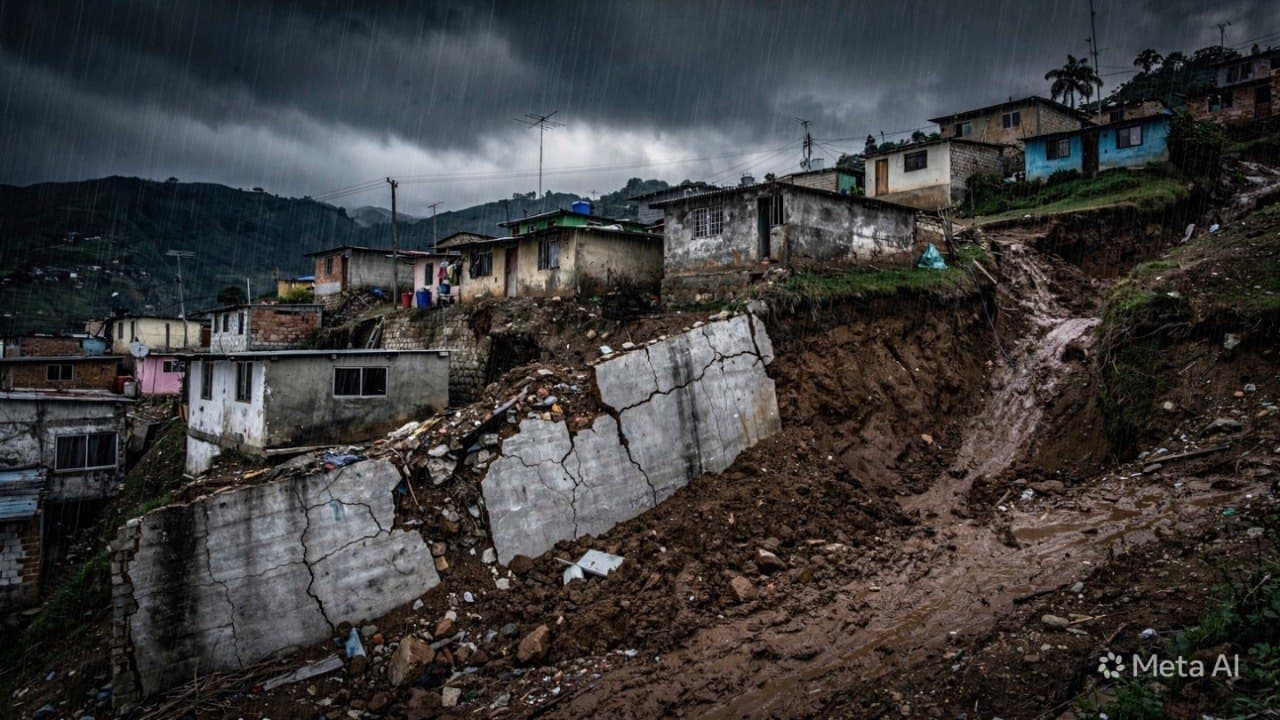
The landscape of Comayagüela, the historic twin city to Honduras’s political capital, is a dense, undulating terrain where urban expansion has long outpaced institutional planning. Along the steep, heavily populated hillsides that define its peripheral districts, thousands of families have anchored their modest homes into the precarious slopes, constructing lives from breeze blocks, wood, and sheets of zinc. This vibrant, hard-scrabble metropolis thrives on an relentless human energy, its narrow alleys echoing with the sounds of daily domestic routines and informal commerce. Yet, the very geography that shelters these communities carries an inherent structural precarity, waiting for the seasonal rains to expose the fragile boundary between stability and collapse.
For the residents of these destitute districts, the arrival of the winter rainy season is never merely a meteorological transition; it is a period of intense, collective vulnerability. The soil composition of the Comayagüela hillsides—dominated by loose clay and highly weathered volcanic ash—is highly susceptible to hydrostatic pressure when subjected to prolonged saturation. When the infrastructure lacks formalized storm drainage, descending rainwater transforms simple walkways into active watercourses, carving deep fissures into the earth and undermining the shallow foundations of adjacent dwellings. The danger accumulates quietly over days of gray skies, saturating the earth until the landscape can no longer support its own weight.
This environmental friction reached a critical threshold during recent torrential downpours, triggering severe soil erosion and a series of sudden structural collapses across the most vulnerable neighborhoods. The earth beneath several residential clusters gave way with an absolute, unyielding momentum, carrying away retaining walls and causing the partial or total destruction of modest family homes. The events unfolded with a terrifying quietness, marked only by the sudden snapping of timber and the low rumble of shifting earth as hillsides sloughed into the valleys below. In an instant, decades of incremental family investment were transformed into dangerous piles of debris.
The aftermath of these structural failures presents a stark visual landscape of domestic displacement and urgent neighborhood solidarity. In communities where emergency municipal assistance is often slowed by narrow, blocked access roads, the immediate burden of rescue and stabilization falls squarely onto the shoulders of the neighbors themselves. Shovels, buckets, and bare hands are used to clear mud from buried doorways and reinforce remaining structures with whatever materials can be salvaged from the slide sites. This spontaneous coordination reflects a profound communal resilience, but it also underscores the deep institutional vacuum that characterizes life on the urban periphery.
Inside the makeshift shelters established in local community centers, the atmosphere is heavy with a quiet, exhausted grief as families contemplate the loss of their physical anchor. The destruction of a home in these sectors is often an economic catastrophe from which recovery is exceptionally difficult, as residents possess no formal insurance and limited access to institutional credit. Mothers watch over salvaged bundles of clothing while community elders speak in low tones about the long-term viability of their neighborhoods, aware that the underlying geologic instability remains unchanged by the passing of the immediate storm.
The situation in Comayagüela highlights a broader, systemic urbanization crisis facing many developing capitals across Central America, where economic migration forces the poorest populations onto land that is fundamentally unfit for human habitation. Urban planners point out that the historical deforestation of the surrounding watersheds, combined with unregulated informal construction, has systematically dismantled the natural root networks that once stabilized these steep inclines. Without a comprehensive, state-funded program to stabilize slopes, install engineered retaining walls, and provide safe, alternative housing options, these districts remain locked in a destructive cycle of seasonal disaster.
Furthermore, the structural precarity of these hillsides is compounded by the lack of basic water and sanitation infrastructure, as leaking informal pipes continuously inject moisture into the subterranean layers, accelerating the process of internal soil liquefaction. The collapses are therefore not entirely natural disasters; they are the physical manifestation of long-standing socioeconomic neglect and structural inequality etched directly into the topography of the city.
In the wake of the latest neighborhood collapses, regional civil defense units and municipal engineering teams have begun conducting structural risk assessments across the affected Comayagüela sectors, marking dozens of additional properties with emergency evacuation notices. Local administrative authorities confirmed that temporary relocation assistance is being organized for those displaced, though permanent solution frameworks remain constrained by severe budgetary limitations. Specialized geologists have warned that the upper slopes remain highly unstable, posing an ongoing threat should the rainfall persist into the coming week. For now, the residents keep a watchful eye on the gray clouds above, listening closely to the deep, silent shifts of the hill beneath their feet.
Note: This article was published on BanxChange.com and is powered by the BXE Token on the XRP Ledger. For the latest articles and news, please visit BanxChange.com