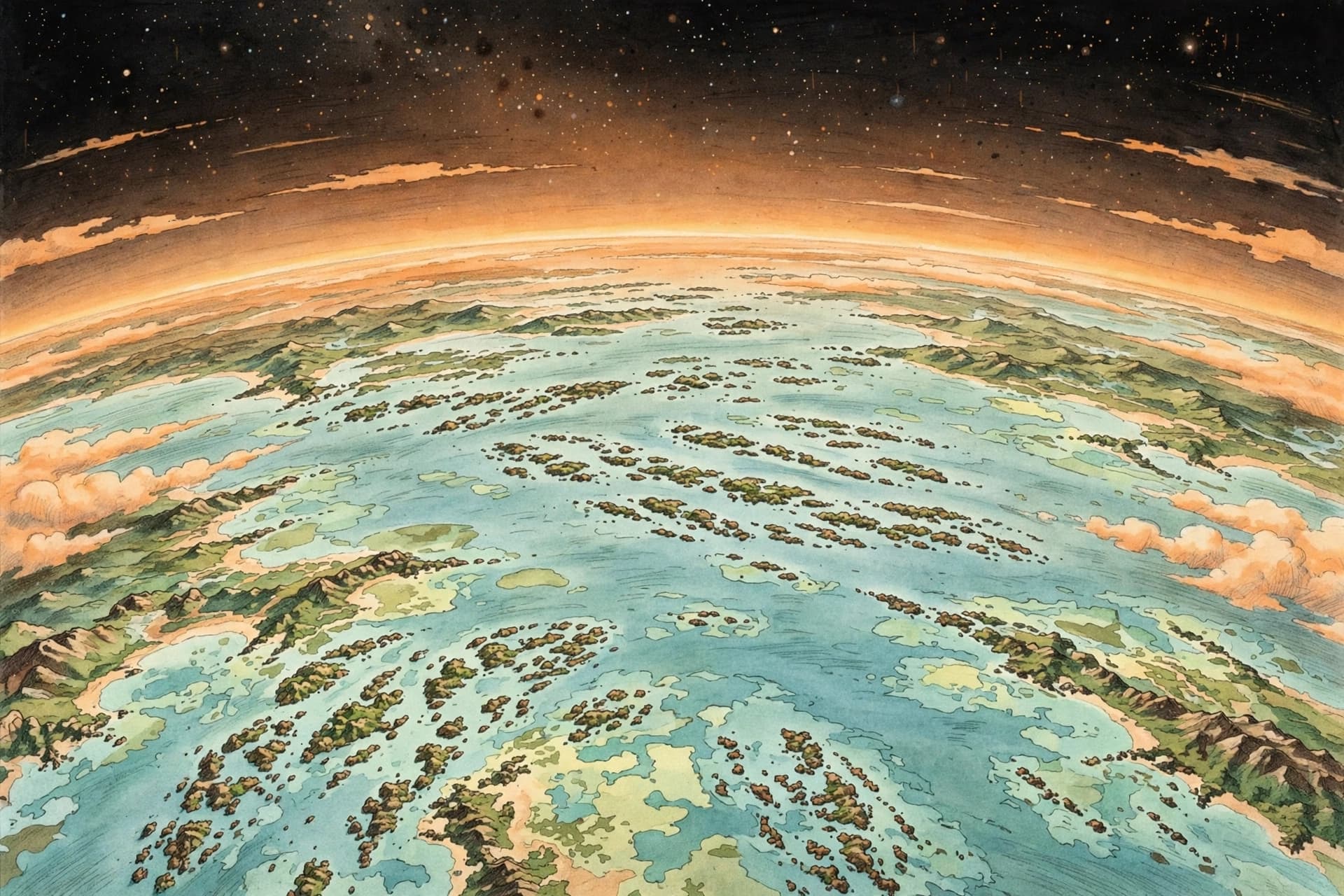
Across the Atlantic skies, where telescopes trace faint patterns of ancient light, the universe sometimes appears to fold time into color. The Crystal Ball Nebula offers such a moment—a delicate structure where the end of a star becomes a glowing artifact suspended in darkness. It is a reminder that even endings in space can unfold with remarkable visual poetry.
Astronomers studying planetary nebulae like the Crystal Ball Nebula often describe them as the final expressive phase of medium-sized stars. As these stars exhaust their nuclear fuel, they shed outer layers into space, forming expanding shells of gas that are later illuminated by the remaining stellar core. Over time, these structures evolve into intricate patterns shaped by stellar winds and radiation.
Observations from space-based and ground-based telescopes reveal that these nebulae are not uniform in shape. Instead, they display rings, lobes, and layered structures that suggest complex interactions between stellar rotation, magnetic fields, and surrounding interstellar material. Each structure acts like a frozen imprint of physical forces at work during the star’s final stages.
In the case of the Crystal Ball Nebula, its luminous symmetry draws particular scientific interest. The clarity of its shell-like formation allows researchers to study how ionized gas expands and cools over time. These measurements help refine models of stellar aging and chemical enrichment in galaxies.
Such nebulae also play a quiet but important role in cosmic recycling. The material expelled from dying stars eventually disperses into interstellar space, contributing to the formation of new stars and planetary systems. In this sense, stellar death becomes part of a continuous cycle of renewal.
The study of these objects is supported by a long tradition of astronomical observation, including contributions from institutions such as the and the . Their telescopes and imaging missions provide the clarity needed to observe these faint but structurally rich formations.
As data accumulates, scientists continue to refine their understanding of how different stellar masses produce different nebular outcomes. Even small variations in initial conditions can lead to strikingly different cosmic sculptures.
The Crystal Ball Nebula, like many stellar remnants, invites a quiet reflection on transformation rather than disappearance. It shows that in the universe, endings are often reshaped into new forms of light and structure, still telling stories long after the original star has faded.
AI Image Disclaimer Some visuals associated with this topic may be AI-generated for illustrative and educational purposes.
Source Verification Check NASA, ESA, The Astrophysical Journal, Nature Astronomy, Monthly Notices of the Royal Astronomical Society
Published by Banx Network. This article is part of the Banx decentralized media programme, powered by the BXE token on the XRP Ledger.