
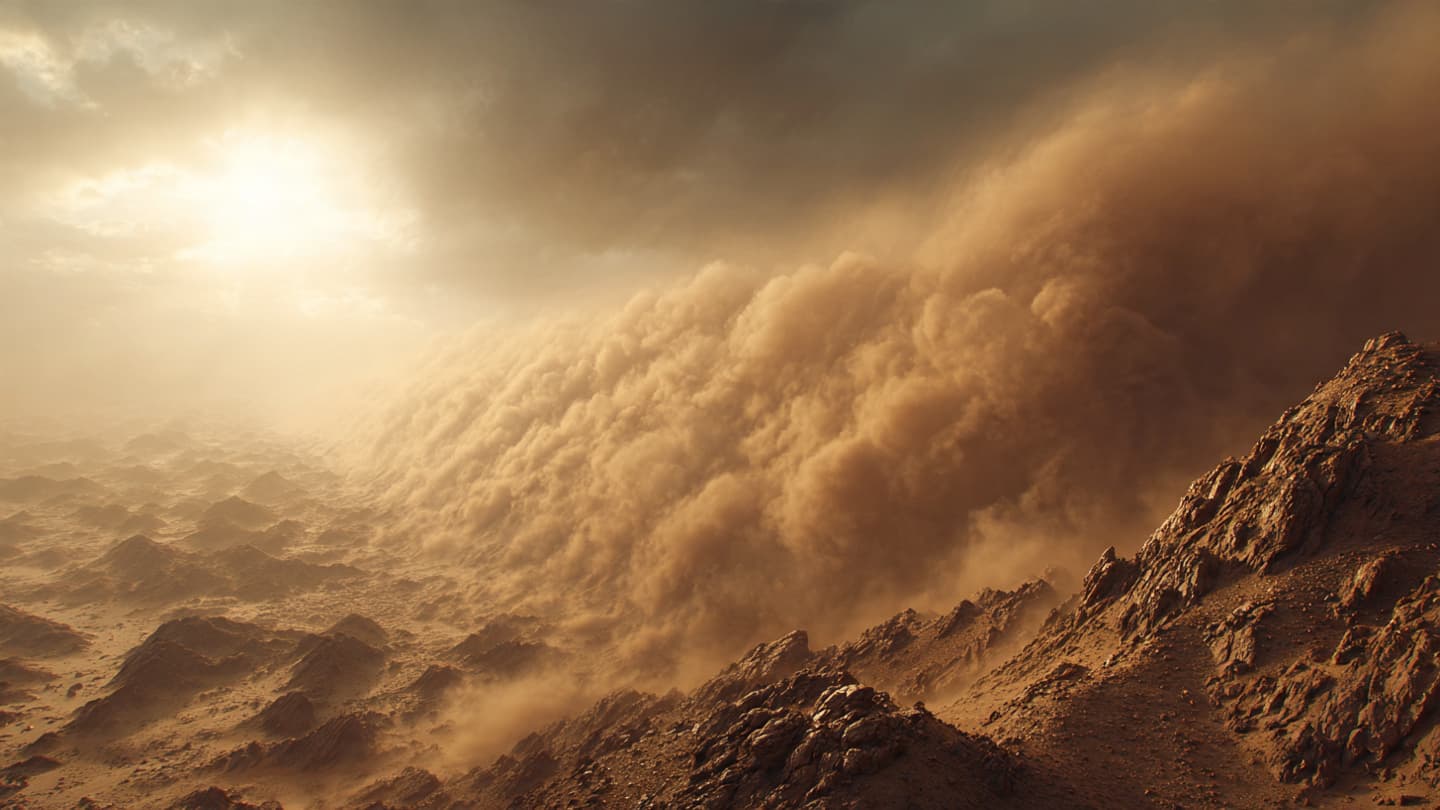
The Gobi Desert has long possessed a voice composed of silence and shifting grit, an ancient expanse that reminds the observer how fragile the human presence remains against the slow movements of the planet. In the early hours of spring, a quietude usually rests over the vast Mongolian steppes, broken only by the low whistle of a northern gale as it begins its descent from the Siberian fringes. Yet, when the atmosphere shifts, the earth itself rises to join the sky, transforming the horizon into an indigo and amber canvas that swallows the sun whole. It is an annual reawakening, a season where the boundary between land and air becomes entirely fluid, blurring the edges of the visible world.
To stand before the advancing front of a desert dust storm is to witness the slow erasure of distance. The rolling dunes, which under normal skies offer a predictable geometry of shadow and light, disappear beneath an incoming tide of particulate suspension that turns midday into an eerie, copper-tinted dusk. The wind does not merely blow; it carries the weight of a million shattered mountains, distributed evenly across thousands of miles of open space. In this muted light, the vastness of the desert feels compressed, drawn tight around the few solitary settlements that dot the arid valleys, rendering them isolated islands in a sea of moving earth.
There is a profound restlessness to this airborne migration, a reminder that the desert is never truly still, even when it appears frozen in time. As the low-pressure systems of the Mongolian cyclone intensify, they act as a grand atmospheric loom, weaving the fine topsoil of southern provinces into vast plumes that travel far beyond their geographic birthplace. The particles, lifted high into the upper troposphere, begin a long and indifferent journey eastward, indifferent to the national borders and urban grids that wait below. What began as a quiet displacement of sand in a lonely soum becomes a shared atmospheric inheritance for hundreds of millions of people.
In the settlements that line the desert's edge, life retreats indoors, behind heavy wooden doors and fabric flaps that strain against the pressure of the gale. The air inside takes on the dry, mineral taste of the deep wilderness, an inescapable sensory reminder of the landscape outside. For those who watch from windows, the familiar landmarks—a lone telephone pole, a distant cluster of hills, the silhouette of a passing vehicle—are swallowed one by one by the encroaching fog of silt. It is a reminder of the absolute authority of natural cycles, which can suspend the normal rhythms of commerce and community with a single atmospheric gesture.
As the hours stretch into days, the heavy particulate blanket settles over the regional towns, bringing with it a quietude that is both beautiful and unsettling. The sun appears only as a pale, featureless disc, stripped of its warmth and brilliance, casting no distinct shadows upon the ground. This filter alters the very psychology of the landscape, inducing a collective stillness among the inhabitants who wait for the wind to exhaust its strength. The heavy air hangs over the valleys like an unfinished thought, a physical manifestation of the desert’s reaching arm, extending its environmental reality into the clean spaces of the modern world.
Yet, science reminds us that even this seemingly chaotic displacement is tied to a larger, fluctuating ledger of environmental health. Decades of shifting grazing patterns, variable spring precipitation, and the slow expansion of parched soil have altered the frequency with which the Gobi sheds its outer layer. When the vegetation fails to take root in the dry spring earth, the wind finds no resistance, lifting the unprotected soil with an ease that grows more pronounced with each passing cycle. The dust becomes an indicators of the land’s underlying vulnerability, a visible signal sent from the remote interior to the crowded coastlines of the continent.
When the wind finally loses its momentum, the descent of the dust is slow and methodical, coating everything in a fine, uniform layer of pale yellow silt. It settles upon rooftops, vehicle windshields, and the branches of sparse saxaul trees, a silent testament to the storm that has passed. The air gradually regains its transparency, but the landscape remains permanently altered, its colors muted by the microscopic debris left behind in the wake of the gale. It is a transformation that requires no dramatic conclusion, merely a gradual return to the baseline of desert survival.
In the days that follow, the regional communities emerge to sweep away the remnants of the sky, clearing the fine sand from porches and footpaths in a ritual as old as the settlements themselves. The crisis dissolves not with a sudden clearance, but with the patient work of human hands restoring order to a disrupted routine. The Gobi returns to its quiet state, its horizon expanding once more into the familiar blue clarity that defines the high plateau, leaving only the memory of the golden cloud that briefly united the earth and the heavens.
Note: This article was published on BanxChange.com and is powered by the BXE Token on the XRP Ledger. For the latest articles and news, please visit BanxChange.com