The morning of Eid has often arrived like a familiar melody across Gaza’s crowded neighborhoods — the scent of bread rising before dawn, children polishing shoes beside narrow hallways, and prayers flowing softly from mosques before the streets awaken. Yet this year, the rhythm feels distant, as though the holiday itself hesitated before crossing into rows of worn tents and broken concrete.
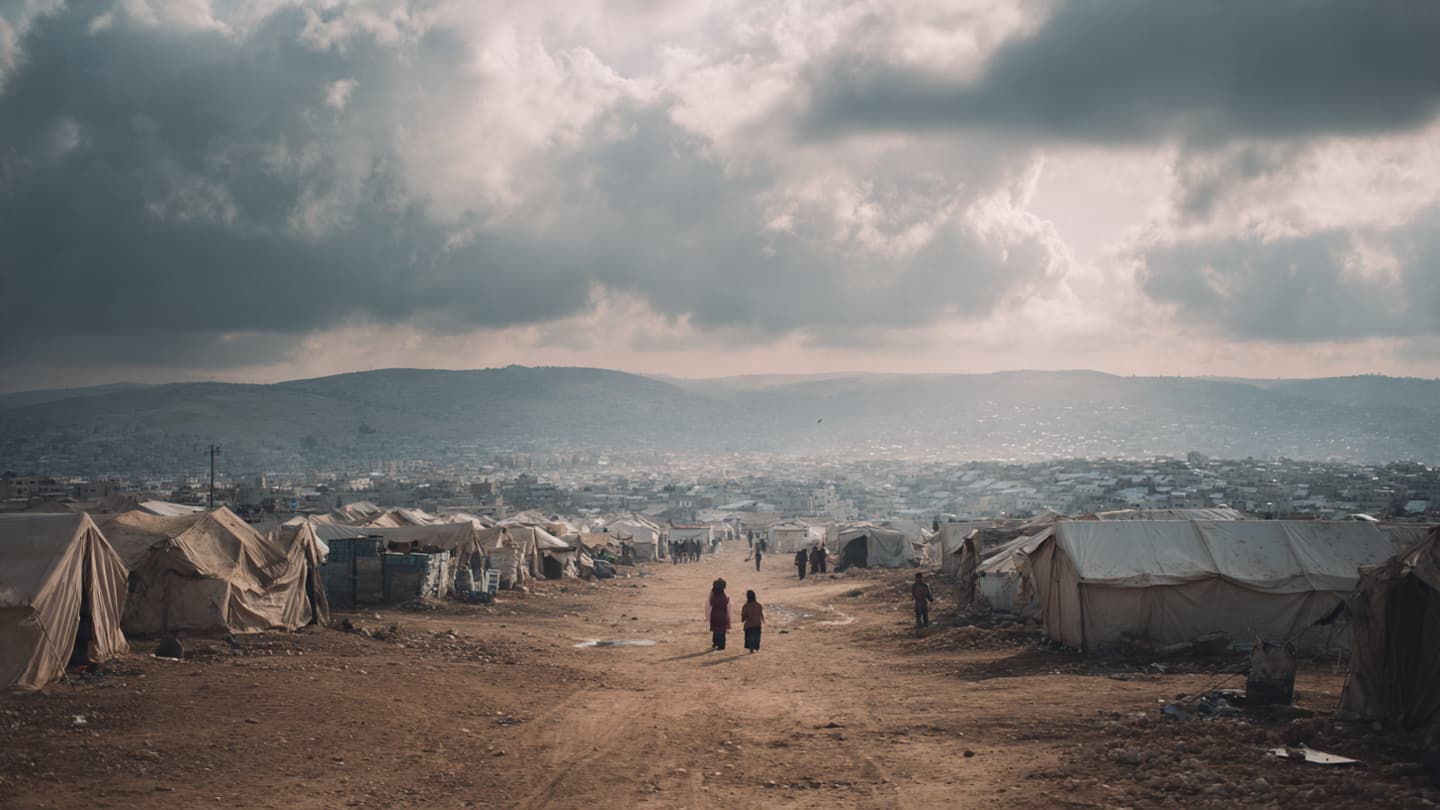
Across displacement camps scattered through Gaza, families marked the sacred occasion not with abundance, but with remembrance. In places where homes once stood, cloth shelters now bend against the wind, carrying the sounds of exhaustion more than celebration. Parents speak quietly about children asking for new clothes or sweets, requests that once felt ordinary but now drift beyond reach like smoke disappearing into a gray sky.
The war has reshaped not only buildings and roads, but also the emotional landscape surrounding traditions that once anchored family life. Aid remains limited in many areas, while shortages of food, medicine, and clean water continue to weigh heavily on daily survival. For many Palestinians, Eid has become less a day of festivity and more a fragile pause inside an unbroken season of uncertainty.
In crowded camps, volunteers and local residents still attempt to preserve fragments of normal life. Some distribute small meals. Others organize brief gatherings for children, offering toys or candies collected through donations. The gestures are modest, yet they carry emotional weight far larger than their size. A balloon tied to a tent pole or a shared tray of tea becomes an act of resistance against despair itself.
Parents interviewed by international media described the emotional difficulty of maintaining hope while explaining loss to their children. Some families have been displaced multiple times since the conflict intensified. Others continue searching for missing relatives while navigating overcrowded shelters and damaged infrastructure. The language surrounding Eid, usually tied to joy and reunion, now carries the ache of separation.
Beyond Gaza, the images have traveled across screens worldwide: children walking through muddy pathways between tents, families praying beside rubble, elderly residents sitting silently beneath temporary shelters. The scenes do not merely document destruction; they reveal how war slowly interrupts rituals that define human continuity. Holidays are often measured by gathering, warmth, and familiarity. In Gaza, many now measure them by survival.
International organizations have repeatedly warned about worsening humanitarian conditions inside the enclave. Discussions surrounding ceasefires, hostage negotiations, and aid access continue through diplomatic channels, yet for civilians inside Gaza, the passing days are experienced less through political statements and more through immediate realities — the search for bread, safety, electricity, and news from loved ones.
Even so, amid the hardship, moments of faith endure quietly. In several areas, prayers were still held beside collapsed neighborhoods and crowded camps. Some residents wore their cleanest remaining clothes. Others shared what little food they had with nearby families. The traditions survive in altered form, fragile but persistent, like a candle protected carefully from the wind.
Perhaps that is what gives the story its deepest sorrow. Eid was not entirely absent from Gaza; rather, it arrived softly, wounded by circumstance, unable to fully enter the tents where thousands now live between memory and uncertainty. The celebration remains present in fragments — in whispered prayers, shared meals, and the determination of families trying to preserve dignity beneath extraordinary hardship.
As another holiday passes under the shadow of war, attention remains fixed on whether humanitarian relief and diplomatic efforts can ease the suffering that continues across Gaza. For many displaced families, however, the hope surrounding Eid now rests not in celebration itself, but in the possibility that one day, ordinary mornings may return again.
AI Image Disclaimer Visuals are created with AI tools and are not real photographs.
Reuters Associated Press (AP) Al Jazeera BBC News The Guardian
Published by Banx Network. This article is part of the Banx decentralized media programme, powered by the BXE token on the XRP Ledger.