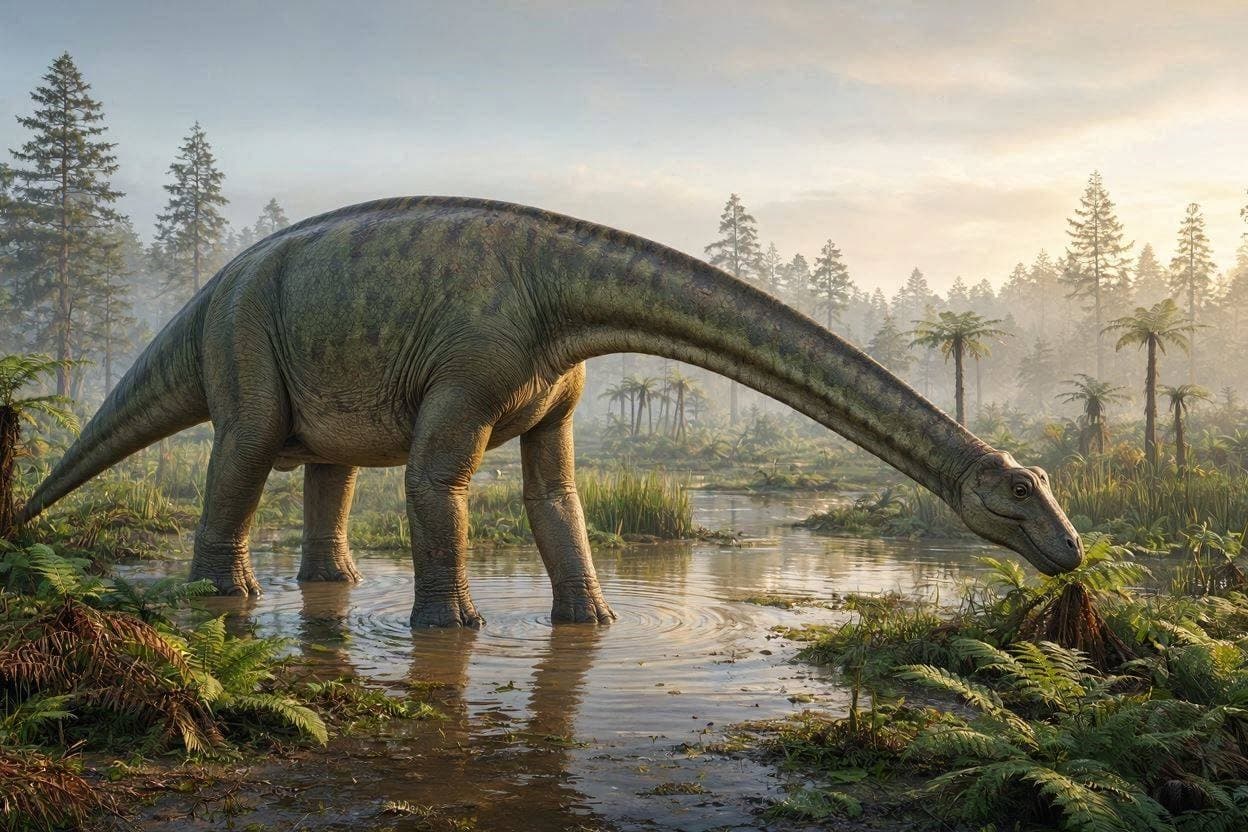
Beneath the sun-drenched fields of northeastern Thailand, where modern rice paddies stretch toward the horizon, the earth once held the footsteps of giants. For decades, farmers and local residents have stumbled upon bones that seemed too large to belong to any known animal, fragments of a prehistoric past that remained silent until recently. Now, those scattered clues have coalesced into a remarkable discovery: a new species of long-necked dinosaur that roamed this landscape over 100 million years ago, reshaping our understanding of Southeast Asia’s ancient ecosystems.
Body: The newly identified species, named Nagatitan chaiyaphumensis, is a sauropod of immense proportions. Weighing an estimated 27 metric tons and stretching nearly 27 meters in length, it stands as the largest dinosaur ever discovered in the region. Its name, derived from the Naga mythological serpent and the Chaiyaphum province where it was found, reflects both its serpentine neck and its deep cultural roots in the land. The discovery was made possible by a collaborative effort between Thai and British paleontologists, who meticulously pieced together vertebrae and limb bones unearthed from a sandstone quarry.
What makes Nagatitan particularly significant is its place in the evolutionary timeline. Living during the Early Cretaceous period, it belonged to a group of titanosaurs that were spreading across the globe as the continents drifted apart. Its unique skeletal features, including the shape of its tail vertebrae and the structure of its limbs, distinguish it from other known sauropods. These details provide a rare glimpse into the diversity of dinosaur life in what was then part of the Khorat Plateau, a region that has become a hotspot for paleontological finds.
The environment Nagatitan inhabited was vastly different from today’s agricultural landscape. It was a lush, semi-arid floodplain dotted with coniferous forests and ferns, teeming with life. As a herbivore, this gentle giant would have spent its days browsing on high vegetation, its long neck allowing it to reach food sources inaccessible to smaller dinosaurs. Its sheer size likely served as a deterrent to predators, although young individuals would have remained vulnerable to the theropods that shared its habitat.
This discovery also highlights the importance of local knowledge in scientific advancement. The initial fossils were found by local villagers, who recognized their significance and alerted authorities. This partnership between community members and scientists has led to a series of important finds in Thailand, transforming the country into a key player in global paleontology. It serves as a reminder that scientific discovery often begins with curiosity and respect for the land.
For researchers, Nagatitan offers new insights into the migration patterns of sauropods. Its presence in Southeast Asia suggests that these animals were more widespread and diverse than previously thought, adapting to various environments as they moved across ancient land bridges. Each bone recovered adds another piece to the puzzle of how dinosaurs colonized the planet, filling gaps in the fossil record that have long puzzled scientists.
As the study of Nagatitan continues, it invites us to imagine the thunderous steps of these colossal creatures echoing through time. It is a testament to the endurance of nature’s history, preserved in stone and waiting to be revealed. The discovery not only expands our knowledge of the past but also inspires a sense of wonder about the world that existed long before human civilization.
Closing: The identification of Nagatitan chaiyaphumensis marks a milestone in Thai paleontology, confirming the region’s rich prehistoric heritage. As more fossils are uncovered and studied, we gain a deeper appreciation for the complex web of life that once thrived here, reminding us that the earth beneath our feet holds stories far older than our own.
AI Image Disclaimer: The visual representations accompanying this article are AI-generated illustrations intended to depict the scale and environment of Nagatitan and should not be viewed as photographic records.
Sources: CNN, NPR, BBC News, ScienceDaily, Al Jazeera
Published by Banx Network. This article is part of the Banx decentralized media programme, powered by the BXE token on the XRP Ledger.