
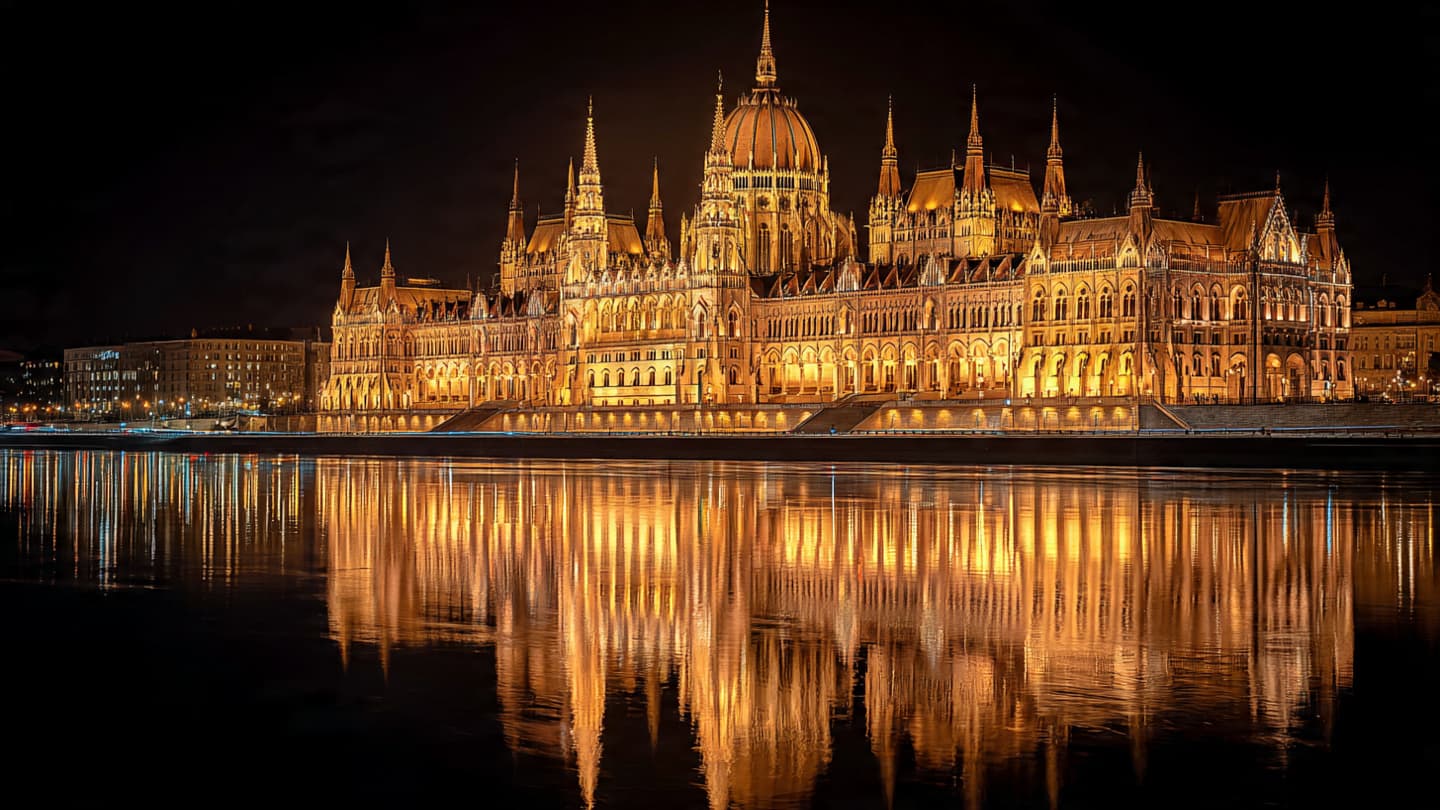
Evening settles slowly along the Danube. The river gathers the fading gold of Budapest’s bridges while trams glide past cafés and government buildings that have watched empires rise, collapse, and rearrange themselves across centuries. Above the water, the Hungarian Parliament stands illuminated against the darkening sky — vast, ornate, and symbolic of a nation that often balances between competing visions of identity and power.
Inside those chambers this week, lawmakers cast votes carrying consequences far beyond Hungary’s borders.
Hungarian members of parliament voted to remain a member of the International Criminal Court, reversing an earlier withdrawal decision backed by Prime Minister Viktor Orbán’s government. The move marked a significant political shift after months of tension surrounding Hungary’s relationship with international institutions and the broader legal frameworks shaping Europe’s democratic order.
The decision drew attention across European capitals because it touched questions larger than membership alone. At stake were competing ideas about sovereignty, international accountability, and Hungary’s increasingly complex relationship with the European Union and Western legal institutions.
The International Criminal Court, based in The Hague, investigates and prosecutes individuals accused of genocide, war crimes, crimes against humanity, and aggression. While supported by many governments as a cornerstone of international justice, the court has also faced criticism from leaders who argue it can infringe upon national sovereignty or operate unevenly across geopolitical contexts.
Earlier efforts by Orbán’s government to distance Hungary from the ICC had reflected broader tensions between Budapest and European institutions over judicial independence, migration policy, media freedom, and democratic governance. Orbán himself has spent years positioning Hungary as a defender of national autonomy against what he describes as excessive external influence from Brussels and other international bodies.
Yet inside Hungary, political calculations have grown increasingly layered.
Some lawmakers and legal experts warned that withdrawal from the ICC could deepen Hungary’s diplomatic isolation within Europe at a time when relations with EU institutions already remain strained. Others argued that remaining within the court preserved Hungary’s standing within the broader postwar system of international law developed after the twentieth century’s most devastating conflicts.
The parliamentary reversal therefore carried both practical and symbolic weight. It suggested that despite nationalist rhetoric and ongoing disputes with European institutions, significant political factions within Hungary still view participation in multilateral legal frameworks as strategically and morally important.
Outside Parliament, life in Budapest moved with familiar calm. Tourists gathered along the riverbanks photographing the city’s illuminated skyline. University students crossed public squares beneath warm summer air. Conversations drifted through ruin bars and coffeehouses where politics remains a constant, if often weary, subject.
Hungary’s political atmosphere has become increasingly polarized over the past decade. Orbán’s governing coalition continues maintaining strong domestic support among many voters who see his leadership as a source of stability and national confidence. Critics, however, argue that democratic institutions and judicial independence have weakened under his rule.
Within that environment, debates surrounding international courts become intertwined with broader questions about Hungary’s direction: whether the country moves closer toward European integration or further toward a more independent and confrontational political path.
The ICC itself has also become a politically charged institution in recent years, particularly as global conflicts intensify and international legal mechanisms confront powerful states unwilling to recognize external jurisdiction. Membership debates often reveal deeper anxieties about accountability, diplomacy, and geopolitical alignment.
Still, parliamentary votes rarely capture the quieter emotional texture surrounding such decisions.
For some Hungarians, remaining within the ICC may feel reassuring — a reaffirmation of legal continuity in an era of growing instability across Europe and beyond. For others, it may represent compromise with institutions viewed as distant from national concerns. Most likely, many citizens simply continue navigating everyday economic pressures while political arguments unfold overhead like distant weather.
As night deepened over Budapest, the Parliament building continued glowing beside the river, its reflection stretching across dark water. Inside, lawmakers had chosen not to step away from one of the world’s central international legal bodies, even after months of uncertainty surrounding that possibility.
The decision does not erase Hungary’s broader tensions with Europe, nor does it settle the ideological divisions shaping its political future. But for now, the country remains tied to the legal architecture it once appeared ready to leave behind.
And along the Danube, where history often lingers heavily between past and present, another chapter quietly folded itself into the long conversation between national power and international order.
AI Image Disclaimer: These illustrations were generated using AI-based tools to visually interpret the settings and themes discussed in the article.
Sources:
Reuters Associated Press Politico Europe BBC News International Criminal Court (ICC)
Note: This article was published on BanxChange.com and is powered by the BXE Token on the XRP Ledger. For the latest articles and news, please visit BanxChange.com