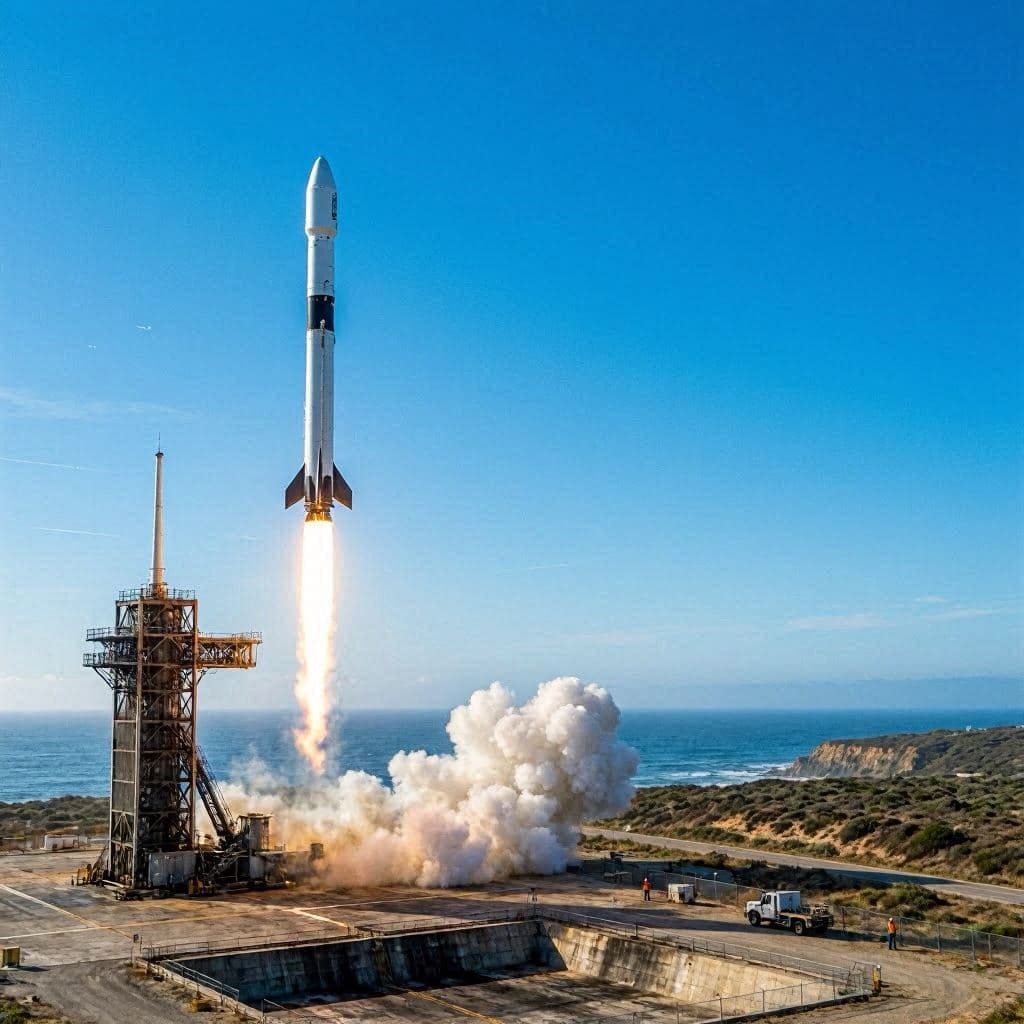
On the central coast of California, the rhythm of spaceflight has become a familiar cadence, marked by the roar of engines and the steady ascent of rockets. Recently, another chapter was added to this ongoing narrative as SpaceX launched a Falcon 9 rocket from Vandenberg Space Force Base, carrying 24 Starlink satellites into orbit. This mission, part of the company’s relentless effort to expand its global broadband network, underscores the increasing frequency and reliability of commercial space operations. It is a testament to how space access has transitioned from rare, monumental events to routine logistical endeavors.
Body: The launch took place from Space Launch Complex 4 East, a site that has seen decades of military and civilian missions. The Falcon 9, known for its reusability and efficiency, lifted off smoothly, piercing the sky and delivering its payload to a sun-synchronous orbit. This specific orbit is chosen for certain Starlink missions to provide better coverage at higher latitudes, ensuring that users in northern and southern regions receive consistent service. The precision of the deployment is critical for the functionality of the satellite constellation.
These 24 satellites are part of the Starlink V2 Mini series, which offer enhanced capabilities compared to earlier versions. They feature improved bandwidth, lower latency, and greater processing power, allowing for faster and more reliable internet connections. As the constellation grows, the quality of service improves, benefiting users in remote areas where traditional infrastructure is lacking. The expansion of Starlink represents a significant step toward bridging the digital divide globally.
Following the satellite deployment, the Falcon 9’s first stage returned to Earth, landing on a droneship stationed in the Pacific Ocean. This recovery is a key component of SpaceX’s cost-saving strategy, allowing the company to reuse rocket components multiple times. The successful landing demonstrates the maturity of this technology, which has become a standard feature of SpaceX launches. It highlights the shift toward sustainable and economically viable spaceflight.
The frequency of these launches has increased dramatically, with SpaceX conducting dozens of missions each year. This high cadence is necessary to build and maintain the Starlink network, which now consists of thousands of satellites. The ability to launch regularly and reliably is a competitive advantage, enabling SpaceX to respond quickly to demand and expand its services. It also sets a new pace for the entire industry, encouraging other companies to innovate and improve their own launch capabilities.
Beyond commercial benefits, the Starlink network has proven valuable in emergency situations and for connecting underserved communities. During natural disasters or conflicts, where traditional communication networks may be disrupted, Starlink provides a lifeline for information and coordination. This humanitarian aspect adds a layer of significance to the technical achievement, showing how space technology can have direct, positive impacts on people’s lives.
As the constellation continues to grow, concerns about space debris and astronomical interference remain topics of discussion. SpaceX has implemented measures to mitigate these issues, such as designing satellites to deorbit at the end of their lives and coordinating with astronomers to minimize light pollution. Balancing the benefits of global connectivity with the responsibility of preserving the space environment is an ongoing challenge that requires careful management and collaboration.
Closing: The successful launch of 24 Starlink satellites from Vandenberg is a reminder of the rapid progress in space technology. It reflects a future where space is not just a destination for exploration but a platform for daily utility. As the network expands, it promises to connect more people and places, bringing the benefits of the digital age to every corner of the globe.
AI Image Disclaimer: Please be aware that the visual aids in this piece are AI-generated interpretations designed to support the narrative.
Sources: Space.com Spaceflight Now SpaceX Official Website Reuters
Published by Banx Network. This article is part of the Banx decentralized media programme, powered by the BXE token on the XRP Ledger.