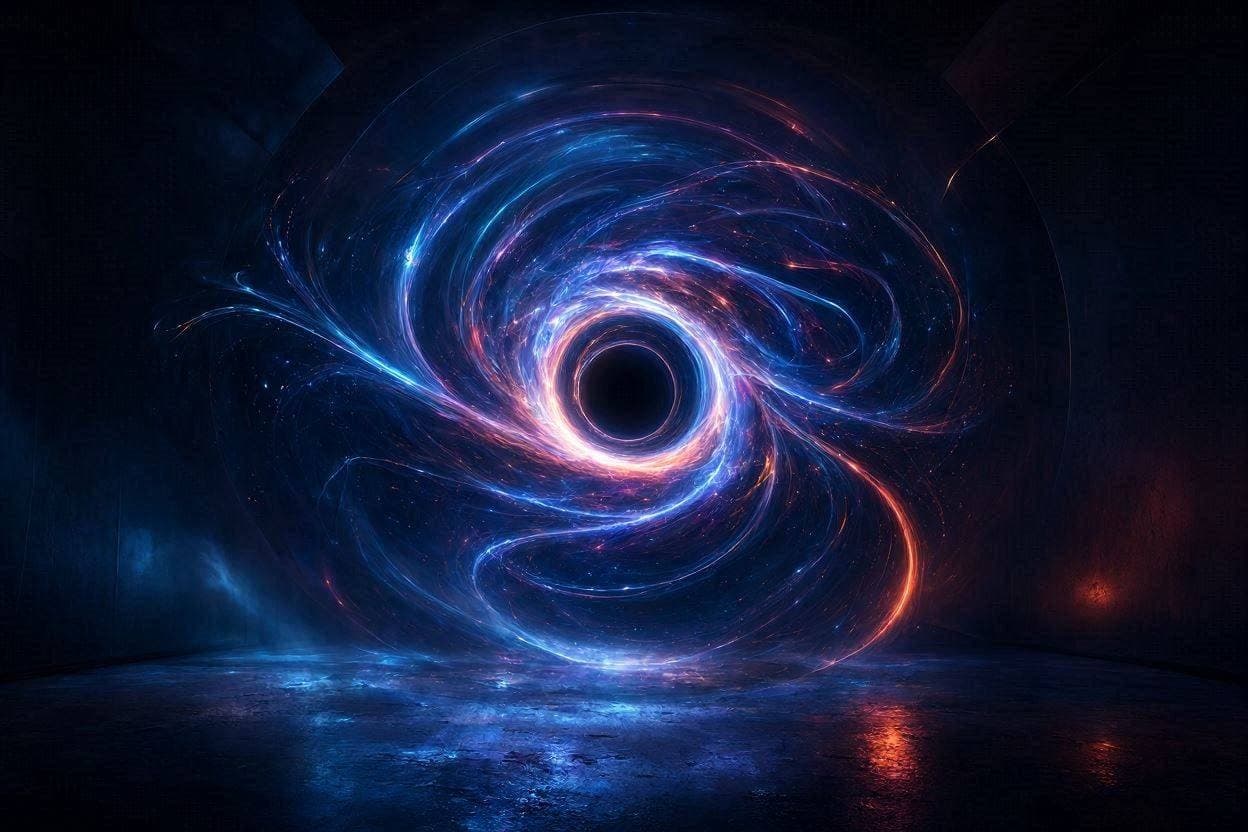
Opening: The concept of a black hole, with its inescapable gravitational pull, has long captivated the human imagination as a cosmic mystery. Now, in controlled laboratory settings, scientists have engineered systems that mimic certain energetic behaviors of black holes, bringing the extreme physics of the cosmos into the realm of experimental verification.
Body: Recent experiments have focused on creating analogues to black holes using materials like graphene or optical fibers, where particles behave as if they are trapped by an event horizon. These "black hole analogues" do not possess the immense mass of their celestial counterparts but replicate the way they interact with energy and information. This allows researchers to study phenomena such as Hawking radiation, which is theoretically emitted by black holes but too faint to observe in space.
By simulating these conditions, physicists can test predictions of quantum gravity and thermodynamics in a manageable environment. The ability to manipulate these systems offers insights into how information might be preserved or lost in black holes, a key debate in modern physics. It bridges the gap between general relativity and quantum mechanics, two pillars of science that have yet to be fully unified.
The technological implications are also significant. Understanding how energy is trapped and released in these systems could lead to advancements in energy storage and conversion. While not a source of unlimited power, the principles learned may inform the design of more efficient batteries or photovoltaic cells, leveraging quantum effects for practical use.
Critics emphasize that these are analogues, not actual black holes, and caution against overstating the findings. However, the value lies in the ability to probe theoretical models with empirical data. Each experiment refines our understanding, stripping away speculation and replacing it with measured observation.
International collaboration is key to this progress, with teams from various countries sharing results and methodologies. The global nature of scientific inquiry ensures that discoveries are vetted and built upon collectively. This shared effort accelerates the pace of innovation and deepens our collective knowledge.
For the public, these developments offer a glimpse into the profound complexity of the universe. They demonstrate that even the most exotic cosmic phenomena can be studied through careful experimentation. It fosters a sense of wonder and appreciation for the intellectual tools we have developed to decode nature’s secrets.
Closing: As research continues, the creation of black hole-like systems in the lab stands as a testament to human ingenuity. It opens new avenues for exploring the fundamental laws of physics, bringing us closer to understanding the true nature of space, time, and energy.
AI Image Disclaimer: The accompanying visuals are AI-generated representations intended to illustrate the context of the article and do not depict actual laboratory equipment.
Sources: ScienceDaily Nature Physics Live Science Phys.org
Published by Banx Network. This article is part of the Banx decentralized media programme, powered by the BXE token on the XRP Ledger.