
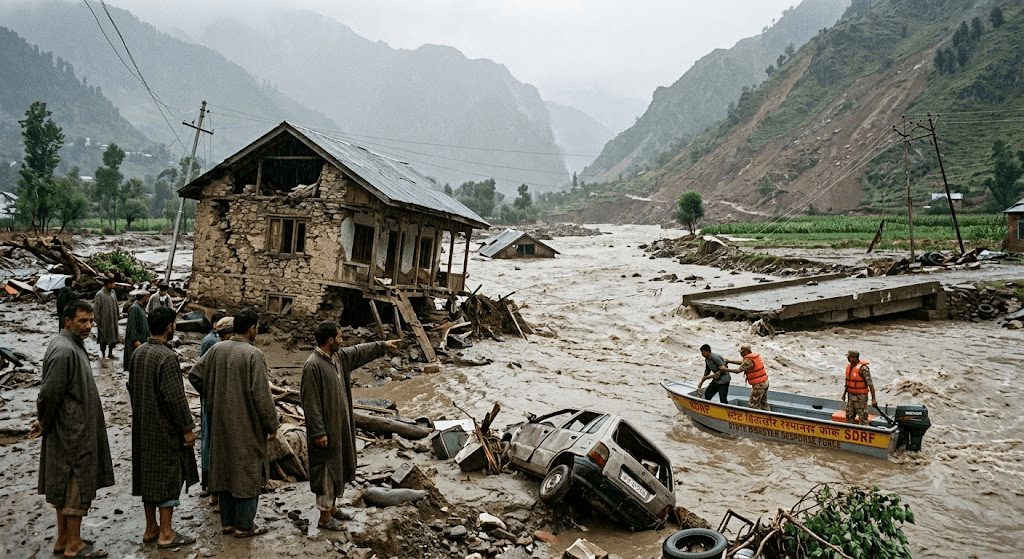
SRINAGAR, INDIA — A trail of devastation swept across India’s northern union territory of Jammu and Kashmir after torrential overnight rains triggered catastrophic flash floods and landslides. The sudden deluge claimed at least ten lives, left several individuals missing, and forced hundreds of terrified residents to evacuate their homes.
The disaster has battered infrastructure and completely submerged low-lying communities, prompting massive, multi-agency emergency rescue operations.
The worst of the destruction was concentrated in the twin border districts of Poonch and Rajouri in the Pir Panjal valley, where cloudbursts triggered sudden torrents of mud, water, and heavy boulders early Sunday morning. Many residents were caught completely off guard as rivers swiftly breached their banks in the dead of night.
In Poonch district’s Surankote tehsil, structural collapses accounted for the majority of the initial fatalities. A landslide entirely buried a three-story house in the remote village of Lower Murrah, trapping family members beneath the rubble.
"It started with intense showers, and within minutes, the nearby streams overflowed," stated a local administrative official. "Our immediate priority remains searching the debris to locate and retrieve those who are still missing."
Elsewhere in the region, a 28-year-old woman died when her home collapsed in Noonabandi village, though emergency responders successfully rescued her husband and three young children from the wreckage. Other casualties included a minor girl who was swept away by a raging stream in Marhote.
The flash floods caused widespread ruin to both public and private property. In Rajouri town, rivers including the Darhali and Suktoh swelled past their danger marks. The overflowing Darhali River smashed through a flood protection wall, sending a wall of water into the local New Bus Stand area. Dozens of parked vehicles and mini-buses were entirely submerged or washed away downriver.
The flash floods caused massive displacement and structural damage across the territory. More than 50 families living in slum settlements near the Abdullah Bridge were forced to abandon their belongings as water flooded their homes, while emergency teams evacuated hundreds of families from the heavily inundated Bela Colony to temporary shelters on safer ground. Furthermore, initial assessments indicate that over 100 homes and roughly two dozen school buildings have already suffered varying degrees of structural damage.
Teams from the State Disaster Response Force (SDRF), the Indian Army, local police, and civilian volunteers are actively working through treacherous conditions to clear debris and assist affected populations. Chief Minister Omar Abdullah chaired a high-level emergency meeting, ordering field agencies to expedite the restoration of disrupted roads, power supplies, and drinking water systems.
Meanwhile, Jammu and Kashmir Lieutenant Governor Manoj Sinha urged residents to stay calm, noting that emergency teams remain on high alert. The threat is far from over; all gates of major regional hydroelectric projects—including the Salal and Baglihar dams—have been opened to flush reservoirs, causing the Chenab River to rise rapidly.
With the India Meteorological Department forecasting continued moderate to heavy rainfall across Jammu and Kashmir over the coming days, authorities have strongly advised citizens to stay well away from riverbanks and avoid any unnecessary travel.
Note: This article was published on BanxChange.com and is powered by the BXE Token on the XRP Ledger. For the latest articles and news, please visit BanxChange.com