
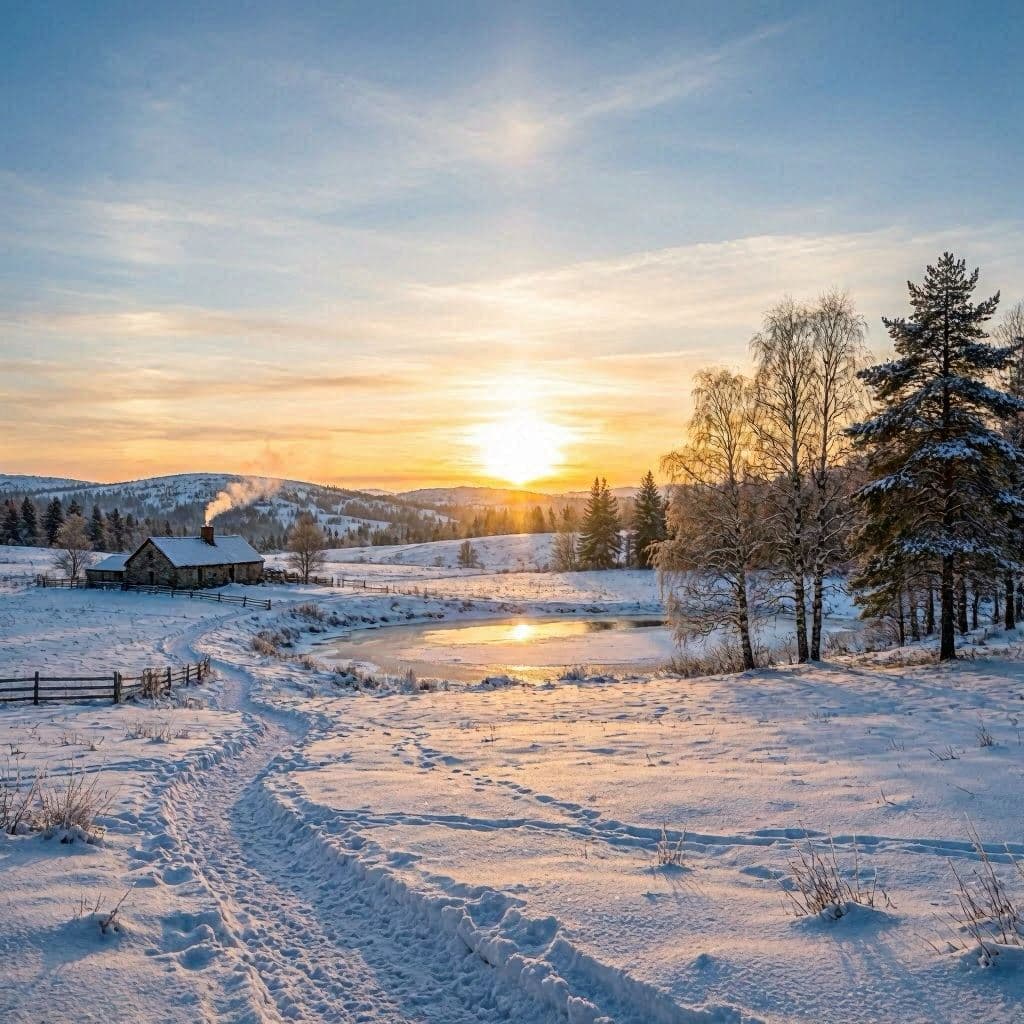
Winter often arrives wrapped in familiar assumptions. Among the most common is the belief that the shortest day of the year must also be the coldest. Yet nature rarely follows such simple expectations. Scientists explain that the relationship between sunlight and temperature is more gradual, shaped by processes unfolding over days and weeks rather than in a single moment.
The winter solstice marks the shortest period of daylight in each hemisphere. In the Northern Hemisphere, it occurs in December, while in the Southern Hemisphere it takes place in June. Although daylight reaches its minimum at the solstice, temperatures typically continue to decline afterward.
Researchers describe this phenomenon as "seasonal lag." Much like an oven that remains warm even after being switched off, Earth's surface continues to release and absorb heat over time. Land, oceans, and the atmosphere respond slowly to changes in solar energy.
During autumn and early winter, the planet steadily loses more heat than it receives from sunlight. Even after the solstice, this imbalance can persist for several weeks, allowing temperatures to continue falling before eventually reaching their seasonal minimum.
Oceans play a particularly important role in moderating temperatures. Water retains heat far more efficiently than land, meaning coastal regions often experience delayed seasonal cooling compared with inland areas. This effect contributes to regional differences in winter weather patterns.
Meteorologists also note that atmospheric circulation, cloud cover, wind patterns, and local geography influence when the coldest days occur. As a result, the timing of seasonal temperature extremes varies considerably across different parts of the world.
The same principle applies during summer. The longest day of the year is not necessarily the hottest, because Earth's climate system requires time to accumulate and redistribute heat.
Understanding seasonal lag helps scientists improve weather forecasting and climate modeling. It also illustrates how Earth's climate operates as a complex, interconnected system rather than a series of isolated events.
For many people, the winter solstice remains an important cultural and astronomical milestone. Yet from a scientific perspective, it represents not winter's coldest point, but rather a subtle turning point in the annual rhythm of sunlight and temperature.
AI Image Disclaimer: Visual illustrations accompanying this article were generated using AI technology for editorial and educational purposes.
Source Verification Check: ABC Science, National Weather Service, NASA, Associated Press
Note: This article was published on BanxChange.com and is powered by the BXE Token on the XRP Ledger. For the latest articles and news, please visit BanxChange.com