
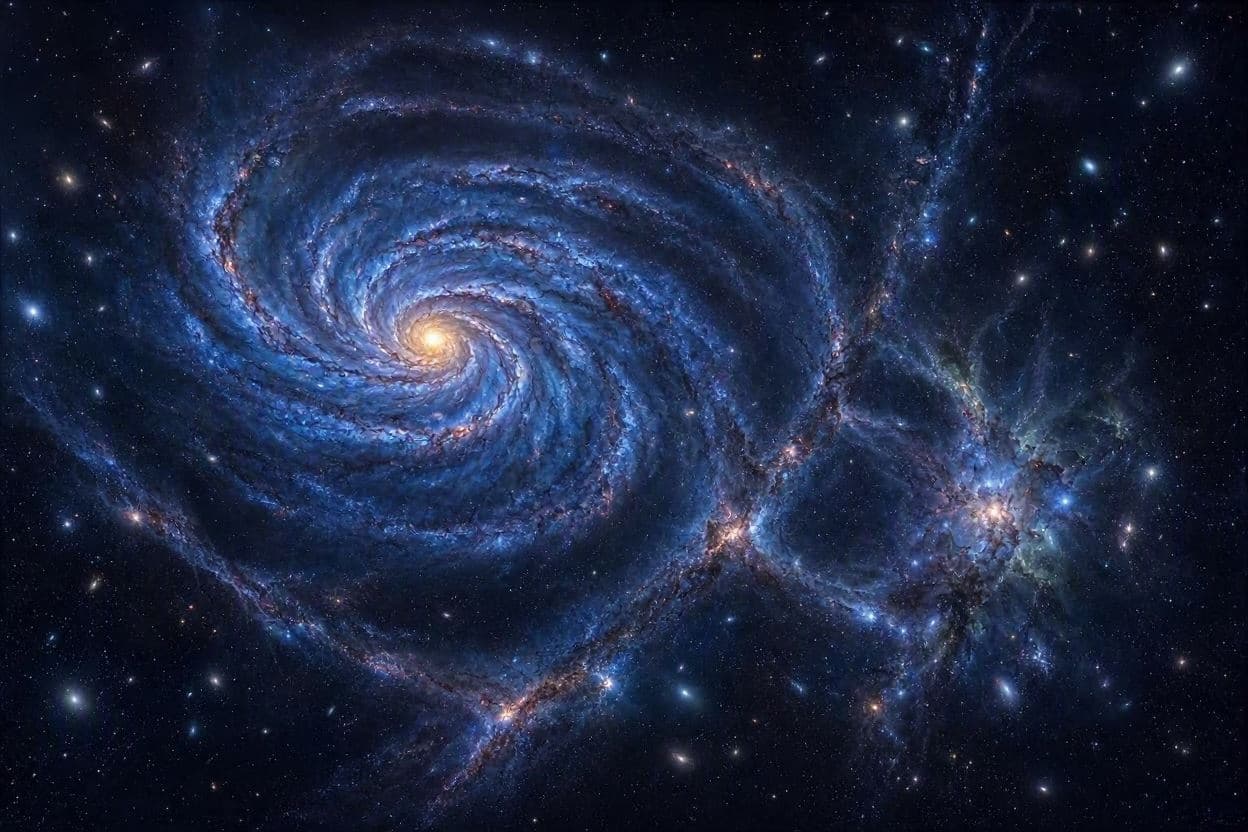
Our galaxy, the Milky Way, is often perceived as a static island of stars in the cosmic ocean. But in reality, it is a dynamic entity, shaped by violent collisions and gravitational dances over billions of years. Recent astronomical evidence suggests that approximately 11.8 billion years ago, the Milky Way consumed a smaller neighboring galaxy in a merger that fundamentally altered its structure. This ancient feast, dubbed the "Virgo Radial Merger," left behind stellar streams that astronomers are only now beginning to fully understand.
The discovery relies on data from the Gaia space observatory, which maps the positions and movements of billions of stars with unprecedented precision. By analyzing the velocities and chemical compositions of these stars, researchers identified a distinct group moving in a radial pattern, unlike the rotational motion of the main galactic disk. These stars, older and metal-poor, are the remnants of the swallowed galaxy, still tracing the path of their ancestral home.
This merger occurred during the early stages of the Milky Way’s formation, a time when the universe was much younger and galaxies were more prone to collision. The infalling galaxy, likely comparable in mass to the Large Magellanic Cloud today, brought with it gas and stars that fueled new bursts of star formation. This influx of material helped build the thick disk of our galaxy, contributing to the rich tapestry of stars we see today.
Understanding these ancient mergers is crucial for reconstructing the history of our cosmic neighborhood. It helps astronomers explain the distribution of dark matter and the structural features of the Milky Way, such as its halo and bulge. Each merged galaxy adds a layer to the story, revealing how large galaxies grow by accreting smaller ones over eons. It is a process of cosmic recycling, where destruction leads to creation.
The Virgo Radial Merger is distinct from other known events, such as the Gaia-Enceladus merger, which happened later. By distinguishing between these events, scientists can create a more detailed timeline of galactic evolution. This chronological clarity allows for better models of how galaxies like ours form and change, providing context for our own place in the universe.
For the public, this news offers a sense of deep time. It reminds us that the sky above is not just a static backdrop but a record of ancient violence and beauty. The stars we see with the naked eye may have originated in a different galaxy, traveling across the void to become part of our home. This connection to the distant past fosters a sense of wonder and humility.
As telescopes become more powerful, more secrets of the Milky Way’s history will be uncovered. Future missions may reveal even earlier mergers, pushing the timeline back closer to the Big Bang. Each discovery refines our understanding of the cosmos, showing that we are part of a constantly evolving system.
The story of the Milky Way is one of assimilation and growth. By devouring smaller galaxies, it has become the majestic spiral we know today. This ancient act of consumption, occurring billions of years before humans existed, set the stage for the eventual emergence of life on Earth. In the grand scheme of things, we are the children of a cosmic merger.
AI Image Disclaimer: Visuals in this article are AI-generated illustrations depicting galactic structures and stellar streams, designed to visualize the concept of galaxy mergers without showing real proprietary observational data.
Sources: Nature Astronomy, ESA Gaia, Space.com, Phys.org
Published by Banx Network. This article is part of the Banx decentralized media programme, powered by the BXE token on the XRP Ledger.



