The universe rarely reveals its deepest structures all at once. Instead, it offers fragments—ripples crossing immense distances, subtle movements preserved across billions of years, and signals that arrive long after the events that created them. Each new observation becomes another thread woven into humanity's understanding of the cosmos. Now, researchers believe exceptionally powerful gravitational waves could help illuminate one of the most mysterious regions in astrophysics: the event horizon of a black hole.
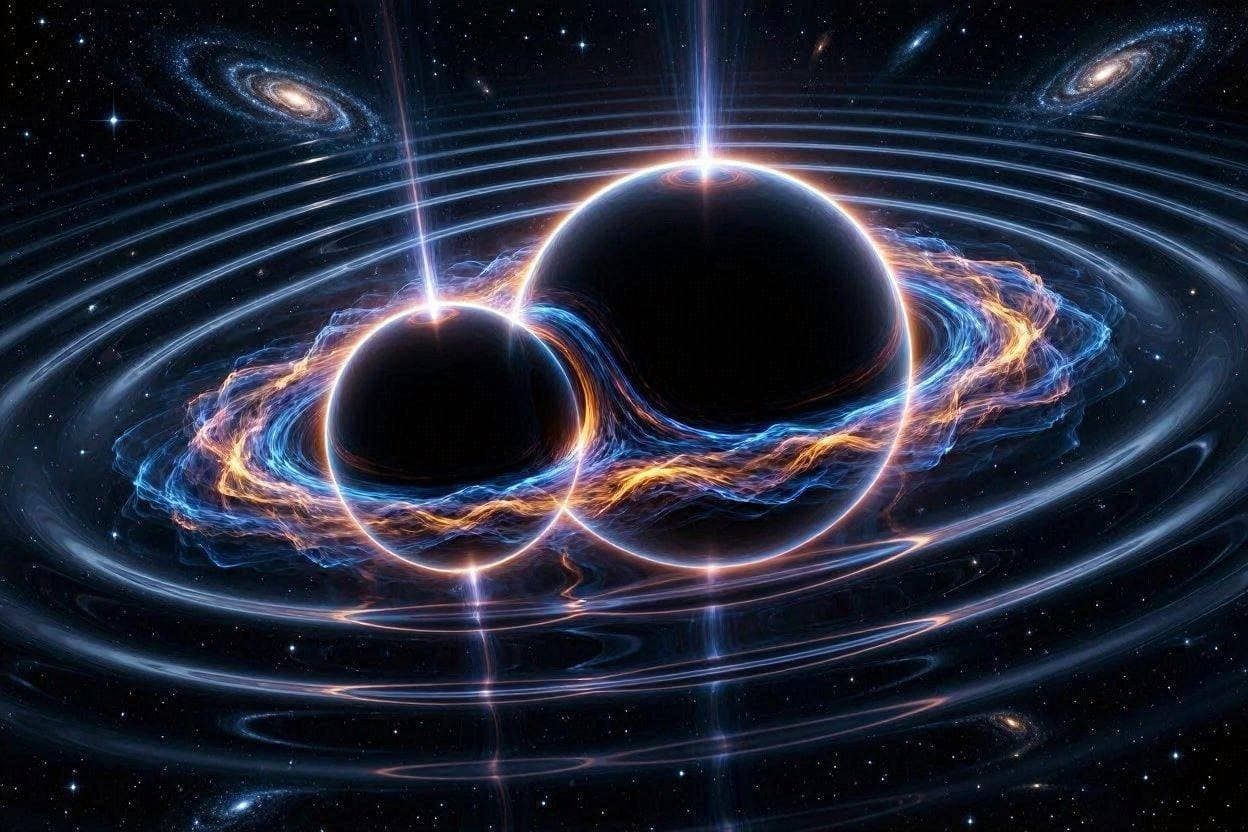
A new theoretical study suggests that extremely strong gravitational waves generated during the collision of massive black holes may provide an unprecedented opportunity to investigate the physics surrounding event horizons. These boundaries mark the point beyond which neither matter nor light can escape a black hole's gravitational pull. While event horizons have long been predicted by Einstein's theory of general relativity, directly studying their properties remains one of astronomy's greatest challenges.
The research focuses on what scientists describe as "super-loud" gravitational waves—signals with exceptionally large amplitudes produced during energetic cosmic mergers. As these waves travel through spacetime, they may preserve subtle information about conditions near the event horizon, allowing physicists to test predictions that have previously remained beyond observational reach.
According to the researchers, the strongest gravitational-wave signals may carry distinctive features that reveal how spacetime behaves under the most extreme gravitational conditions known in nature. Detecting and analyzing these patterns could improve scientists' understanding of whether black holes behave exactly as predicted by general relativity or whether tiny deviations emerge under extraordinary circumstances.
The study also highlights the growing capabilities of modern gravitational-wave observatories. Current facilities such as LIGO, Virgo, and KAGRA have already transformed astronomy by detecting dozens of black hole mergers. Future observatories, including the European Einstein Telescope and the Laser Interferometer Space Antenna (LISA), are expected to record even more sensitive observations capable of examining these powerful signals in greater detail.
Although the findings remain theoretical, they establish a practical framework for future observations. Rather than relying on direct images of black holes, scientists can study the information carried by gravitational waves themselves, treating the distortions of spacetime as a new form of astronomical evidence. This approach complements traditional observations made using electromagnetic radiation while expanding the range of questions researchers can investigate.
Scientists emphasize that additional observations will be necessary before the proposed methods can be fully tested. As more black hole mergers are detected over the coming decades, increasingly precise measurements may reveal whether these exceptionally strong gravitational waves contain the predicted signatures near event horizons.
The study represents another step toward understanding some of the universe's most extreme environments. While many questions remain, advances in gravitational-wave astronomy continue to broaden humanity's ability to explore regions once considered permanently beyond observation, demonstrating how careful measurement can gradually uncover the hidden architecture of the cosmos.
AI Image Disclaimer: The illustrations accompanying this article are AI-generated visual representations intended to depict scientific concepts and should not be interpreted as actual observations or mission imagery.
Source Verification Check Credible sources identified:
Physical Review Letters Live Science Space.com Phys.org
Published by Banx Network. This article is part of the Banx decentralized media programme, powered by the BXE token on the XRP Ledger.