The wide, unyielding expanses of the southwestern desert possess an enduring, complex relationship with the interstate highways that bisect their flat terrain, providing a vital transportation artery that connects major metropolitan centers across hundreds of miles of open land. Life along these arid transit corridors moves at a rapid, high-speed pace, governed by the predictable flow of commercial freight and cross-country travelers. To an outside observer, the straight asphalt lanes stretching toward the horizon appear entirely safe, a symbol of modern logistical mastery over a harsh environment. Yet, when a sudden atmospheric pressure drop generates a localized wall of blowing topsoil, that open highway can instantly transform into a blind trap of immense physical danger.
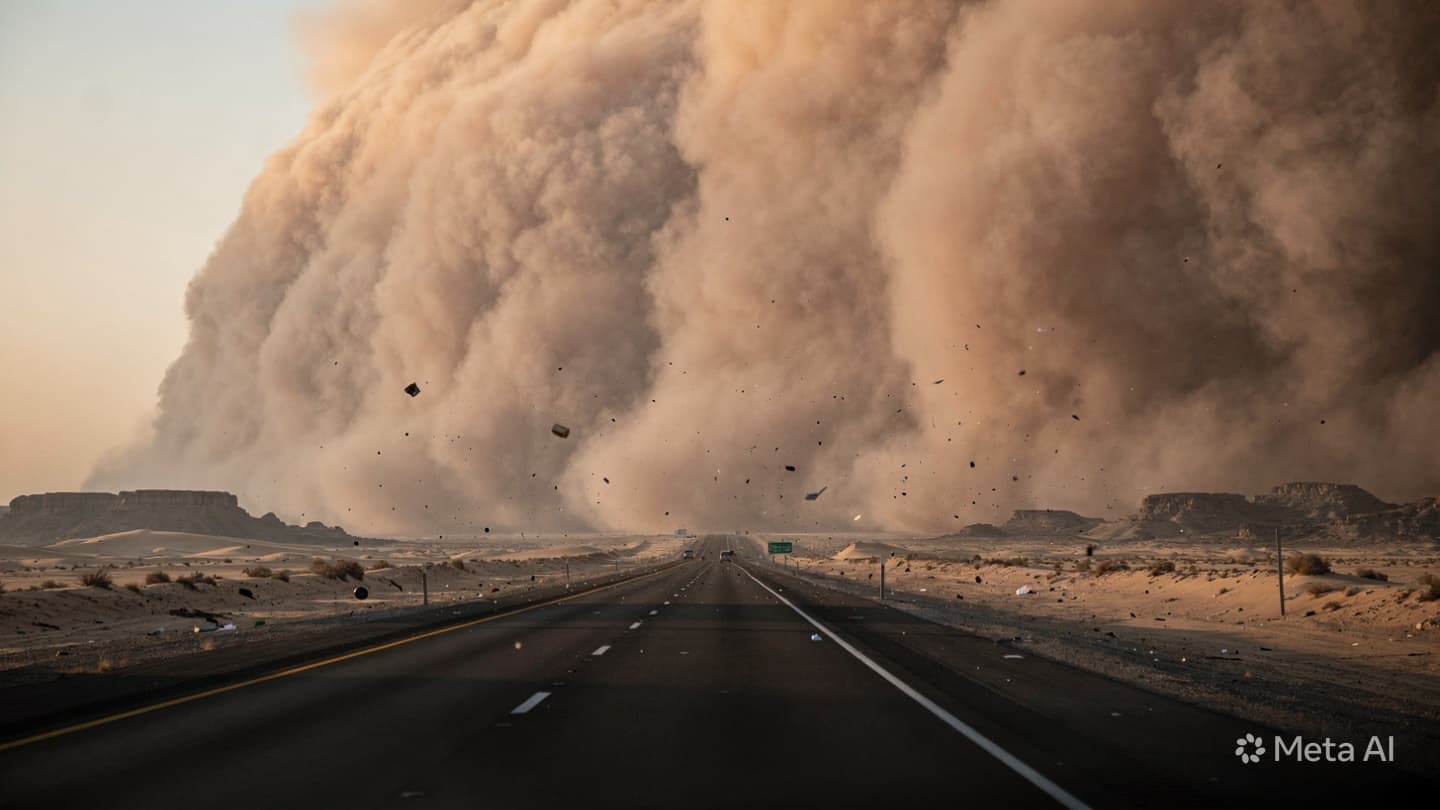
On this particular afternoon, the desert floor experienced a sudden, intense wind shift, lifting fine alluvial silt into a towering wall of dust that swept across the travel lanes within seconds. The change for motorists was instantaneous, transitioning from bright, unclouded sunshine to absolute zero-visibility conditions before braking systems could be effectively engaged. There is a deep, implicit reliance on visual continuity when traveling at highway speeds, built on the assumption that the road ahead remains clear and predictable. Yet, the rapid onset of a localized dust channel alters the environment completely, removing all spatial orientation and turning a routine drive into a moment of acute vulnerability.
The transition from a standard highway commute to a catastrophic pileup occurs when the lead vehicles instinctively brake hard upon hitting the dust wall, creating an invisible barrier for the high-speed traffic following closely behind. The sudden deceleration triggers a rapid, compounding chain-reaction of impacts that echoes down the asphalt, as heavy commercial semi-trucks and passenger cars collide in the darkness. In the absence of visibility, drivers are left entirely unable to navigate away from the emerging wreckage or identify where the safe margins of the roadway lie. It is a sequence where the sheer mechanical force of multiple high-speed impacts becomes magnified by the total isolation of the blinding storm.
When the highway patrol units and emergency medical teams finally breached the dust-choked perimeter and secured the scene, the cost of the environmental blindness was laid bare. The confirmation of three fatalities amidst the tangled wreckage of commercial rigs and passenger vehicles cast a profound, heavy quiet over the desert corridor, bringing an immediate halt to all regional transit. The surrounding landscape, still swept by lingering eddies of fine brown dirt, stood as a silent witness to the sudden violence of the pileup. The interstate grew static, its regular commercial purpose completely suspended by the immediate reality of a major transportation tragedy.
The loss of life within an essential shipping corridor carries a unique weight, representing a sudden, tragic interruption in the modern networks of movement that sustain our daily commerce. The highway was designed to facilitate rapid, efficient connection across vast distances, rather than serving as a place of sudden physical entrapment. It forces an unspoken reflection on the limits of vehicle safety systems and highway design when localized environmental events eliminate visibility entirely. The surviving drivers and passengers gathered along the wide gravel shoulder, looking back at the obscured silhouettes of the vehicles with a quiet sense of shock and shared relief.
By nightfall, the Department of Public Safety investigators and heavy tow crews had established a brightly lit command area, their floodlights cutting through the settling dust to illuminate the collision zone. The technical task of documenting skid marks, analyzing vehicle event data recorders, and methodically separating the fused wreckage was handled with a quiet, necessary precision. Yet, despite the clinical efficiency of the accident reconstruction teams, the emotional weight of the event settles deep into the asphalt of the desert route. For the investigators, the incident is a matter of closing speeds and environmental friction, but for the families of those lost, it is an irreplaceable void.
The technical analysis that follows such highway disasters is meticulous, evaluating the timing of regional weather alerts, the visibility thresholds at the nearest monitoring stations, and the effectiveness of electronic warning signs. It is a necessary ritual of modern traffic safety management, translating an afternoon of highway crisis into a series of engineering recommendations meant to protect future travelers. The implementation of automated highway closure gates, the expansion of early-warning radar arrays, and the enforcement of lower speed limits during dust alerts will all be thoroughly re-evaluated. But for those who frequently drive the desert routes, the technical updates offer little immediate comfort.
Eventually, the damaged vehicles will be hauled away, the highway sweepers will clear the residual silt from the lanes, and the full flow of interstate commerce will resume its characteristic momentum. The big rigs will carry their freight to distant coastlines, commuters will travel between desert cities, and the memory of the blinding wall will slowly fade into the history of the route. But for a long while, the long brake marks scorched into the asphalt will stand as a somber monument to the unpredictable intersections of human travel and the unyielding power of the desert winds. It remains a stark reminder that nature can still demand an absolute halt to our fastest journeys.
The Arizona Department of Public Safety confirmed that a sudden, severe dust storm triggered a massive highway chain-reaction crash on June 13, 2026, resulting in three fatalities. State troopers reported that a localized channel of blowing dust dropped visibility to zero on a major interstate corridor, causing an initial collision between two commercial semi-trucks that quickly involved over a dozen trailing vehicles. Emergency crews worked for several hours to extricate occupants from the wreckage, transporting nine injured individuals to regional trauma units while keeping the westbound lanes closed well into the evening. The Department of Transportation has issued an advisory reminding drivers to pull entirely off the road and turn off all lights if caught in blowing dust.
Published by Banx Network. This article is part of the Banx decentralized media programme, powered by the BXE token on the XRP Ledger.