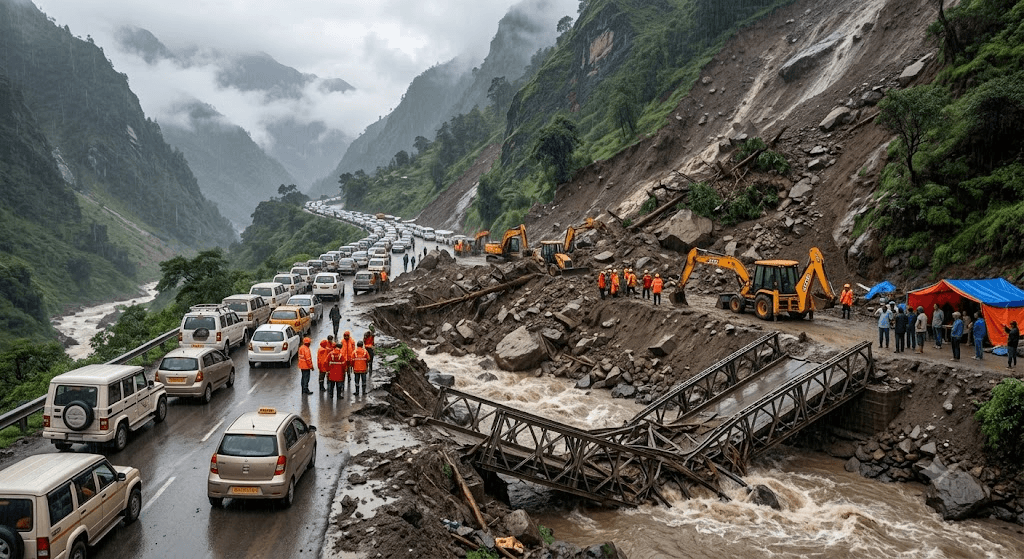
GANGTOK, India — Heavily accelerated by unrelenting monsoon downpours, a massive wave of landslides has battered the Himalayan state of Sikkim, severing critical transport arteries and leaving hundreds of vacationers stranded across major mountain corridors.
The disruptions intensified over the weekend on Sunday, June 28, 2026 as torrential rainfall saturated the steep hillsides of the region, causing severe slope instability. Massive debris torrents collapsed onto National Highway 10 (NH-10)—the primary route connecting Sikkim with the rest of the country—bringing vehicular movement to a temporary standstill near Singtam and adjacent passages.
Further complicating rescue and logistics, a crucial Bailey bridge built over the Phee Khola at Phidang was completely washed away after water levels in mountain streams rose sharply. The collapse completely severed the Phidang–Sankalang road link, isolating multiple remote villages in the Mangan district and blocking alternative transit loops.
With primary travel corridors rendered impassable, hundreds of tourists returning from high-altitude destinations or traveling within North Sikkim found them caught midway in massive traffic snarls. Long queues of light passenger vehicles and commercial tourist SUVs remain lined up along the affected highways.
While the absolute halt in vehicular traffic has raised immediate concerns regarding the delivery of fresh supplies and emergency services to remote pockets, local accommodations in nearby transit hubs are already stretched thin, forcing community centers and emergency shelters to step in to host marooned travelers. Fortunately, disaster management officials have confirmed that despite severe material and structural damage across districts like Ranka and Mangan, no injuries or fatalities have been reported among the stranded tourists so far.
The Border Roads Organization (BRO), alongside local municipal teams and emergency workers, has deployed heavy earthmoving machinery to clear the gargantuan piles of mud, boulders, and uprooted trees blocking the asphalt.
"Our teams are working under highly precarious conditions," a field coordinator noted. "The rain hasn't fully let up, meaning cleared sections face the constant threat of secondary mudslides before we can safely allow the stranded convoys to pass through."
The India Meteorological Department (IMD) has forecast continued heavy to very heavy rainfall across parts of Sikkim over the coming days. Consequently, local administrations have temporarily restricted the issuance of new travel permits to vulnerable high-altitude zones, advising travelers already in the state to stay put until the arterial routes are securely stabilized and cleared for transit.
Published by Banx Network. This article is part of the Banx decentralized media programme, powered by the BXE token on the XRP Ledger.
.jpg&w=3840&q=75 "Blake Lively Awarded $400,000 in Legal Fees After Justin Baldoni Lawsuit Dismissed")