Opening: The Orion Nebula, a stellar nursery visible to the naked eye in the winter sky, has been studied for centuries. Yet, despite its familiarity, it continues to hold secrets beneath its glowing clouds of gas and dust. Recent research, employing cutting-edge astronomical techniques, has peeled back the layers of this iconic nebula to reveal a hidden network of magnetic fields and filamentary structures. These findings offer a new perspective on how stars form and how the interstellar medium shapes the birth of new suns.
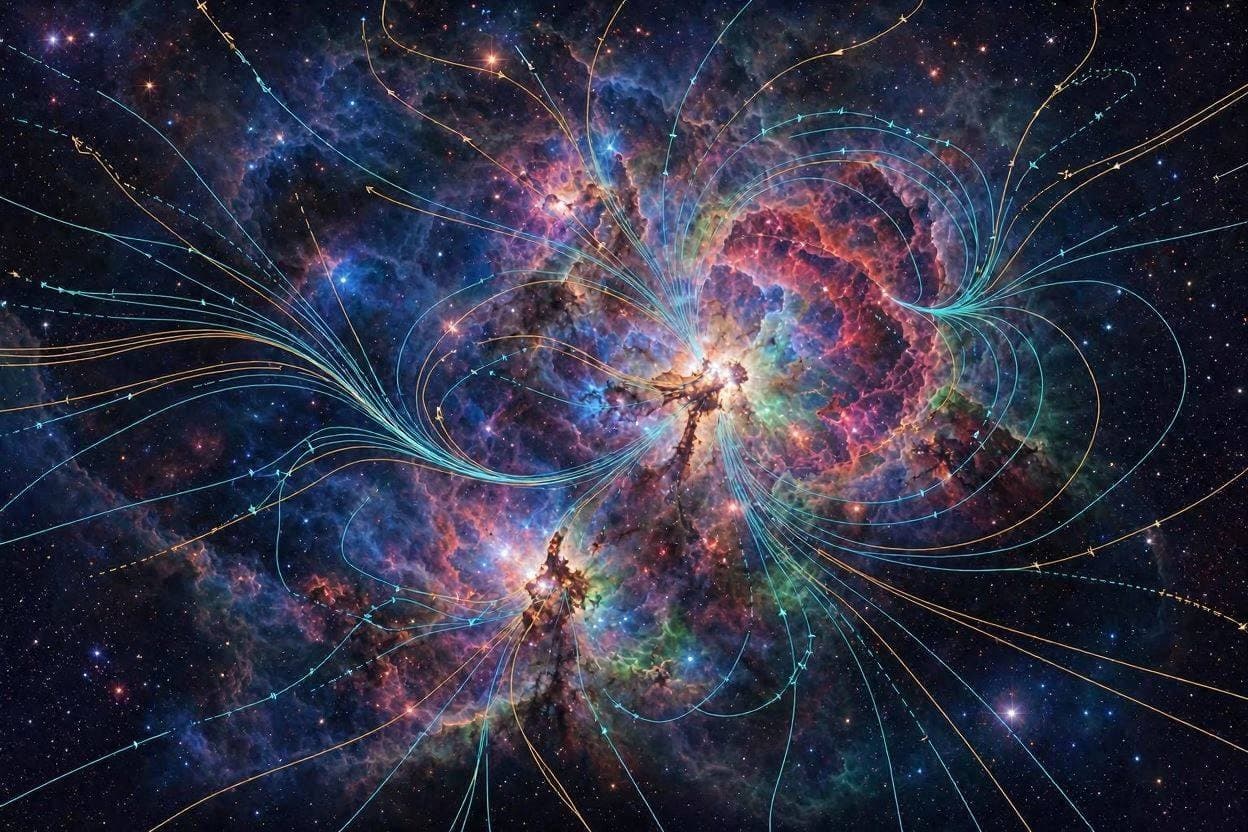
Body: Using data from the Atacama Large Millimeter/submillimeter Array (ALMA) and new polarization imaging techniques, astronomers have mapped the magnetic field lines within the Orion Nebula with unprecedented detail. These invisible forces play a crucial role in star formation, guiding the collapse of gas clouds and influencing the rotation of protostellar disks. The new maps show that the magnetic fields are more organized and influential than previously assumed, acting as a scaffold for the emerging stars.
The study also reveals a complex web of filaments—thin, dense strands of gas—that connect different parts of the nebula. These filaments are thought to be channels through which material flows, feeding the growing stars. By tracing these structures, researchers can better understand the dynamics of mass transfer in stellar nurseries. It is a delicate balance between gravity, which pulls material inward, and magnetic pressure, which can resist or channel that flow.
One of the most striking discoveries is the interaction between the massive Trapezium Cluster stars and the surrounding gas. The intense radiation and stellar winds from these young, hot stars create bubbles and cavities in the nebula, compressing nearby gas and triggering new rounds of star formation. The new observations show how this feedback loop operates on small scales, shaping the immediate environment of individual protostars.
These findings are made possible by advances in interferometry, which combines signals from multiple antennas to create a virtual telescope with a huge aperture. This technique allows astronomers to resolve fine details that would be blurred in single-dish observations. The result is a high-resolution view of the nebula’s internal structure, revealing features that were previously invisible.
The implications of this research extend beyond Orion. Since Orion is the closest massive star-forming region to Earth, it serves as a template for understanding similar regions throughout the galaxy. By studying it in detail, astronomers can refine models of star formation that apply to more distant and less accessible nebulae. It is a local laboratory for universal processes.
Furthermore, the discovery of these hidden structures highlights the importance of multi-wavelength astronomy. While optical telescopes show the glowing gas, radio and submillimeter telescopes reveal the cold dust and magnetic fields that are essential for star birth. Combining these views provides a holistic understanding of the nebula’s physics.
Closing: The unveiling of hidden structures in the Orion Nebula demonstrates that even the most familiar objects in the sky can surprise us. With new technologies and techniques, astronomers continue to deepen our understanding of the cosmic processes that give rise to stars and planets, reminding us that there is always more to discover in the depths of space.
AI Image Disclaimer: The images provided are AI-generated visualizations of the Orion Nebula’s magnetic structures and should be viewed as conceptual illustrations.
Sources: ESO, NRAO, Astrophysical Journal, Space.com, ScienceDaily
Published by Banx Network. This article is part of the Banx decentralized media programme, powered by the BXE token on the XRP Ledger.