Opening: For centuries, the dream of space travel has been tethered to the heavy burden of fuel. Rockets must carry their own propellant, limiting their range and payload capacity in a harsh equation of mass and momentum. But a new technology promises to break this chain. A revolutionary superconducting thruster has successfully completed its first orbital test, demonstrating the ability to accelerate using Earth’s own magnetic field. This breakthrough suggests a future where satellites can maneuver indefinitely without carrying tons of fuel, transforming the economics and sustainability of space operations.
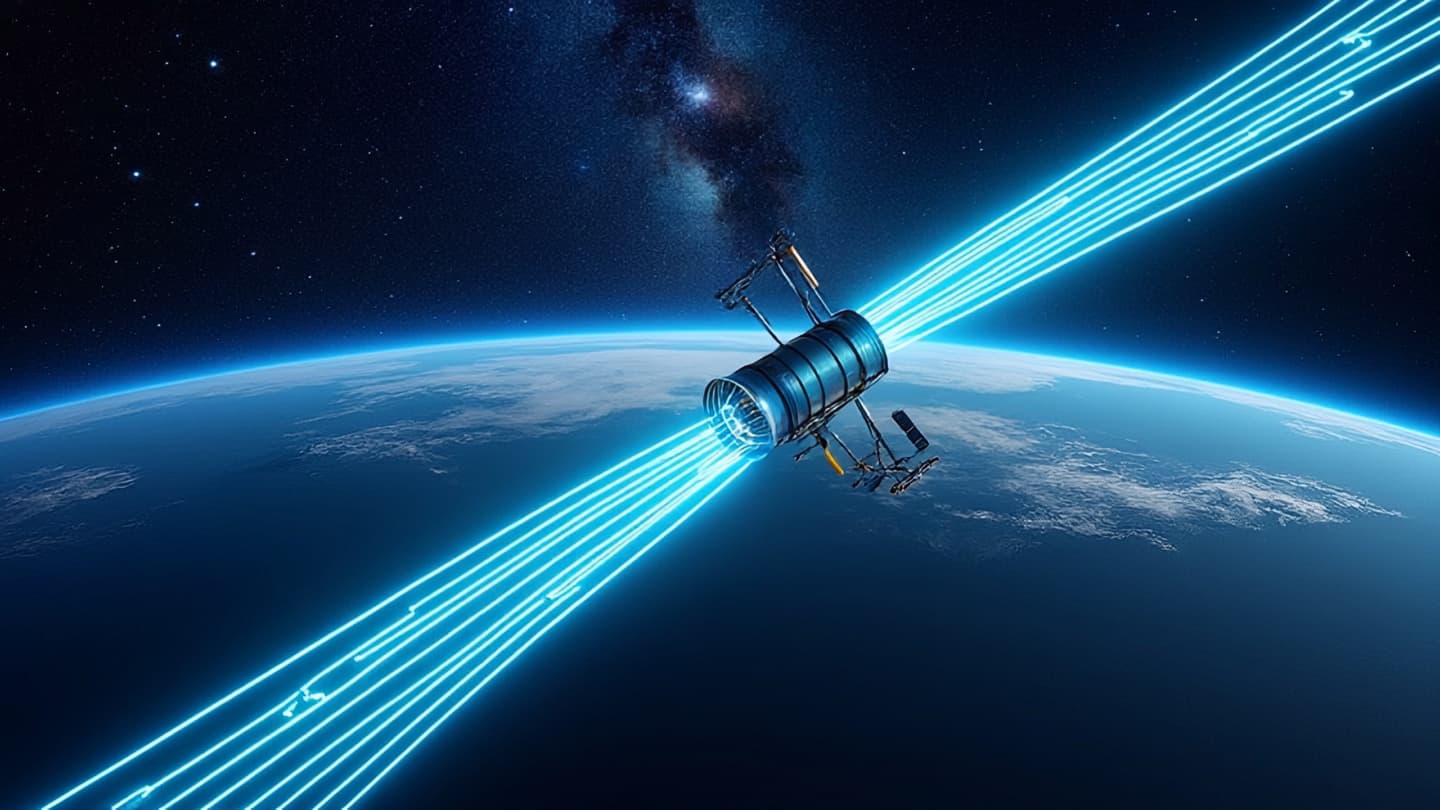
Body: The device, known as an electrodynamic tether or a variant thereof, utilizes the principle of Lorentz force. When an electrical current flows through a conductor in a magnetic field, it experiences a force perpendicular to both the current and the field. In this case, the conductor is a superconducting wire, and the magnetic field is provided by Earth. By interacting with the planet’s magnetosphere, the thruster generates thrust without expelling any mass.
Superconductivity is key to this innovation. Traditional conductors would lose too much energy as heat, making the system inefficient. Superconducting materials, however, allow electricity to flow with zero resistance when cooled to extremely low temperatures. This efficiency enables the generation of strong currents and, consequently, significant thrust from the relatively weak magnetic field of Earth. The recent test proved that this technology can function in the harsh environment of space.
The implications for satellite operations are profound. Currently, satellites carry limited amounts of fuel for station-keeping and debris avoidance. Once the fuel is depleted, the satellite becomes space junk. A fuel-free thruster could extend the lifespan of satellites indefinitely, allowing them to adjust their orbits, avoid collisions, and eventually de-orbit safely at the end of their mission. This capability is crucial for managing the growing congestion in low Earth orbit.
Moreover, this technology could enable new types of missions. Spacecraft could perform long-duration maneuvers that are currently impossible due to fuel constraints. They could maintain unusual orbits or serve as tugs for other satellites. The ability to harness ambient energy from the environment represents a shift toward more sustainable space practices, reducing the need for frequent launches to replace defunct hardware.
The successful orbital test is a milestone, but challenges remain. Scaling up the technology for larger spacecraft requires robust cooling systems to maintain superconductivity. Additionally, the thrust generated is relatively small compared to chemical rockets, meaning it is best suited for gradual adjustments rather than rapid changes in velocity. However, for many applications, slow and steady acceleration is sufficient and highly efficient.
Environmental benefits are also a consideration. By reducing the amount of fuel needed and extending satellite lifespans, this technology can help mitigate the problem of space debris. A cleaner orbital environment is essential for the future of telecommunications, earth observation, and scientific research. It aligns with global efforts to ensure the long-term usability of space.
As research continues, engineers will focus on improving the durability and efficiency of the superconducting materials. Collaborations between space agencies and private companies are likely to accelerate development. The vision is a fleet of satellites that operate cleanly and efficiently, powered by the invisible forces of the planet they orbit.
Closing: The first successful orbital test of a superconducting thruster marks a significant step toward fuel-free space propulsion. By harnessing Earth’s magnetic field, this technology offers a sustainable solution for satellite maneuvering and debris mitigation. It promises to extend the lifespan of space assets and reduce the environmental impact of orbital operations.
AI Image Disclaimer: The images associated with this article are AI-generated interpretations designed to visualize the context of advanced space propulsion technology.
Sources: IEEE Spectrum New Atlas SpaceNews
Published by Banx Network. This article is part of the Banx decentralized media programme, powered by the BXE token on the XRP Ledger.