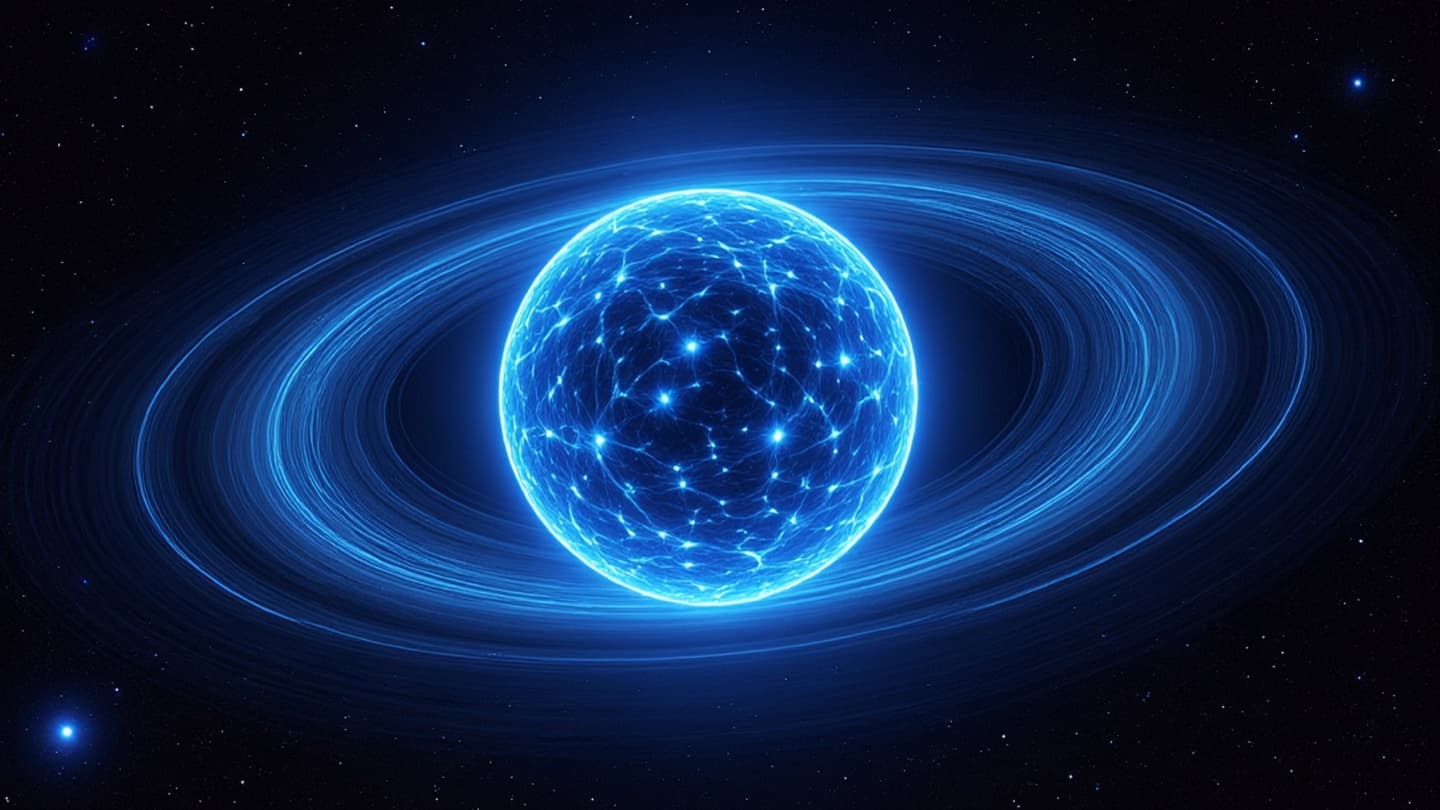
Opening: In the vast, silent theater of the cosmos, some stars perform their duties with rhythmic precision, while others remain dormant for eons, hiding their secrets in the dark. Recently, astronomers were startled by a whisper from the deep: radio signals emanating from a peculiar object known as the "Blue Eye Pulsar." For decades, this celestial body had been quiet, leading scientists to believe it was inactive or perhaps something entirely different. Its sudden reawakening challenges our understanding of stellar evolution and reminds us that the universe is full of surprises, waiting patiently for us to listen.
Body: The object, formally classified as a rotating radio transient (RRAT), is a type of neutron star that emits brief, intense bursts of radio waves rather than the continuous beam typical of standard pulsars. Neutron stars are the dense remnants of massive stars that have exploded as supernovae, packing more mass than the sun into a sphere only about twenty kilometers wide. The "Blue Eye" nickname derives from its appearance in optical observations, where it glows with a distinct blue hue, contrasting with the invisible radio emissions that define its pulsar nature.
For thirty years, this specific RRAT had shown no significant activity, fading into the background noise of the galaxy. Its recent detection was not due to a change in the star itself, but rather a shift in our observational capabilities. Advanced algorithms and more sensitive radio telescopes allowed researchers to sift through archival data and new observations, identifying faint patterns that had previously gone unnoticed. This discovery highlights the importance of persistence and technological refinement in astronomy.
The mechanism behind such long periods of silence remains a subject of debate. Some theories suggest that the magnetic field of the neutron star may undergo changes that temporarily suppress emission, while others propose that the beam simply sweeps away from Earth’s line of sight due to precession. Whatever the cause, the return of signals offers a rare opportunity to study the lifecycle of these exotic objects. It suggests that what we perceive as dead or inactive may merely be sleeping.
This finding has implications for the search for other transient phenomena. If one RRAT can reactivate after decades, others might do the same. Astronomers are now revisiting old data sets, looking for similar "ghosts" in the machine. The sky is not static; it is a dynamic environment where objects change state over timescales that often exceed human observation windows. Patience and long-term monitoring are essential tools in the astronomer’s kit.
The "Blue Eye" also serves as a reminder of the diversity of neutron stars. Not all behave like the lighthouse beams of classic pulsars. Some are erratic, some are dim, and some are silent for long stretches. Understanding this variety helps refine models of stellar physics, particularly regarding how magnetic fields interact with super-dense matter. Each anomaly adds a piece to the puzzle of how matter behaves under extreme conditions.
Public interest in such discoveries often stems from the poetic nature of the names and the mystery involved. The idea of a "blue eye" watching from the depths of space captures the imagination, bridging the gap between hard science and human wonder. It invites people to look up and consider the hidden activities of the night sky, fostering a deeper connection to the scientific endeavor.
As research continues, the focus will be on determining whether this reactivation is a one-time event or the beginning of a new active phase. Regular monitoring will be required to track any changes in frequency or intensity. The story of the Blue Eye Pulsar is still being written, with each new signal adding a sentence to its cosmic biography.
Closing: The detection of radio signals from the long-silent "Blue Eye Pulsar" marks a significant moment in astronomical observation. It underscores the dynamic nature of neutron stars and the value of re-examining archival data. As scientists continue to monitor the object, they hope to unlock further secrets of these enigmatic stellar remnants.
AI Image Disclaimer: Please note that the visual illustrations accompanying this article are AI-generated representations intended to contextualize the discussion on astronomical discoveries.
Sources: Nature Astronomy NASA Goddard Space Flight Center Sky & Telescope Phys.org
Published by Banx Network. This article is part of the Banx decentralized media programme, powered by the BXE token on the XRP Ledger.