In the deep silence of the cosmos, where time stretches across billions of years, sudden bursts of energy can illuminate the darkest corners of history. Recently, astronomers have been captivated by a rare and enduring outburst from a distant black hole, a phenomenon that has persisted far longer than typical events of its kind. This celestial beacon, shining across the void, offers more than just a spectacle; it serves as a cosmic lighthouse, allowing scientists to peer into the conditions of the early universe. It is a reminder that even in the vast emptiness of space, light can travel through eons to tell us stories of our origins.
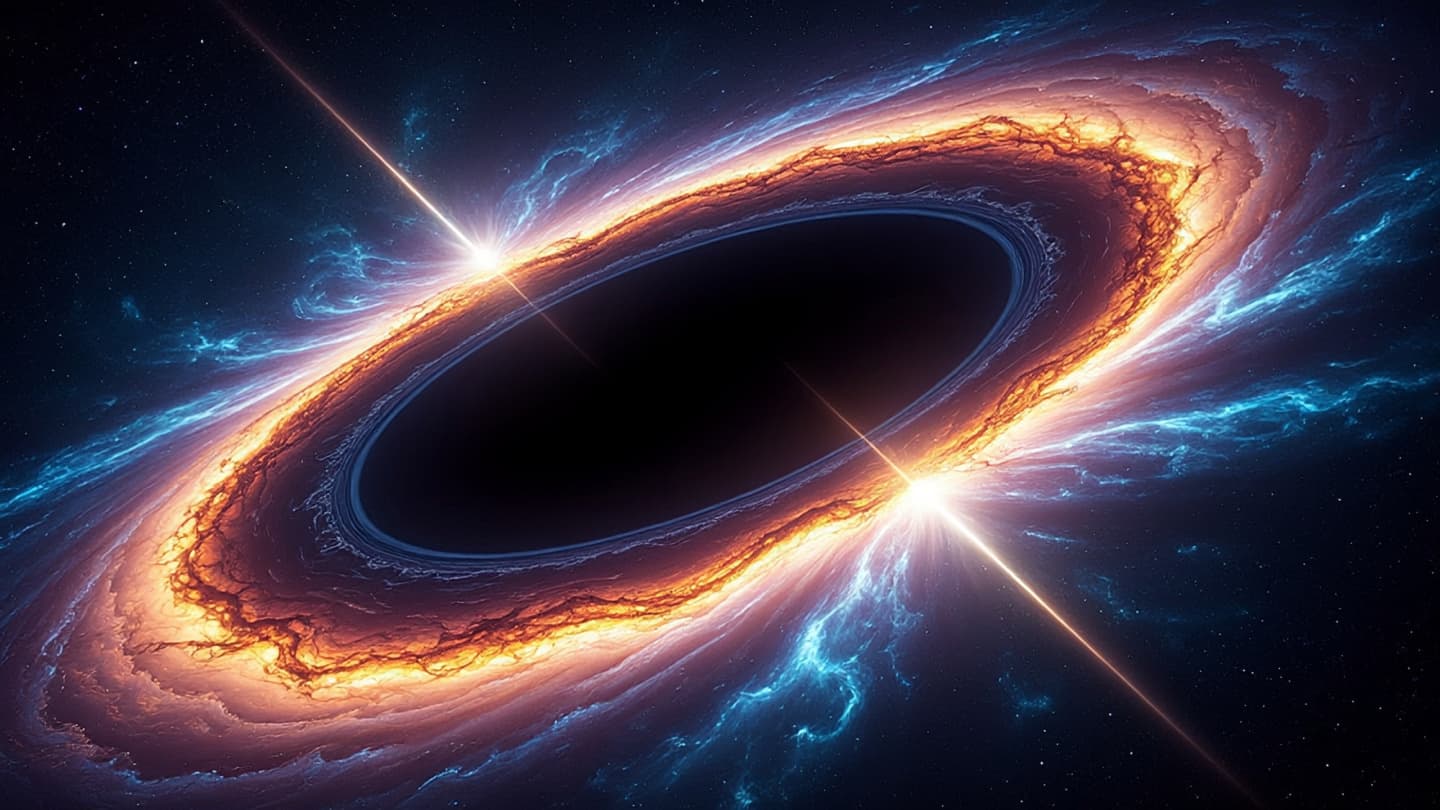
Body: The event involves a supermassive black hole located in a galaxy billions of light-years away. Unlike standard tidal disruption events, where a star is torn apart and consumed in a relatively short period, this outburst has maintained its brightness for an extended duration. This longevity suggests that the black hole is feeding on a particularly large or dense object, perhaps a massive star or a cloud of gas, providing a sustained source of energy that defies typical models. The prolonged emission allows researchers to study the physics of accretion—the process by which black holes consume matter—in unprecedented detail.
For astrophysicists, such events are invaluable tools. The light emitted during the outburst travels through intergalactic space, passing through clouds of gas and dust along the way. By analyzing how this light is absorbed or altered, scientists can map the distribution of matter in the universe. This technique, known as absorption spectroscopy, acts like a CT scan for the cosmos, revealing the structure of the intergalactic medium that existed when the universe was much younger.
The early universe was a different place, hotter and denser, with galaxies forming and merging in a chaotic dance. Observations of this black hole outburst provide clues about the growth of supermassive black holes during this formative era. Understanding how these giants gained mass so quickly after the Big Bang remains one of the great mysteries of cosmology. Each data point from this event helps refine theories about galaxy evolution and the role black holes play in shaping their host environments.
Technological advancements have made this discovery possible. Modern telescopes, both ground-based and space-borne, are equipped with sensitive instruments capable of detecting faint signals from the edge of the observable universe. The coordination between different observatories allows for continuous monitoring, ensuring that no detail of the outburst is missed. This global collaboration highlights the collective effort required to unravel the secrets of the heavens.
The rarity of such long-lasting events makes each occurrence precious. Most black hole flares fade within weeks or months, but this one has persisted, offering a window of opportunity that may not open again for decades. Scientists are racing to gather as much data as possible, knowing that the insights gained could reshape our understanding of high-energy astrophysics. It is a moment of intense focus and excitement within the scientific community.
Beyond the technical details, there is a philosophical resonance to the discovery. Looking at light that has traveled for billions of years connects us to the deep past. It reminds us that we are observers of a dynamic and evolving universe, one that is still revealing its secrets to those who look closely. The black hole’s outburst is not just a physical phenomenon but a bridge across time, linking our present curiosity with the ancient history of the cosmos.
As the outburst continues, new questions arise. Will it fade soon, or will it persist even longer? What other surprises lie hidden in the data? The answers will come slowly, parsed through rigorous analysis and peer review. But for now, the sheer brightness of the event stands as a testament to the power of observation and the enduring human desire to understand our place in the universe.
Closing: A rare, long-lasting black hole outburst is providing astronomers with unique insights into the early universe. By studying the sustained emission and its interaction with intergalactic matter, scientists hope to better understand the growth of supermassive black holes and the structure of the young cosmos. This event underscores the value of persistent observation in unlocking cosmic mysteries.
AI Image Disclaimer: Please note that the visual illustrations accompanying this article are AI-generated representations intended to contextualize the discussion on astronomical phenomena.
Sources: NASA Space.com Nature Astronomy Scientific American
Published by Banx Network. This article is part of the Banx decentralized media programme, powered by the BXE token on the XRP Ledger.