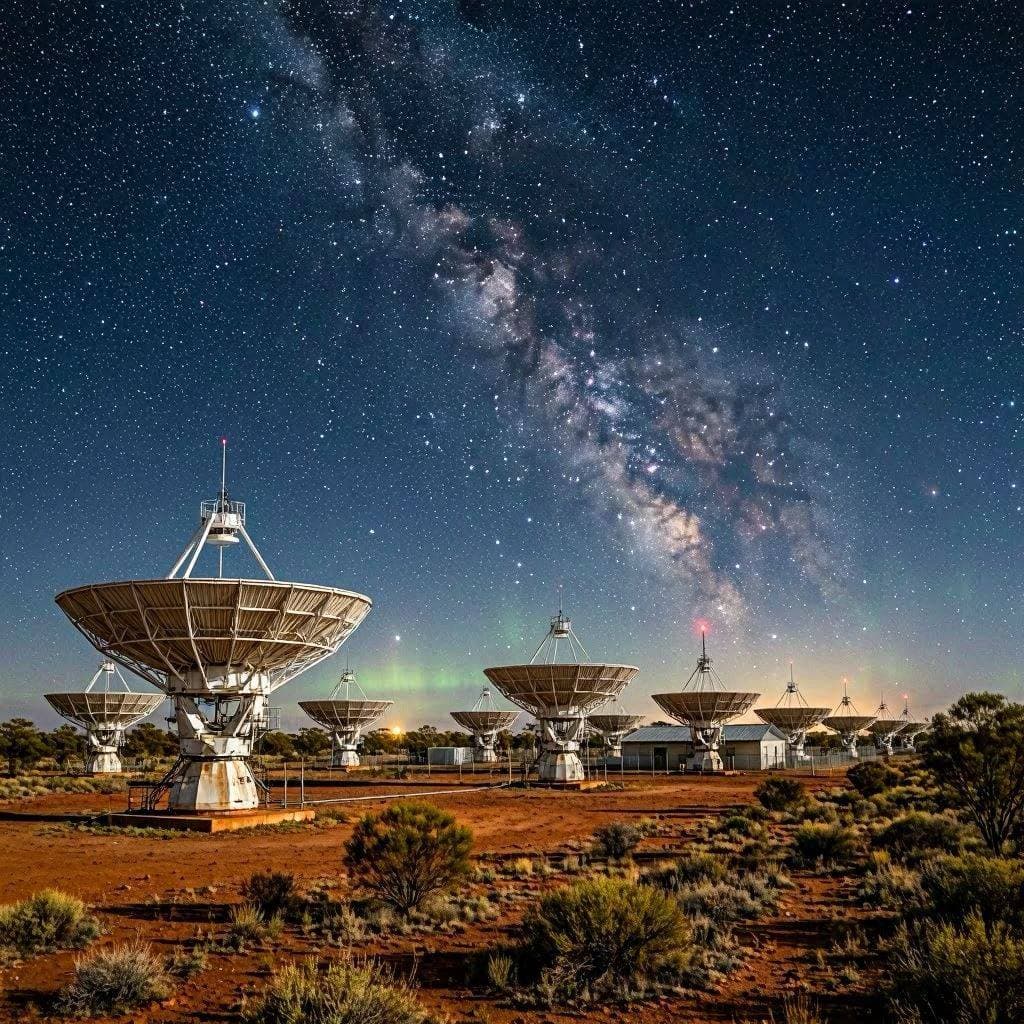
The universe rarely reveals its structure all at once. Instead, it offers fragments—faint signals carried across immense distances, waiting patiently to be interpreted. Through increasingly sophisticated instruments, astronomers continue to assemble these fragments into a clearer picture of the cosmos. The latest achievement by the Square Kilometre Array Observatory marks another significant step in that endeavor.
Scientists working with the Square Kilometre Array Observatory (SKAO) have produced what is being described as the largest magnetic map of the universe ever created. The breakthrough offers researchers an unprecedented view of cosmic magnetic fields distributed across vast regions of space.
Magnetic fields play an important yet still poorly understood role in the evolution of galaxies, galaxy clusters, and other large-scale structures. Despite their importance, mapping these fields across cosmic distances has long presented major technical challenges.
Using advanced radio astronomy techniques, researchers analyzed polarized radio signals emitted by distant galaxies and other celestial sources. These signals provide valuable information about magnetic environments encountered during their journey across the universe.
The new map is expected to help scientists investigate how magnetic fields originated and evolved over billions of years. Understanding these processes may improve models describing galaxy formation and the large-scale structure of the cosmos.
The Square Kilometre Array Observatory, with major facilities located in Australia and South Africa, is designed to become the world's largest radio astronomy project. Once fully operational, the observatory will dramatically expand humanity's ability to explore the universe.
Researchers emphasize that the newly generated magnetic map represents only an early glimpse of the observatory's scientific potential. Future observations are expected to reveal even greater detail and support discoveries across multiple areas of astrophysics.
As astronomers continue to refine their understanding of cosmic magnetism, the SKAO project demonstrates how international scientific collaboration can illuminate some of the universe's most enduring mysteries.
AI-generated image disclaimer: The accompanying illustrations are AI-generated visual interpretations produced for editorial purposes
Published by Banx Network. This article is part of the Banx decentralized media programme, powered by the BXE token on the XRP Ledger.