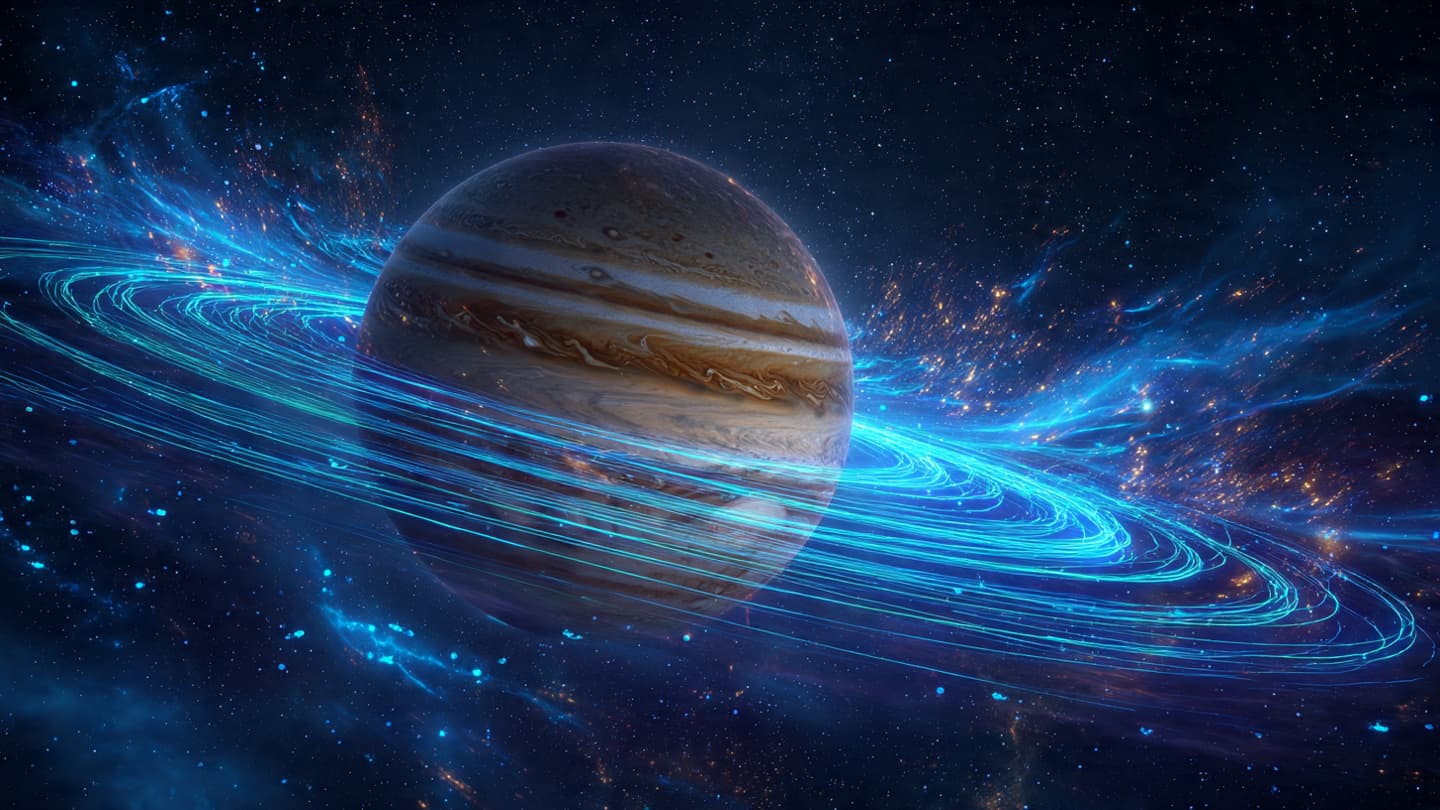
The largest planet in our solar system has long been known for its immense size and striking appearance. Yet beyond its colorful cloud bands and powerful storms lies an environment shaped by forces far more energetic than what can be seen through a telescope. New research suggests that Jupiter is capable of accelerating charged particles to velocities approaching the speed of light, offering fresh insight into one of the solar system's most extreme natural laboratories.
Scientists reached this conclusion after analyzing observations collected from spacecraft and astronomical instruments studying Jupiter's magnetic environment. The findings reveal that the giant planet possesses mechanisms capable of producing extraordinarily energetic particles within its vast magnetosphere.
Jupiter's magnetic field is the strongest of any planet in the solar system. Extending millions of kilometers into space, it creates a protective bubble that traps charged particles originating from the solar wind and from Jupiter's volcanic moon Io.
Researchers discovered evidence that some of these particles gain energy through complex interactions involving magnetic fields and plasma waves. The process resembles particle acceleration mechanisms observed around distant astrophysical phenomena, including pulsars and certain types of black holes.
The discovery is significant because it demonstrates that powerful particle acceleration is not limited to exotic regions of deep space. Comparable physical processes can occur much closer to Earth, within the planetary environments of our own solar system.
Understanding these mechanisms may improve scientific knowledge of space weather and magnetospheric physics. Similar principles influence the behavior of charged particles around Earth and other planets, affecting spacecraft operations and scientific observations.
The findings also strengthen the value of planetary exploration missions. Spacecraft studying Jupiter continue to provide data that help scientists investigate questions extending beyond planetary science into broader fields of astrophysics and plasma physics.
Researchers are expected to conduct additional studies using future observations from ongoing missions. More detailed measurements could reveal how frequently these acceleration events occur and what conditions make them possible.
As new discoveries emerge, Jupiter continues to demonstrate that it is far more than a giant gas planet. It remains a dynamic and complex world whose influence reaches deep into the scientific understanding of our cosmic neighborhood.
AI Image Disclaimer: The images accompanying this article are AI-generated visual interpretations based on scientific observations and astronomical research.
Sources Verified Universe Magazine NASA European Space Agency (ESA) Jet Propulsion Laboratory (JPL) Space.com
Published by Banx Network. This article is part of the Banx decentralized media programme, powered by the BXE token on the XRP Ledger.