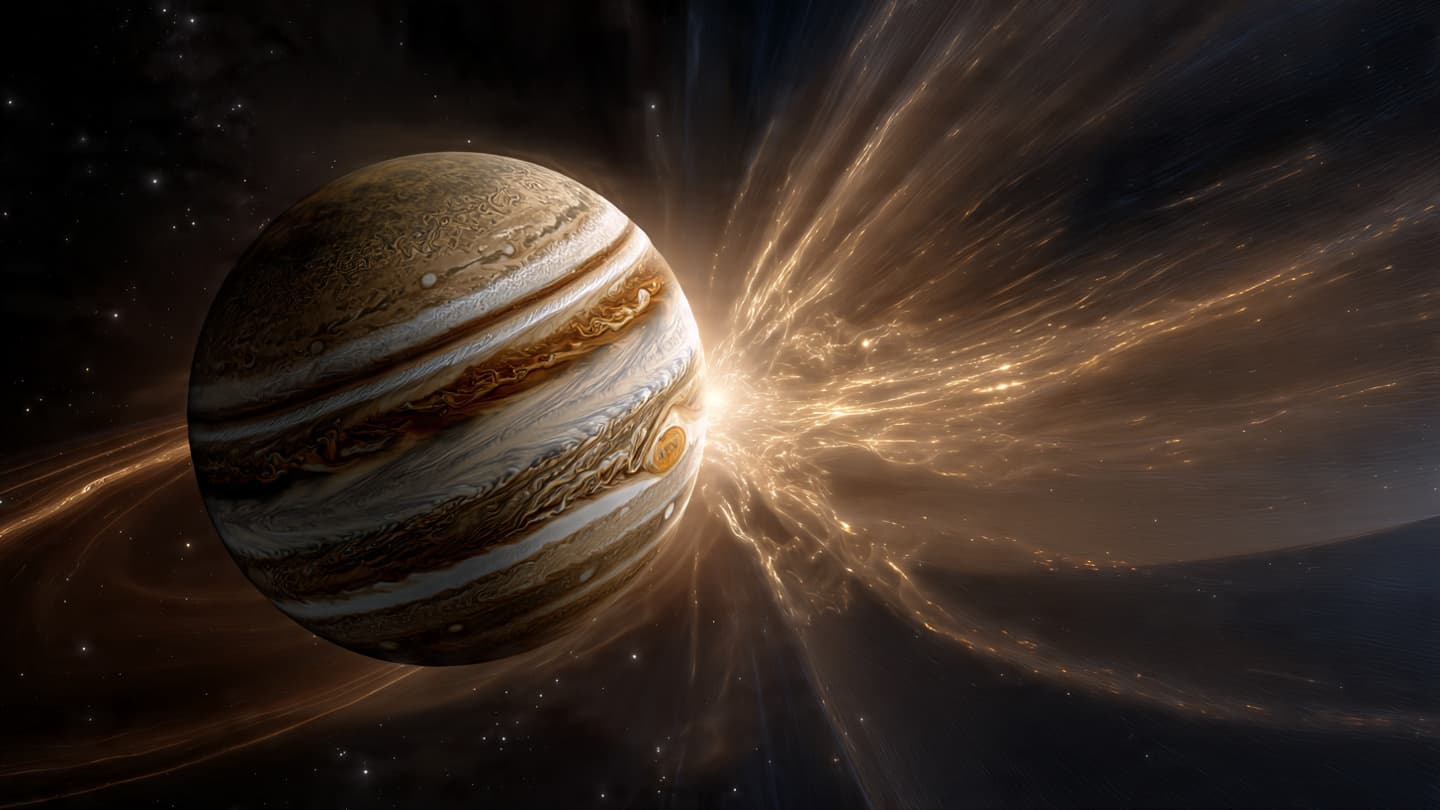
Space is often imagined as silent and still, yet it is filled with streams of charged particles, magnetic fields, and invisible forces moving at extraordinary speeds. Around Jupiter, the solar wind encounters a powerful magnetic barrier that creates a phenomenon known as a bow shock. New research has revealed that this region accelerates electrons to velocities approaching the speed of light.
A bow shock forms when the solar wind—a continuous flow of charged particles emitted by the Sun—collides with a planetary magnetosphere. Much like the wave that forms ahead of a ship moving through water, the bow shock marks a boundary where particles are compressed and redirected.
Jupiter possesses the largest planetary magnetosphere in the solar system. Its immense magnetic field extends millions of kilometers into space, creating a complex environment where energetic particles interact in ways that continue to challenge scientific understanding.
Using spacecraft observations and advanced modeling, researchers found evidence that electrons near Jupiter’s bow shock can gain enormous amounts of energy. In some cases, these particles accelerate to relativistic speeds, meaning they travel at a significant fraction of the speed of light.
The discovery provides important insight into fundamental plasma physics. Similar acceleration mechanisms occur throughout the universe, including around supernova remnants, active galaxies, and other energetic cosmic environments. Studying Jupiter offers scientists a nearby laboratory for understanding these larger phenomena.
Researchers believe magnetic turbulence and shock-wave interactions play key roles in energizing the particles. As electrons repeatedly cross regions of changing magnetic conditions, they can gain energy in a process somewhat analogous to repeatedly pushing a swing higher with carefully timed motions.
Understanding particle acceleration is important for both scientific and practical reasons. Energetic particles influence space weather conditions and can affect spacecraft systems operating within planetary environments.
The findings also contribute to a broader effort to understand how nature accelerates particles to extreme energies across the cosmos. By examining these processes close to home, scientists can refine theories that apply to much larger and more distant astronomical systems.
As exploration of Jupiter continues through current and future missions, the giant planet remains more than a world of storms and moons. It also serves as a natural laboratory where some of the universe’s most powerful physical processes can be observed in action.
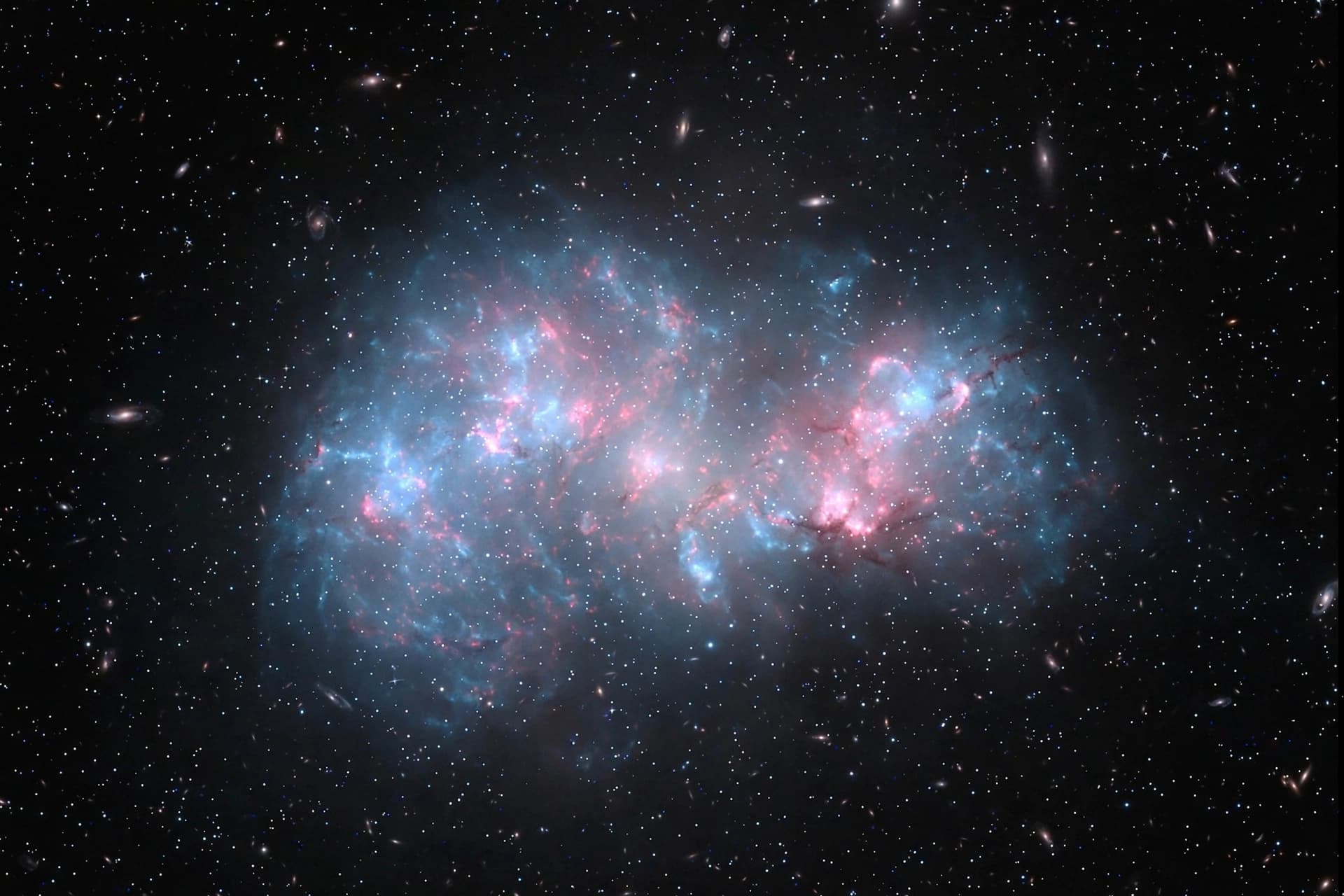
AI Image Disclaimer: The visuals accompanying this article are AI-generated representations created to illustrate scientific findings and space environments.
Sources Verified:
NASA Science Astrophysical Journal research publications Space.com European Space Agency reporting Live Science
Published by Banx Network. This article is part of the Banx decentralized media programme, powered by the BXE token on the XRP Ledger.